

A Comedy of Nobodies, page 1


Subscribe to our newsletter for title recommendations, giveaways, and discounts reserved only for subscribers.
Join here.
“Brilliantly captures the absurdity of life right before ‘real life’ happens.”
Benjamin Holden, second assistant accountant on Barbie
“A witty and heartfelt exploration of modern love and the search for meaning.”
Lorenzo, cashier at 7-Eleven
“This short book is an irresistible blend of humor and humanity that will make you laugh, cry, and then leave you smiling.”
Kyle Dunstan, manager at Aldi
“Funny, thought-provoking, and utterly charming. Baron Ryan captures the ‘I get misty’ aspect of love and friendship.”
Kaitlyn Kuch-Ly, sandwich maker at Jimmy John’s
“An earnest romp through the trials and tribulations of what we ought to do with ourselves—a true gem.”
Erica Zito, financial analyst at wastewater treatment facility
“A college-era coming-of-age with an existential chuckle.”
Heather Robertson, crew member at Trader Joe’s
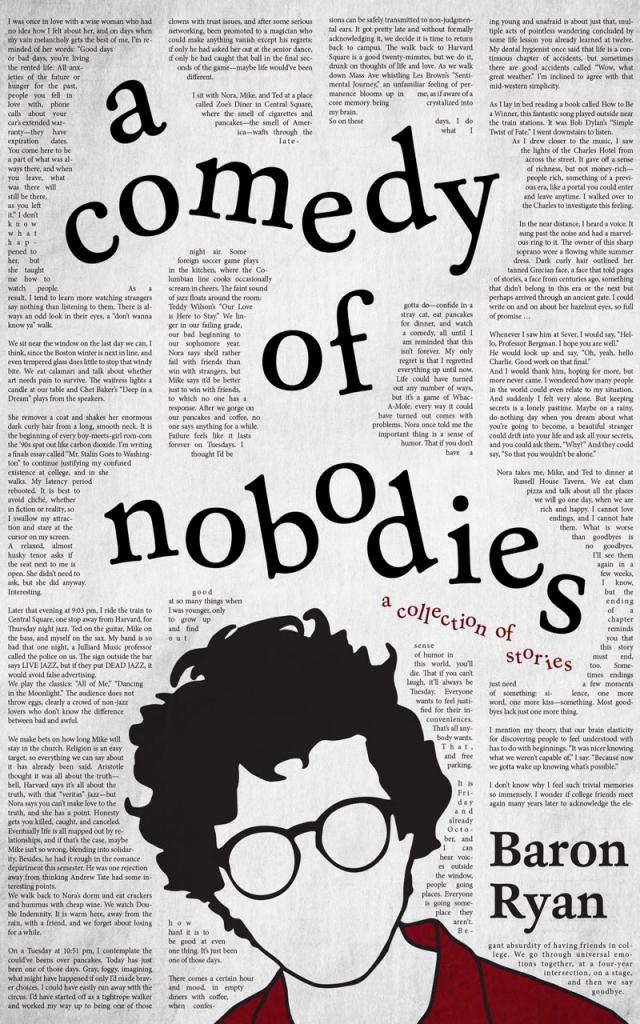
A Comedy of Nobodies
A Collection of Stories
Baron Ryan
Copyright © 2024 by Baron Ryan
E-book published in 2024 by Blackstone Publishing
Cover design by Alenka Vdovič Linaschke
All rights reserved. This book or any portion thereof may not be reproduced or used in any manner whatsoever without the express written permission of the publisher except for the use of brief quotations in a book review.
The characters and events in this book are fictitious.
Any similarity to real persons, living or dead, is coincidental
and not intended by the author.
Trade e-book ISBN 979-8-212-23536-5
Library e-book ISBN 979-8-212-23535-8
Fiction / Short Stories (single author)
Blackstone Publishing
31 Mistletoe Rd.
Ashland, OR 97520
www.BlackstonePublishing.com
Thank you, Katrina, for everything.
Contents
how to fall in love in 36 questions
(september)
getting there
(october)
the story behind this story
(october)
jumping out a window
(october)
the vent
(november)
the last american pie
(november)
what’s up, god?
(december)
looking for love in a loveless world
(december)
walking home
(december)
About the Author
how to fall in love in 36 questions
(september)
I was once in love with a wise woman who had no idea how I felt about her, and on days when my vain melancholy gets the best of me, I’m reminded of her words: “Good days or bad days, you’re living the rented life. All anxieties of the future or hunger for the past, people you fell in love with, phone calls about your car’s extended warranty—they have expiration dates. You come here to be a part of what was always there, and when you leave, what was there will still be there, as you left it.” I don’t know what happened to her, but she taught me to observe gently with aggressive curiosity and nonjudgmental eyes. As a result, I’ve learned with knowing naivety that the world so far is refreshingly small, and we are refreshingly unoriginal inhabitants. Our pain is plagiarized from the same sources.
I’m walking down Bow Street with my friends Mike and Ted after a café gig. We played classics from the Bee Gees in another of our vain attempts to jazzify songs that never deserved to go near a bass, guitar, and sax trio. We are casualties of the sad irony that jazz is the most inclusive and exclusive clique to belong to.
Ted, our guitar player, has something to say: “They liked us. I could feel it in my tailbone.”
“They gave no indication they liked us,” Mike (stand-up bass) says. “Actually, I got the distinct sense they despised us.”
“Right, but they despised us much less than any other crowd we’ve played, so, comparatively, they liked us.”
With me and Mike, it’s all laughs and observations. We communicate mainly through quips, with the goal of one-upping the other’s bit each time. Occasionally, though, we allow each other a window of sensitivity, usually after a romantic rejection of some kind, when we can talk openly about the burdens of the messy male psyche. With Ted, forget it. He refuses to feel a thing, the kind of guy who wears plate armor made of pure sarcasm for any human interaction.
We head to a shop called Insomnia Cookies on Bow Street, open all hours of the bare but lingering Harvard nightlife. It is a narrow building that overlooks—and technically lives under—the picturesque Lowell House. Just a glance to the left is the Harvard Lampoon which I only now realize looks like Otto von Bismarck disguised as a building. We arrive at Insomnia Cookies around 8:00 p.m. for a bottle of milk and to meet our fourth musketeer, Nora. Nora comes from an old-moneyed family of rubber-nipple tycoons in Montreal. They supply rubber nipples to every baby and pervert in North America. The four of us, all going into our sophomore year at Harvard, stick together for safety. After our disastrous jazz gig, I glare out the window at the neo-Georgian architecture of Lowell House, slurping milk, mad at myself for everything I didn’t do before nineteen. Nora is late to meet us.
The psychology class I enrolled in with Mike, Ted, and Nora isn’t going too hot either. We apparently got approval for a group project that Mike, Ted, and I have no awareness of. The way group projects go, it’ll be skippered by one person, and that person is Nora. She wrote the pitch and obtained all the permissions, and now we’re supposed to conduct some experiment tomorrow morning.
Nora enters Insomnia Cookies in a yellow raincoat, and moments later it starts sprinkling outside. A blue binder is clutched under her arm, like a mother hen’s eggs.
“So, what’s happening tomorrow?” Mike asks her with gum in his teeth.
Nora blinks. “Did you read my emails about it?”
“I think they ended up in my spam . . .”
“I mean, I did, but can you sort of summarize, or . . .” I say.
Her nostrils twitch. “None of you have any idea what’s happening tomorrow, do you?”
Mike and Ted grumble something about how distracted they’ve been about some vague news in the Middle East.
“It’s an experiment,” she says.
“What are we experimenting?” I mumble.
The sprinkling outside turns heavier, and fat raindrops percussively thump the window.
Nora scans the room for spies and whispers, “How to fall in love with anyone.”
I turn to Mike and Ted for permission to laugh, but they seem more curious than amused.
Nora apparently read studies on increasing the speed of intimacy between strangers. She wants to throw people in rooms without air-conditioning and have them ask each other thirty-six invasive questions that will make the schmucks fall in love.
“What do you mean anyone?” Mike asks. “Sounds like voodoo.”
“That’s the experiment, that’s the whole thing.” Nora’s Quebecois accent gets even heavier when she’s riled up. “I want to see if any stranger, no matter how incompatible, can fall in love with anyone who asks them these questions.” She thumps her blue binder.
“I have so many questions about these questions,” I say.
“Then you should have brought them up before everything was arranged,” she says. “I’ve booked three hours at William James Hall for us to conduct this experiment tomorrow. Sixteen people volunteered as test subjects. Strangers. All single. I think.”
“Where did you find these strangers?” I ask.
“Match.com.”
My disastrous semester consists of four courses, including an anthropology course: History of Agnosticism. I have a bad habit of leaving things to the last minute, and like some proverbial joke, I must pay the price by enrolling in courses that aren’t full—one of them being History of Agnosticism. The TA dislikes me because she thinks I’m a Mormon, for some reason. I explicitly clarified that I am not Mormon, and she asked if I had a problem with being Mormon. I said no. Then she asked if I had a problem with the Church of Latter-Day Saints in general, and I said no, and that was probably the wrong answer. I should’ve had objections with every religion, because she replied, “How interesting . . .”
I get a C-minus on my first homework assignment from that anti-Mormon Nazi. After class, I get a message from Nora: WHERE ARE YOU???
Oh right, the love study.
I feel a nervous buildup, a feeling I try not to feel and then feel more as a result. I don’t know what I’m afraid of. I go to CVS and pat on some “Sample Only” cologne. It smells like old hand sanitizer after ten minutes on my skin.
The Old Yard flows with students coming out of class. A labyrinth of pathways cuts across the grass, giving the illusion of a pattern or a well-planned route. No sidewalk in Harvard Yard curves—all are sharp, straight, tapered.
I get to William James Hall, the psychology building, passing the modern metallic Science Center and the Gothic Annenberg dining hall. These two buildings provide instant meeting places—“Just meet me at the Science Center,” “I’ll be in front of Annenberg”—or if you need a cheap lie, “I’m going all night at the Science Center.”
I use the front entrance,
I ride the elevator down to where the classrooms are. With a ding, it opens to a quiet student lounge with orange sofas where Nora, Ted, and Mike swig from Styrofoam cups. They are plugged in, each watching a live video feed from laptops. Mike’s screen displays two women talking to each other. Ted’s displays a man and woman doing the same. It looks like interrogation footage.
“You’re late,” Nora says casually. She’s wearing a lab coat for some reason.
“I had class.”
“One volunteer had to leave. You’re down to one couple.”
“What do you mean I’m down to one?”
She gestures for me to sit and presents me with headphones and a laptop. It displays a live feed of a woman sitting at a table in a room.
“I get it,” I start. “So just watch a couple ask a bunch of questions, and then see if they fall in love, right?”
“Well, yes, and then . . .” Nora clears her throat. “Then you have to follow them on their first date.”
I stare at her.
“There have been many experiments like this.” Her tone is firm, as if she rehearsed this response. “But they all end in the laboratory. None are followed through in person. None observe the couples, after the experiment, on a date like this. We’ll be the first.”
“Can I ask why?”
“Extra credit.”
“I don’t want extra credit.”
“Charlie, this group project is thirty percent of the grade. We fail this, we’re already in the C-plus region.”
I sigh, put the headphones over my neck, and wipe my hands.
The room I observe in the live feed is about the size of a Starbucks bathroom. A woman sits by herself with a cup of tea, waiting for something. She wears an oversized checkered knit sweater. She has almond-shaped eyes that look around, like a lost animal would. She appears to be in her midtwenties.
The legs of my chair are imbalanced, so I rock diagonally back and forth as I watch her like a certified pervert. She looks into the camera and waves. I wave. She can’t see me, but she must know someone is behind that blinking red dot.
The door in her room clacks open and startles us both.
A man with Macklemore hair walks in with a distinctive strut. Subtle bumps of muscle protrude under his clothes.
“Hello.” The woman sort of laughs at herself. I laugh with her.
“Hey, how’s it going? I’m Wade.”
“Nice to meet you, Wade. I’m Camilla.” Her voice is sensitive and not loud.
“Camilla. Is that Russian?”
What an opener, Wade. They both sit with suppressed blushes, her more than him. He seems like the kind of guy who handles embarrassment with a kind of accidental cool.
Nora enters their room and gives them each an electronic wristband to track their heart rates.
“Your time starts now.” Nora dampens her tone like a yoga instructor. “Read the questions on the clipboard and begin when you’re ready. If you want to end the session at any time, just tell the camera. Any questions?”
None. Nora closes the door, winking at the camera on the way out.
Wade looks around for an excuse. “So, I guess we’re on the clock now?”
“Yep. On the clock.” Camilla glances down, holding in a laugh.
“So . . .” He looks at the clipboard, imitating her amusement. “Intimate details. You want to start?”
“Okay.” She speaks with two dimples. “How about we introduce ourselves first?”
“Yes, please,” I say to the screen.
“Cool,” he shrugs.
“Hello, I’m Camilla.” She waves. “I’m twenty-nine, and I’m originally from Oregon. I’m doing my master’s in twentieth-century literature.”
Wade does the “rock on” gesture. His necklace with a coin at the end of it clacks against the table.
“Dating never ends well for me, so now I’m here, wondering what I’m doing and what’s wrong with me. Because I really don’t know.” Camilla rearranges the cup in front of her, slightly to the left, blushing.
Wade searches the ceiling, scratching his chin. “Nice, I love Oregon.”
They ask their questions: What’s the perfect day? What do you value in a friendship? Do you feel your childhood was happier than other people’s? I’m distracted by his answers, answering the questions myself while Wade is talking. As insane as it sounds, the questions have at least some effect. The more I hear from Camilla, the more I want to know.
Absolutely no chemistry, I write in the notes. Wade is without doubt a mere product of a weak pullout game.
Thirty minutes later, a buzzer goes off, and they look at the clock, then into the camera.
“I guess this is where we stare at each other?” Wade asks.
“For four minutes, I think.” Camilla purses her lips.
“Four minutes. That’s intense.”
“Okay, let’s do it.”
He puts his hands on the table while she hides hers beneath it. They stare. No clocks, no phones, no traffic, only naked silence and eye contact. I balance on the legs of my chair.
They stare without expression, completely still. Maybe this is the secret to the whole experiment, this four-minute stare. This is what no one else sees. Public life requires wearing the attachable face of one’s environment. But here, the only face they wear is their own. Total acceptance of the other.
What seems like only one minute later, a buzzer sounds. Wade and Camilla look down with pinkish faces, saying nothing. Nora knocks and enters the room with a bright look.
“Camilla, Wade, how was that?”
Wade spills his guts. “She’s amazing, wow. She’s really great. Probably the greatest.”
Nora interviews them about their physical states when they were asked certain questions, and then explains that they are now free to do whatever they want—go on a date, not go on a date, whatever. She thanks them for participating and shows them the exit, sticking her tongue out at the camera.
I take the headphones off.
“That was strange,” I say to the air.
“Did any of yours ask each other out?” Ted asks behind his screen.
“Mine both did,” says Mike, playing solitaire on his computer. “Lesbian couple and a straight couple.”
I don’t know whether I want this experiment to work or not. A familiar feeling of confusion and curiosity hits me, like when I know I will change by the end of a book I’m reading, but I don’t know how just yet.
Nora emerges behind me, jolting me. She’s thrilled: every test subject came out wanting a first date, including Wade and Camilla.
“Good,” I mumble.
“This means you’re on! I’ve told them you’ll be observing them,” Nora says, fiddling with some documents. “They’ve signed all the waivers.”
“Good.”
“Oh, and this goes for all of you,” she addresses the room. “It’s very important that you don’t speak to either person while on their date.”
“Why?” I ask, a little too excited.
“In order for the data to come out legitimate, they need to feel uninhibited by you,” she explains. “The only way I convinced the board is if you, the volunteers, have zero verbal contact with the subjects. You must become flies on the wall.”
“A fly on the wall,” I mutter. “Invisible, anonymous, a third wheel, forgotten—what else would you like to know about my childhood?”
The first date is the next night. I wear a corduroy suit jacket and jeans like I’m in an ’80s sitcom. I have this scenario in my head of Camilla realizing Wade’s staleness and falling into my arms under the moonlight. How I’m going to accomplish this without words, I don’t know. Nora isn’t kidding about the no-talking part. If the subjects report that we “observers” talked during their date, the data will be deemed void, resulting in the instant failure of our group. Nora is carrying this whole crew; I can’t go letting her down.


