The Nubian's Curse, page 1


Contents
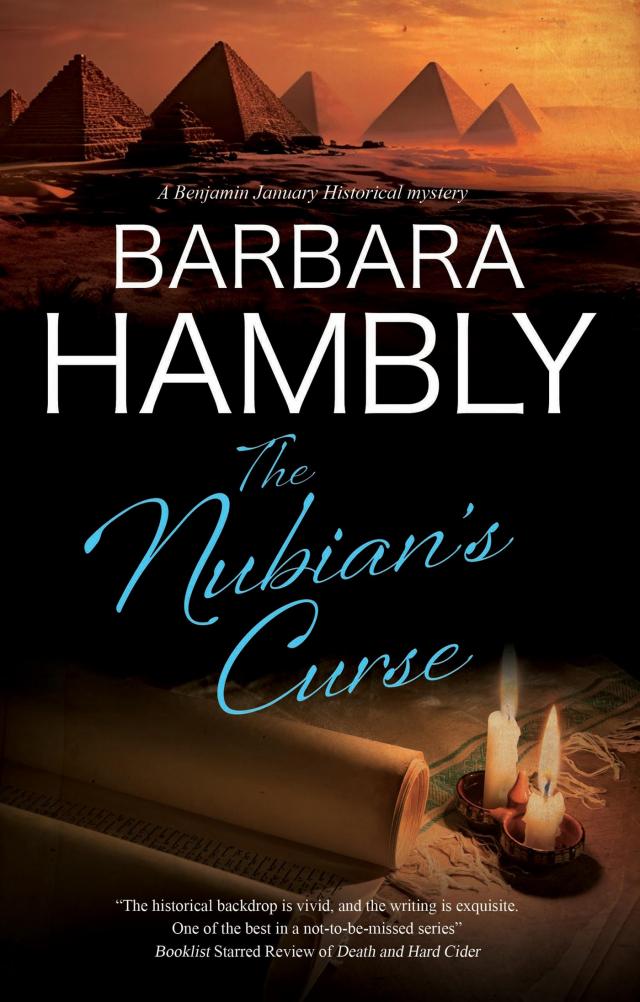
Cover
Also by Barbara Hambly from Severn House
Title Page
Copyright
Praise for the Benjamin January series
About the Author
Dedication
Chapter One
Chapter Two
Chapter Three
Chapter Four
Chapter Five
Chapter Six
Chapter Seven
Chapter Eight
Chapter Nine
Chapter Ten
Chapter Eleven
Chapter Twelve
Chapter Thirteen
Chapter Fourteen
Chapter Fifteen
Chapter Sixteen
Chapter Seventeen
Chapter Eighteen
Chapter Nineteen
Chapter Twenty
Chapter Twenty-One
Chapter Twenty-Two
Chapter Twenty-Three
Chapter Twenty-Four
Chapter Twenty-Five
Also by Barbara Hambly from Severn House
The James Asher vampire novels
BLOOD MAIDENS
THE MAGISTRATES OF HELL
THE KINDRED OF DARKNESS
DARKNESS ON HIS BONES
PALE GUARDIAN
PRISONER OF MIDNIGHT
The Benjamin January series
DEAD AND BURIED
THE SHIRT ON HIS BACK
RAN AWAY
GOOD MAN FRIDAY
CRIMSON ANGEL
DRINKING GOURD
MURDER IN JULY
COLD BAYOU
LADY OF PERDITION
HOUSE OF THE PATRIARCH
DEATH AND HARD CIDER
Silver Screen historical mysteries
SCANDAL IN BABYLON
ONE EXTRA CORPSE
THE NUBIAN’S CURSE
Barbara Hambly
This ebook is copyright material and must not be copied, reproduced, transferred, distributed, leased, licensed or publicly performed or used in any way except as specifically permitted in writing by the publishers, as allowed under the terms and conditions under which it was purchased or as strictly permitted by applicable copyright law. Any unauthorised distribution or use of this text may be a direct infringement of the author’s and publisher’s rights and those responsible may be liable in law accordingly.
First world edition published in Great Britain and the USA in 2024
by Severn House, an imprint of Canongate Books Ltd,
14 High Street, Edinburgh EH1 1TE.
This eBook edition first published in 2024 by Severn House,
an imprint of Canongate Books Ltd.
severnhouse.com
Copyright © Barbara Hambly, 2024
All rights reserved including the right of reproduction in whole or in part in any form. The right of Barbara Hambly to be identified as the author of this work has been asserted in accordance with the Copyright, Designs & Patents Act 1988.
British Library Cataloguing-in-Publication Data
A CIP catalogue record for this title is available from the British Library.
ISBN-13: 978-1-4483-1136-1 (cased)
ISBN-13: 978-1-4483-1137-8 (e-book)
This is a work of fiction. Names, characters, places and incidents are either the product of the author’s imagination or are used fictitiously. Except where actual historical events and characters are being described for the storyline of this novel, all situations in this publication are fictitious and any resemblance to actual persons, living or dead, business establishments, events or locales is purely coincidental.
This eBook produced by
Palimpsest Book Production Limited,
Falkirk, Stirlingshire, Scotland
Praise for the Benjamin January series
“The historical backdrop is vivid, and the writing is exquisite. One of the best in a not-to-be-missed series”
Booklist Starred Review of Death and Hard Cider
“This masterly portrayal of smoldering racial tensions deserves a wide readership”
Publishers Weekly Starred Review of Death and Hard Cider
“One of Hambly’s best mysteries combines historical detail, intense local color, and ugly truths about slavery and politics”
Kirkus Reviews on Death and Hard Cider
“Outstanding … Hambly’s masterful historical detail, scrupulous character portrayal, and psychological analysis of human frailties contribute handsomely to her storytelling”
Publishers Weekly Starred Review of House of the Patriarch
“A fascinating, sadly timely tale of the hero’s struggles with his rage over the treatment of Black people”
Kirkus Reviews on House of the Patriarch
“A stark and occasionally brutal story, and Hambly tells it superbly, in prose that is vivid and empathetic. For fans of this fine series, this is a must-read”
Booklist Starred Review of Lady of Perdition
“Deeply researched … Hambly’s well-wrought denunciation of slavery and her skillful defense of women’s rights resound from January’s times to our own”
Publishers Weekly on Lady of Perdition
About the author
Barbara Hambly, though a native of Southern California, lived in New Orleans for many years while married to the late science fiction writer George Alec Effinger. Hambly holds a degree in medieval history from the University of California and has written novels in numerous genres.
www.barbarahambly.com
For Laurel
ONE
Réveillon.
Waking.
‘But it’s an ancient feast,’ old Lucien Imbolt had said, back in Paris in the days of the restored kings. ‘Older than the Evangelists who claimed it as the celebration of Our Savior’s birth.’ His dark eyes had sparkled in the candlelight of some nobleman’s gilt-trimmed salon, the great chamber temporarily silent – like this dining room tonight, Benjamin January reflected, with the food spread waiting and the servants in pantry and kitchen catching a last bit of rest before their betters came in to feast.
In his mind he still heard the white-haired violinist’s creaky voice, smelled the savor of goose and caramel and rich sauces above the honeyed scent of a thousand beeswax candles. The chilly whisper of draft that stirred the long velvet curtains tonight, sixteen years later (Has it been only sixteen?) and half a world away, reminded January of how deep snow had lain in the Paris streets that Christmas of 1824.
‘It’s the midnight of the year,’ Imbolt had gone on, thin fingers adjusting the ivory pegs of his fiddle. ‘The long dark, when the gates between the worlds stand open, and all the spirits walk freely back and forth. I don’t think it was originally a celebration at all. I think it was a way of making sure that everybody was in the same room, with all the lamps burning, until day came again.’
Tonight – Christmas of 1840 – from his place on the musicians’ dais, January surveyed the dining room of the Viellard townhouse on the Rue Royale in New Orleans, and smiled at the memory of his friend.
Réveillon.
Paris.
Was that really me sitting at the harpsichord, waiting for all the cousins and uncles and in-laws of the Comte de Morens-Vrillière to come back from Mass? It was hard to believe.
Jacques Bichet, the flute player who usually made up one of the little group of New Orleans musicians with whom January regularly performed, leaned across to him now, asking ‘It true they got a genuine French princess coming here tonight?’
‘I heard she was a marquise.’ Cochon Gardinier slipped back into the dining room through the discreet pantry door, hopped up on to the dais with surprising lightness for a man of nearly three hundred pounds. He moved his violin, where he’d left it on his chair, with one hand, balancing in the other a plate full of vol-au-vents pilfered from the Viellard kitchen.
‘A vicomtesse,’ corrected the other fiddler, Hannibal Sefton, like an emaciated Celtic elf beside Cochon’s comfortable enormity. ‘Madame de St-Forgeux, kin to the d’Aumonts and Rochebarons and I don’t know how many other aristocratic houses of France. She is escorting, I understand, one Daisy Emmett, of Virginia. A family less renowned in heraldry, perhaps, but with a dowry of half a million dollars and prospect to inherit six times that sum.’
He pressed his hand to his ribs to still a cough, while around him the other musicians – Jacques and his old uncle, Cochon and the handsome Philippe duCoudreau – exclaimed in awe. News of the heiress’s arrival in New Orleans had been bandied among the whites of the town – both American and Creole French – for a week; among the free colored of the French town for twice as long.
‘Quite a catch,’ Hannibal concluded, when he got his breath, ‘for the Viellards to celebrate Christmas with. Gratias tibi maximus,’ he added, as January stepped down from the dais and brought him a champagne-glass full of water from the sideboard.
The master of Bellefleur – the plantation where January had been born – had in general celebrated Christmas by getting savagely drunk and finding a reason to horsewhip at least three of the house servants before passing out on the parlor floor. As a small child, January had spent two Christmases hiding in the ciprière swamps when Michie Simon went on his customary Yuletide rampage down the ‘street’ of the quarters. He still recalled the piercing cold, the scorched-sugar smell of the fog mingling with the wet stink of the ash, where the men had burned over the harvested fields. The birdless silence of those winter woods.
The beau
Stille Nacht, went the German Christmas carol. Silent Night indeed.
While the other musicians pressed Hannibal for further particulars about Miss Emmett (‘Of course she’s beautiful! What girl with a half-million-dollar dowry is ugly?’), January mentally placed the ancient houses of French nobility that the fiddler had mentioned. Even in New Orleans, even with the storming of the Bastille fifty years in the past, any Frenchman would have attested that such families as the d’Aumonts and Rochebarons were ‘real’ or ‘legitimate’ nobility, far superior to the ducs, comtes and barons granted their titles by Napoleon in exchange for ‘services rendered’ to the Empire. During the sixteen years that he had lived in Paris – working first as a surgeon, then as a musician and a teacher of music – January had listened to more details than he could ever possibly have wanted to know about why even the most impoverished ‘legitimate’ barons, half-starving in the countryside (to whom this evening’s employers, the wealthy Viellards, were related), had infinitely superior ‘blood’ than those jumped-up Bonapartist parvenus … like their in-laws the Miragouins, for instance. The Miragouins were on the guest-list tonight.
(‘Two cents says Florentin Miragouin’s gonna call out that cousin of M’am Viellard …’)
‘For sure somebody’s gonna get called out,’ prophesied Cochon, handing around vol-au-vents and keeping a wary eye on the pantry door. ‘M’am Mabillet’s gonna be here, and if she knows there’s an heiress under this roof, she’ll bring that nephew Gontran of hers – the one with the thing on his nose? And I know Ma’m Viellard’s cousin Cèphalide gonna be here with her son Scaevola, that’s been courtin’ Mamzelle Ophèlie Viellard …’
‘Who he’s gonna drop like a hot potato,’ opined Jacques, ‘if this Miss Emmett so much as bats her eyelashes at him …’
‘Et genus et formam regina pecunia donat,’ remarked Hannibal, with an air of deep satisfaction as bets were laid on who would call out whom and why. ‘What would the families of New Orleans do without Christmas?’
Back on Bellefleur, January recalled, Michie Simon’s Spanish wife had usually taken her little son and gone to her family in town the minute the sugar harvest and the roulaison – the grinding season – were done. On the one occasion M’am Juana had spent the twenty-fifth of December on Bellefleur, Christmas Day had passed without comment, though that lady had held a little party, in the Spanish fashion, for the children of their nearest neighbors to celebrate the visit of los Reyes Magos on the sixth of January.
Benjamin himself had been eight years old, newly freed, and going to school in New Orleans before he’d even heard of the custom of réveillon. ‘It’s when you go to midnight mass and come home to a big feast and your mama gives you presents from Père Noël,’ had explained one of the other boys at the St Louis Academy for Young Gentlemen of Color, adding for good measure, ‘you dumb bozal.’ At eight, January had been taller than most of the eleven-year-olds and stood out among those light-complected octoroon and musterfino boys like a lump of coal in a bucket of pale-brown eggs.
As he stood out still, among the other musicians, he reflected – except for Uncle Bichet and Hannibal. Hannibal Sefton, a stray Anglo-Irishman with his long, graying hair wound up over a woman’s tortoiseshell comb, was one of the few white men in the companionable network of the free colored ‘downtown’ musicians. Uncle Bichet, with his tribal scars and thick-lensed spectacles, was another lump of coal beside his quadroon nephew Jacques, the octoroon Cochon and the ivory-fair Philippe duCoudreau.
By the time January was nine, he had made friends with most of the other boys at the Academy. He would go to midnight Mass with the family of Gilles Gignac, whose plaçée mother had been paid off by her ‘protector’ with a house on Rue Burgundy and enough of a settlement to set up in business as a dressmaker. M’am Gignac would let her cook go to early Mass in the afternoon, and January would come to help Gilles and M’am Gignac prepare the réveillon supper – oysters, turtle soup, grillades and a towering croquembouche glistening with threads of caramel sugar. His own mother rarely noticed whether he was at home or not, and after herself attending midnight Mass – sitting with the other plaçées at the back of the cathedral – would spend the rest of the night doing exquisite needlework beside the small but elegant feast that awaited her protector, whenever he could slip away from his white family’s réveillon to join her for champagne and oysters in the small hours of Christmas morning.
January wasn’t completely sure that his mother even knew that he’d gone to Mass with the Gignacs, much less when he returned to his room in the garçonnière behind the cottage. He’d certainly never gotten so much as a pair of shoelaces from Père Noël. His mother still attended Mass every Sunday and confession every Saturday and, so far as January knew, was a complete atheist.
When he was sixteen, January had started playing piano with the other musicians of the town, and after that date had been to twenty-nine réveillons celebrated by wealthy white people, either in New Orleans or in Paris. Not once in those twenty-nine years had he been able to attend a midnight Mass himself.
The pantry door behind the musicians’ dais opened, disgorging three footmen and Visigoth, the grizzled, kingly Viellard butler. January glanced at the clock. It was one fifteen. Fingers were hastily cleansed of vol-au-vent sauce on handkerchiefs, music was opened, not that any of the six men needed reminders of how to play ‘Adeste Fideles’ or the ‘March of the Kings’. Like January, they had all been playing for other people’s réveillons for years.
The clock chimed the half-hour (Everybody’s standing on the cathedral steps talking …). Then hooves clattered in the brick passageway that ran beside the Viellard townhouse and into the courtyard behind. The light of cressets jigged behind the curtains at that end of the room; voices exclaimed at the raw, foggy cold. Someone groaned audibly, ‘I thought that old fly-trap would never shut up!’
At January’s sign, Hannibal floated the first sweet notes of ‘Laissez Paître vos Bestes’. Cochon’s deeper viol, Uncle’s cello, Jacques’ flute widened and deepened the tune as more voices sounded in the passageway, and the courtyard French door opened to admit stately Madame Aurélie Viellard, like a dowager queen on the arm of Monseigneur Blanc, the Bishop of New Orleans. Her stout, myopic son Henri followed, blinking in the blaze of the dining room’s three hundred candles, a slim, dark-haired lady on his arm who had to be the Vicomtesse de St-Forgeux. Henri’s wife Chloë followed, dainty as a spider wrought of diamonds and glass, escorted by Madame Aurélie’s brother Veryl St-Chinian in a coat and knee-smalls, which had seen their debut two decades before Napoleon had sold New Orleans to the Americans. Behind her, pink with self-consciousness on the arm of Madame Aurélie’s Bonapartist son-in-law Florentin Miragouin, walked a mousy-haired, slightly pudgy girl of seventeen, her mourning black offset by the effulgence of her diamond necklace, diamond tiara, diamond bracelets, ruby-and-diamond earrings, and a ruby-and-diamond breast-pin the size of an artichoke.
Presumably, thought January, Daisy Emmett.
Other guests followed. A scrimmage of footmen in the carriageway to the street; flambeaux gleaming when the doors were opened. Men and women laughing as they came up the steps and into the long ground-floor room. Madame Aurélie welcomed them, Henri at her side, trying to pretend he recognized them without his spectacles; Visigoth showed them to the two long tables where they took their places with holiday informality. Jests and greetings rode above the sweetness of the music. After seven years back in New Orleans – seven years of playing for réveillons, Twelfth Night parties, balls and receptions at the houses of the French Creole upper crust and the wealthy upstart Americans uptown – January knew their faces and their names. After seven years of listening to his mother gossip about them, he also knew more than he really wanted to about their personal lives, families, finances, and how they treated their slaves.
So it didn’t surprise him to see Gontran Mabillet, ‘Scae’ Viellard (who was engaged to Madame Aurélie’s third daughter but clearly hoped he could do better), the dandified Evard Aubin and even M’sieu Brinvilliers – the Viellard family lawyer – practically shouldering one another aside to fetch Miss Emmett lemonade, in the hopes of gaining the seat at her elbow. Times were hard. It would be worth it, presumably, to listen to Miss Emmett’s constant, squealing giggle, or to watch her fuss at the footmen over the best bits of duck in the ragout (‘Maybe you could go check in the kitchen to see if there’s any dark meat left there? The sausage is just so nasty …’), in order not to worry about one’s rent again, ever. ‘Of course I’m just heartbroken about poor Papa, and just when he’d promised we’d go to Paris in April …’