

The Leaping Flame, page 1


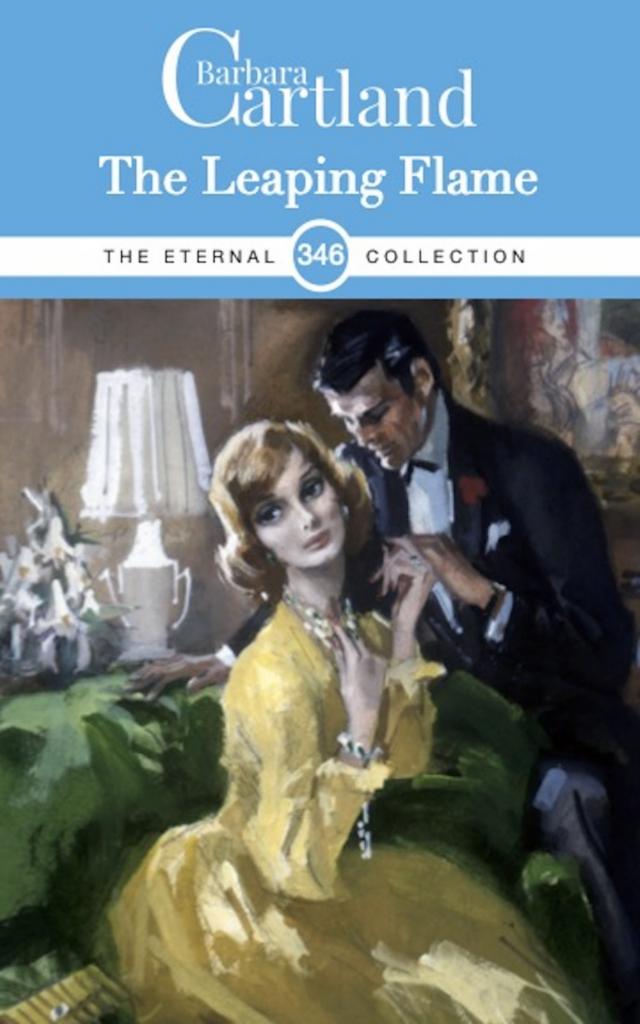
The Leaping Flame
©1942
‘And there are those
Through whom the stream flows slowly,
Often dim and grey, but never still.
Its flow unceasing, ceaseless,
Till – as dawn breaks in a sable sky –
The purpose of its moving stands revealed,
The path of God – the leaping flame of life.’
One
‘Hell, I look awful!’
Mona knelt on the seat of the railway carriage and stared at herself in the looking-glass. She was too thin and there were dark lines heavily scored under her eyes.
‘Overdressed, too,’ she thought, and reaching up, she unclasped the diamond brooch from her shoulder. She stared at it for some moments. The diamonds were exquisitely set in platinum – French workmanship of course as no one could design or set jewels like the French. But it wasn’t of its beauty that Mona was thinking as she turned it over in her hands then hurriedly, as if she could not bear to look at it any longer, put it away in her handbag.
How vividly she could remember Lionel giving her that brooch. They had been in Naples. They had dined together and just before midnight they had walked out onto a wide marble balcony. Beneath them lay the city, its golden lights glittering and flashing, and in the distance was Vesuvius, silhouetted against the velvet sky, and not far away a young voice of haunting beauty was singing a serenade.
It was a night of stars, which the sea reflected on its smooth surface – smooth, yet moving gently and rhythmically, like a woman’s sleeping form. Mona had leant forward with her arms on the cool stone of the balustrade. She could feel the soft night breeze on her face, smell the fragrance of flowers and hear, above the murmur of the city, Lionel’s voice ask softly,
“Are you happy, darling?”
She had turned towards him. No need for words – he could read the answer in her eyes, in the expectant parting of her lips.
Then, breaking in upon the enchantment of the moment midnight had struck, came the tinkling chimes from many parts of the city, clear and melodious on the night air.
“Many happy returns of the day, my darling.”
Lionel had kissed her and for a moment they had clung together, a moment so ecstatic, so pulsating with wonder and loveliness that Mona shut her eyes, wanting it to last until eternity. Then he had released her and drawn a small pink leather case from his pocket.
“For you, my sweet.”
She had opened her eyes to thank him but it was difficult not to look at the man she loved rather than the present he offered. She had opened the box and drawn in her breath.
“Oh, it’s too marvellous! Put it on for me.”
He had pinned it where her dress ended low between her breasts.
“It suits you,” he said.
Thinking more of the touch of his fingers than of his gift she had whispered,
“I wish it could stay there forever. I wish we could stay here forever.”
“Darling, I can think of better places – not so public,” he had laughed, and broken the intensity of her mood so that she had laughed too.
How wonderful Lionel had been that night. How old had she been? Nineteen? No, twenty. Five years ago! How far away it seemed now! How lost – that quivering, breathless happiness…
Mona was suddenly conscious that she was still kneeling and staring with unseeing eyes at her reflection in the railway carriage mirror. She stood up, steadying herself against the swaying movement of the train. Again she looked at herself in the glass. The brooch was gone but it made little difference. She could not alter the cut of her clothes, the richness of silver foxes, the elegance with which the curls of her red-gold hair lay against her ears. Every inch of her screamed sophistication, polished poise, ‘a woman of the world’ and she knew just how flamboyant she would appear in Little Cobble.
She made a slight grimace at her reflection. Oh well, what did it matter? But she unpinned a spray of orchids from the furs lying across her shoulder – purple orchids, fragile, exotic and romantic.
How long, she wondered, would it be before she was given such flowers again? That nice man had scoured Lisbon for these.
“To bring you luck,” he murmured as he said goodbye.
She had let him kiss her hand and then her cheek. What did it matter? She would never see him again and he had been kind this last month while she had waited for a seat in an aeroplane to bring her home.
“You were made for orchids,” someone had once told her.
She had forgotten now who it was but she could recall the tone of voice in which the nameless one had spoken. Perhaps it was true. Orchids were useless, beautiful flowers without any scent.
‘That’s me,’ Mona thought. ‘Something decorative without a soul.’
Then she laughed out loud at her own theatricalism.
‘How serious I am becoming – and what a bore!’
She glanced out of the window. She would arrive in another five minutes.
The train was passing through a well-remembered bit of flat, dismal country and the weather might have chosen its mood specially to greet her – a grey day, a mist on the horizon, the fields wet and muddy from recent rains.
‘Typical English weather,’ she told herself. ‘I might as well get used to it.’
Funny to think how long it was since she had last seen the dreary dampness of an English winter. Four, or was it five years since she had been home? It was difficult to be sure, but her mother would be able to tell her exactly.
At the thought of her mother Mona made an impatient gesture. Here was really the reason for her self-criticism. Darling Mummy – how eagerly she would be waiting – killing the fatted calf, of course, for the return of the prodigal daughter.
‘And what shall I say to her?’ Mona asked herself. ‘Mother, I have sinned against Heaven and before thee?’
That, at least, would be appropriate and truthful. Yet was she going to tell the truth? Hadn’t she planned in her own mind to announce that she had come back to help her country.
“I understand there is work for every Englishwoman however unskilled.”
How easily, how convincingly she would say it! No! – she was sick of lies, sick of subterfuge. Hadn’t she had enough of them these last years? She’d tell the truth – she’d say,
“I’ve come home because I’m broke.”
That was the truth, anyway, even if it wasn’t the whole truth. And supposing Mummy asked,
“But, darling – what did you do with the salaries you told me you were getting all these years, the sums you got as secretary to that American millionaire? As companion to that delightful Frenchwoman? For running that little dress shop in Cairo?”
Or was it Cannes? Why hadn’t she kept a list of the things she was supposed to have done? She had forgotten them now, forgotten the lies she had invented, the convincing answers she had given to the questions from home. She couldn’t even remember the names of the people with whom she was supposed to have been. They had been clever names, too.
Sometimes Lionel and she would amuse themselves by inventing them. Sometimes she would take them from the character in a play or from the gossip columns of some local paper, and then she would go on to describe the person wittily and in detail. Having written them down, across the world her lies would wend their way by aeroplane, by train, by ship, until finally they reached their destination at the Priory.
Now they would be waiting for her, those pages and pages and pages of lies, preening themselves like the white pigeons on the grey gables. That was a good simile because they were white lies after all…
‘Yes, white,’ Mona told herself fiercely, as if someone had contradicted her.
And if white lies had kept Mummy happy and free from worry, wasn’t she justified in telling them? How could she have told the truth? How could she have begun to explain? Now, perhaps, she might have to! Not if she could avoid it, but there was always the possibility that she would not be able to go on lying. What was it Nanny used to say when she was a child?
“Be sure your sins will find you out.”
Dear old Nanny. She would be waiting too, getting excited now at the thought of seeing her.
The train was slowing up. Mona threw the spray of orchids under the seat and started collecting her things – the crocodile dressing-case, the soft pale-blue cashmere travelling rug, the mink coat of dark, specially selected skins – they all seemed incongruous in her present situation with a third-class ticket in her handbag.
When she had tipped the porter that would leave her exactly ten shillings in the world. Of course, when she got to the bank, she might find that some of Ned’s ridiculous shares had paid at last, but it seemed unlikely in wartime. Oh well, she was lucky to get home at all. There were many English women abroad in a far worse position than herself, left completely penniless without even the price of their ticket home.
Now the train had stopped. She opened the door and saw Dixon standing on the station. How old he looked! of course he must be over seventy, but she had even thought of him as an old man when he had first taught her to ride a pony!
“Here I am, Dixon.”
She held out her hand.
“It’s fine to see you, Miss Mona.”
Dixon never could remember that she had another name.
“I’ve got a mass of luggage in the van. Is there a porter?”
“There’s one of them women about somewhere,” Dixon replied. “Ted was called up last week. Reckon us’ll have to move it ourselves.”
“I’m afraid that’s impossible,” Mona said. “The cabin trunks are very heavy.”
“Maybe someone will give us a hand,” Dixon said laconically as they walked down the platform together.
His optimism was justified. A couple of soldiers assisted and soon all Mona’s numerous pieces of luggage were piled on the platform, their foreign labels looking like a flight of butterflies, she thought, a bright, frivolous touch on the otherwise dreary station.
She thanked the soldiers graciously.
“It’s a pleasure,” one of them told her.
People always found it a pleasure to do things for Mona there was something appealingly feminine about her and if she needed help men appeared as if by magic.
“Reckon us won’t get all this in the trap,” Dixon said, scratching his head.
“Dixon, you don’t mean to say you’ve brought the little governess cart?”
“It’s that or nothing nowadays,” Dixon replied. “Us put up the car at the beginning of the war.”
“Well, we certainly can’t get even half these in on one journey,” Mona said. “What are you going to do?”
“Robinson will bring ’em up when he brings the coal,” Dixon said. “It’ll be all right.”
Mona looked slightly apprehensive at the idea of her luggage resting cheek by jowl with the sacks of coal, but there was nothing for it, and soon, with only her dressing case beside her, she was being driven away from the station in the old governess cart in which she had driven round the countryside as a child.
“How is my mother?” she asked.
“Her seems well enough,” the old man replied. “Don’t alter much.”
“Nor do you, Dixon,” Mona said, but he shook his head.
“I be getting on,” he replied, “but I mustn’t grumble. I ain’t fared too badly this winter, one way and another, and there’s been a lot to do. I be the only man left at the Priory nowadays.”
“Your son’s gone then?” Mona asked, remembering vaguely, although she could not recall his name, a middle-aged man who used to work in the garden.
“Yes, Jack be in the Pioneers,” Dixon said. “He were in Crete but he got away and the last the wife heard from him he were somewhere in Egypt.”
“Somewhere in Egypt!” That brought back memories. Memories of palm trees and sand, of moving slowly up the Nile, of Luxor, of a moon shining on the enigmatic mystery of the Sphinx, of driving out into the vast waste of empty desert, and of the hot, weary nights when she had lain in loneliness longing for Lionel…
No use thinking of that now. She gave herself a little shake. She must keep her mind on the present.
They had reached the bottom of the hill and the pony began to climb slowly up it. She could see the squat tower of the church, the thatched cottages and the ugly red brick of the school.
“The village hasn’t changed much,” she remarked.
“No, things don’t alter in Little Cobble,” Dixon answered.
“Is everyone the same? Are the Gunthers still at the Vicarage?”
“Yes, they be here right enough.”
“And Doctor Howlett and his wife?”
“Yes, the doctor be here, too.”
They reached the top of the hill. Mona looked back. That was the view which always meant home and England to her – the valley, green and flat, stretching away into a blue distance, broken only by the winding of the river and a line of poplars pointing like startled fingers towards the sky.
Now they were driving past the church with a few very white gravestones. And here were the gates, the gates of the Priory, just as they always had been, dilapidated and still in need of a coat of paint – but what did that matter when they always stood open invitingly?
The overgrown drive, the rhododendron bushes interspersed among the green and red holly, the oak trees, which had once formed an avenue but which were now irregular and ragged, their orderliness destroyed by age, by tempest and by lightning. And there was the house, the clinging ivy green against the weathered beauty of Elizabethan brick, the delicate tracery of stone-mullioned windows, and the nail-studded oak door under its pointed arch.
‘Home!’ Mona thought, and saw her mother standing in the doorway, a smile of eager welcome on her face.
Upstairs, Mona drew her hat slowly from her head. Her room seemed very small and yet she was ridiculously glad to be in it again. She had been half-afraid that her mother would insist on her sleeping in the spare room. But it had been stupid of her to think for one moment that such an idea would occur to her mother. Custom and tradition were the ruling factors at the Priory and, even though she had been away for years, nothing had changed, everything was just the same. Even the ornaments were in their accustomed places.
She looked round her bedroom. Yes, it was identically as she had left it, even to the pig with Brighton’s coat-of-arms across its back standing on the mantlepiece! The chintz four-poster, the blue casement curtains – a little more faded perhaps – the dressing table with its flounced petticoats to match, and the silver candlesticks by the bed – nothing was forgotten, nothing was changed.
‘I’ve come home,’ Mona thought, ‘and now that first moment of arrival is over, I’m glad.’
It was a relief to be able to relax, to know that she need not be amusing or clever, to know there were no cold, calculating eyes waiting to criticise, no bitter, spiteful tongues moving relentlessly.
Suddenly she wanted to identify herself with the house, to be part of its quiet, cosy shabbiness, to shut away in a cupboard with her mink that other smart, sophisticated self she hated – and regretted.
‘I must find something suitable to wear,’ she reflected, visualising those piles of chiffons and satins, ermine-trimmed velvets, brocades and lamés, all waiting at the station for the privilege of coming up in the coal cart. How utterly incongruous they would be here. No, need even to unpack them, she would never need them. All she would want would be an old tweed skirt, a jumper or two, and a pair of thick shoes.
“I don’t believe I possess such a thing,” Mona said out loud.
“Possess what, dearie?” a voice asked from the doorway, and she saw that Nanny had come in.
“The right clothes.”
“Haven’t you brought any with you?” Nanny inquired. “Because if you haven’t, I’ve got some of your old things put away in the wardrobe.”
“What things?”
“The tweeds you had before you married and that tea-gown of yours that you used to be so fond of – the black velvet with the little lace collar.”
“Oh, Nanny, you haven’t really kept them?”
“Indeed I have, and perhaps you will be glad of them now. What with coupons and high prices there’s nothing that doesn’t come in useful.”
“I shall be thrilled to see them again – they’re exactly what I want.”
“They’ll have to be taken in then,” Nanny said reproachfully. “You’ve got so thin there’s nothing of you. What have you been doing with yourself, child, all these years? Burning the candle at both ends, I shouldn’t wonder.”
“That’s exactly what I have been doing,” Mona replied, half-seriously, “but, oh Nanny – it gave a lovely light!”
Nanny sniffed.
“You always were one for doing too much. Restless, tearing about, wearing yourself out. But now we’ve got you home again we’ll soon fatten you up, though goodness knows what with! So little butter and so little sugar. As I said to your mother, it’s a puzzle nowadays to know what you can eat, and no mistake.”
Mona suddenly put out her arms and giving the old women a hug, she kissed her wrinkled cheek.
“I am glad to be home, Nanny, really glad.”
“And so I should hope. It’s about time you did come home – five years next April it will be since we last saw you.”
“As long as that?”
“As long as that,” Nanny echoed sharply. “Disgraceful. I’ve always thought it, the way you neglected your mother – but there, she wouldn’t listen to me.
“‘Write and tell her to come back,’ I’ve said to her so often, but she wouldn’t listen.
“‘She’s having a lovely time, Nanny,’ she’d answer, ‘and she’s meeting nice people. That’s what I want for my daughter – nice friendships with the right sort of people.’”
Mona turned away sharply. If Mummy only knew! But thank God she didn’t!


