The Card, page 13
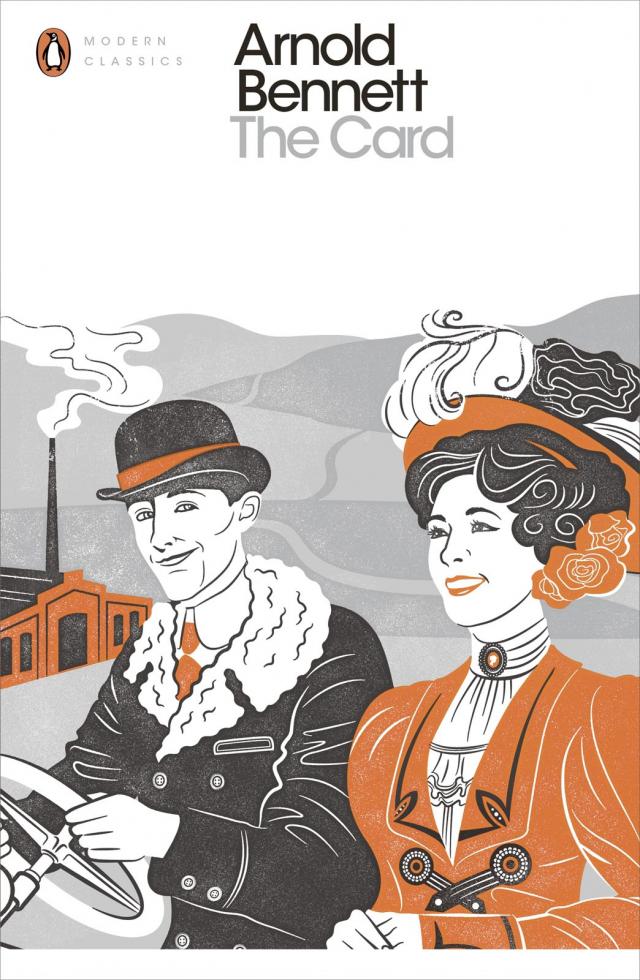


The solemn day was a day in March, and the hour was fixed for three o’clock, and the place was the large hall of the Institute itself, behind Crown Square, which is the Trafalgar Square of Hanbridge. The Countess was to drive over from Sneyd. Had the epoch been ten years later she would have motored over. But probably that would not have made any difference to what happened.
In relating what did happen, I confine myself to facts, eschewing imputations. It is a truism that life is full of coincidences, but whether these events comprised a coincidence, or not, each reader must decide for himself, according to his cynicism or his faith in human nature.
The facts are: First, that Denry called one day at the house of Mrs Kemp a little lower down Brougham Street, Mrs Kemp being friendly with Mrs Machin, and the mother of Jock, the Countess’s carriage-footman, whom Denry had known from boyhood. Second, that a few days later, when Jock came over to see his mother, Denry was present, and that subsequently Denry and Jock went for a stroll together in the cemetery, the principal resort of strollers in Bursley. Third, that on the afternoon of the opening ceremony the Countess’s carriage broke down in Sneyd Vale, two miles from Sneyd and three miles from Hanbridge. Fourth, that five minutes later Denry, all in his best clothes, drove up behind his mule. Fifth, that Denry drove right past the breakdown, apparently not noticing it. Sixth, that Jock, touching his hat to Denry as if to a stranger (for, of course, while on duty a footman must be dead to all humanities), said: ‘Excuse me, sir,’ and so caused Denry to stop.
These are the simple facts.
Denry looked round with that careless half-turn of the upper part of the body which drivers of elegant equipages affect when their attention is called to something trifling behind them. The mule also looked round – it was a habit of the mule’s and if the dog had been there the dog would have shown an even livelier inquisitiveness; but Denry had left the faithful animal at home.
‘Good-afternoon, Countess,’ he said, raising his hat, and trying to express surprise, pleasure, and imperturbability all at once.
The Countess of Chell, who was standing in the road, raised her lorgnon, which was attached to the end of a tortoiseshell pole about a foot long, and regarded Denry. This lorgnon was a new device of hers, and it was already having the happy effect of increasing the sale of long-handled lorgnons throughout the Five Towns.
‘Oh! it’s you, is it?’ said the Countess. ‘I see you’ve grown a beard.’
It was just this easy familiarity that endeared her to the district. As observant people put it, you never knew what she would say next, and yet she never compromised her dignity.
‘Yes,’ said Denry. ‘Have you had an accident?’
‘No,’ said the Countess, bitterly: ‘I’m doing this for idle amusement.’
The horses had been taken out, and were grazing by the roadside like common horses. The coachman was dipping his skirts in the mud as he bent down in front of the carriage and twisted the pole to and fro and round about and round about. The footman, Jock, was industriously watching him.
‘It’s the pole-pin, sir,’ said Jock.
Denry descended from his own hammercloth. The Countess was not smiling. It was the first time that Denry had ever seen her without an efficient smile on her face.
‘Have you got to be anywhere particular?’ he asked. Many ladies would not have understood what he meant. But the Countess was used to the Five Towns.
‘Yes,’ said she. ‘I have got to be somewhere particular. I’ve got to be at the Police Institute at three o’clock particular, Mr Machin. And I shan’t be. I’m late now. We’ve been here ten minutes.’
The Countess was rather too often late for public ceremonies. Nobody informed her of the fact. Everybody, on the contrary, assiduously pretended that she had arrived to the very second. But she was well aware that she had a reputation for unpunctuality. Ordinarily, being too hurried to invent a really clever excuse, she would assert lightly that something had happened to her carriage. And now something in truth had happened to her carriage – but who would believe it at the Police Institute?
‘If you’ll come with me, I’ll guarantee to get you there by three o’clock,’ said Denry.
The road thereabouts was lonely. A canal ran parallel with it at a distance of fifty yards, and on the canal a boat was moving in the direction of Hanbridge at the rate of a mile an hour. Such was the only other vehicle in sight. The outskirts of Knype, the nearest town, did not begin until at least a mile further on; and the Countess, dressed for the undoing of mayors and other unimpressionable functionaries, could not possibly have walked even half a mile in that rich dark mud. She thanked him, and without a word to her servants took the seat beside him.
III
Immediately the mule began to trot the Countess began to smile again. Relief and content were painted upon her handsome features. Denry soon learnt that she knew all about mules – or almost all. She told him how she had ridden hundreds of miles on mules in the Apennines, where there were no roads, and only mules, goats, and flies could keep their feet on the steep, stony paths. She said that a good mule was worth forty pounds in the Apennines, more than a horse of similar quality. In fact, she was very sympathetic about mules. Denry saw that he must drive with as much style as possible, and he tried to remember all that he had picked up from a book concerning the proper manner of holding the reins. For in everything that appertained to riding and driving the Countess was an expert. In the season she hunted once or twice a week with the North Staffordshire Hounds, and the Signal had stated that she was a fearless horsewoman. It made this statement one day when she had been thrown and carried to Sneyd senseless.
The mule, too, seemingly conscious of its responsibilities and its high destiny, put its best foot foremost and behaved in general like a mule that knew the name of its great-grandfather. It went through Knype in admirable style, not swerving at the steam-cars nor exciting itself about the railway bridge. A photographer who stood at his door manoeuvring a large camera startled it momentarily, until it remembered that it had seen a camera before. The Countess, who wondered why on earth a photographer should be capering round a tripod in a doorway, turned to inspect the man with her lorgnon.
They were now coursing up the Cauldon Bank towards Hanbridge. They were already within the boundaries of Hanbridge, and a pedestrian here and there recognized the Countess. You can hide nothing from the quidnunc of Hanbridge. Moreover, when a quidnunc in the streets of Hanbridge sees somebody famous or striking, or notorious, he does not pretend that he has seen nobody. He points unmistakably to what he has observed, if he has a companion, and if he has no companion he stands still and stares with such honest intensity that the entire street stands and stares too. Occasionally you may see an entire street standing and staring without any idea of what it is staring at. As the equipage dashingly approached the busy centre of Hanbridge, the region of fine shops, public-houses, hotels, halls, and theatres, more and more of the inhabitants knew that Iris (as they affectionately called her) was driving with a young man in a tumble-down little victoria behind a mule whose ears flapped like an elephant’s. Denry being far less renowned in Hanbridge than in his native Bursley, few persons recognized him. After the victoria had gone by people who had heard the news too late rushed from shops and gazed at the Countess’s back as at a fading dream until the insistent clang of a car-bell made them jump again to the footpath.
At length Denry and the Countess could see the clock of the Old Town Hall in Crown Square and it was a minute to three. They were less than a minute off the Institute.
‘There you are!’ said Denry, proudly. ‘Three miles if it’s a yard, in seventeen minutes. For a mule it’s none so dusty.’
And such was the Countess’s knowledge of the language of the Five Towns that she instantly divined the meaning of even that phrase, ‘none so dusty’.
They swept into Crown Square grandly.
And then, with no warning, the mule suddenly applied all the automatic brakes which a mule has, and stopped.
‘Oh Lor!’ sighed Denry. He knew the cause of that arresting.
A large squad of policemen, a perfect regiment of policemen, was moving across the north side of the square in the direction of the Institute. Nothing could have seemed more reassuring, less harmful, than that band of policemen, off duty for the afternoon and collected together for the purpose of giving a hearty and policemanly welcome to their benefactress the Countess. But the mule had his own views about policemen. In the early days of Denry’s ownership of him he had nearly always shied at the spectacle of a policeman. He would tolerate steam-rollers, and even falling kites, but a policeman had ever been antipathetic to him. Denry, by patience and punishment, had gradually brought him round almost to the Countess’s views of policemen – namely, that they were a courteous and trustworthy body of public servants, not to be treated as scarecrows or the dregs of society. At any rate, the mule had of late months practically ceased to set his face against the policing of the Five Towns. And when he was on his best behaviour he would ignore a policeman completely.
But there were several hundreds of policemen in that squad, the majority of all the policemen in the Five Towns. And clearly the mule considered that Denry, in confronting him with several hundred policemen simultaneously, had been presuming upon his good-nature.
The mule’s ears were saying agitatedly:
‘A line must be drawn somewhere, and I have drawn it where my forefeet now are.’
The mule’s ears soon drew together a little crowd.
It occurred to Denry that if mules were so wonderful in the Apennines the reason must be that there are no policemen in the Apennines. It also occurred to him that something must be done to this mule.
‘Well?’ said the Countess, inquiringly.
It was a challenge to him to prove that he and not the mule was in charge of the expedition.
He briefly explained the mule’s idiosyncrasy, as it were apologizing for its bad taste in objecting to public servants whom the Countess cherished.
‘They’ll be out of sight in a moment,’ said the Countess. And both she and Denry tried to look as if the victoria had stopped in that special spot for a special reason, and that the mule was a pattern of obedience. Nevertheless, the little crowd was growing a little larger.
‘Now,’ said the Countess, encouragingly. The tail of the regiment of policemen had vanished towards the Institute.
‘Tchk! Tchk!’ Denry persuaded the mule.
No response from those forefeet!
‘Perhaps I’d better get out and walk,’ the Countess suggested. The crowd was becoming inconvenient, and had even begun to offer unsolicited hints as to the proper management of mules. The crowd was also saying to itself: ‘It’s her! It’s her! It’s her!’ Meaning that it was the Countess.
‘Oh no,’ said Denry, ‘it’s all right.’
And he caught the mule ‘one’ over the head with his whip.
The mule, stung into action, dashed away, and the crowd scattered as if blown to pieces by the explosion of a bomb. Instead of pursuing a right line the mule turned within a radius of its own length, swinging the victoria round after it as though the victoria had been a kettle attached to it with string. And Countess, Denry, and victoria were rapt with miraculous swiftness away – not at all towards the Policemen’s Institute, but down Longshaw Road, which is tolerably steep. They were pursued, but ineffectually. For the mule had bolted and was winged. They fortunately came into contact with nothing except a large barrow of carrots, turnips, and cabbages which an old woman was wheeling up Longshaw Road. The concussion upset the barrow, half filled the victoria with vegetables, and for a second stayed the mule; but no real harm seemed to have been done, and the mule proceeded with vigour. Then the Countess noticed that Denry was not using his right arm, which swung about rather uselessly.
‘I must have knocked my elbow against the barrow,’ he muttered. His face was pale.
‘Give me the reins,’ said the Countess.
‘I think I can turn the brute up here,’ he said.
And he did in fact neatly divert the mule up Birches Street, which is steeper even than Longshaw Road. The mule for a few instants pretended that all gradients, up or down, were equal before its angry might. But Birches Street has the slope of a house-roof. Presently the mule walked, and then it stood still. And half Birches Street emerged to gaze, for the Countess’s attire was really very splendid.
‘I’ll leave this here, and we’ll walk back,’ said Denry. ‘You won’t be late – that is, nothing to speak of. The Institute is just round the top here.’
‘You don’t mean to say you’re going to let that mule beat you?’ exclaimed the Countess.
‘I was only thinking of your being late.’
‘Oh, bother!’ said she. ‘Your mule may be ruined.’ The horse-trainer in her was aroused.
‘And then my arm?’ said Denry.
‘Shall I drive back?’ the Countess suggested.
‘Oh, do,’ said Denry. ‘Keep on up the street, and then to the left.’
They changed places, and two minutes later she brought the mule to an obedient rest in front of the Police Institute, which was all newly red with terracotta. The main body of policemen had passed into the building, but two remained at the door, and the mule haughtily tolerated them. The Countess dispatched one to Longshaw Road to settle with the old woman whose vegetables they had brought away with them. The other policeman, who, owing to the Countess’s philanthropic energy, had received a course of instruction in first aid, arranged a sling for Denry’s arm. And then the Countess said that Denry ought certainly to go with her to the inauguration ceremony. The policeman whistled a boy to hold the mule. Denry picked a carrot out of the complex folds of the Countess’s rich costume. And the Countess and her saviour entered the portico and were therein met by an imposing group of important male personages, several of whom wore mayoral chains. Strange tales of what had happened to the Countess had already flown up to the Institute, and the chief expression on the faces of the group seemed to be one of astonishment that she still lived.
IV
Denry observed that the Countess was now a different woman. She had suddenly put on a manner to match her costume, which in certain parts was stiff with embroidery. From the informal companion and the tamer of mules she had miraculously developed into the public celebrity, the peeress of the realm, and the inaugurator-general of philanthropic schemes and buildings. Not one of the important male personages but would have looked down on Denry! And yet, while treating Denry as a jolly equal, the Countess with all her embroidered and stiff politeness somehow looked down on the important male personages – and they knew it. And the most curious thing was that they seemed rather to enjoy it. The one who seemed to enjoy it the least was Sir Jehoshophat Dain, a white-bearded pillar of terrific imposingness.
Sir Jee – as he was then beginning to be called – had recently been knighted, by way of reward for his enormous benefactions to the community. In the rôle of philanthropist he was really much more effective than the Countess. But he was not young, he was not pretty, he was not a woman, and his family had not helped to rule England for generations – at any rate, so far as anybody knew. He had made more money than had ever before been made by a single brain in the manufacture of earthenware, and he had given more money to public causes than a single pocket had ever before given in the Five Towns. He had never sought municipal honours, considering himself to be somewhat above such trifles. He was the first purely local man to be knighted in the Five Towns. Even before the bestowal of the knighthood his sense of humour had been deficient, and immediately afterwards it had vanished entirely. Indeed, he did not miss it. He divided the population of the kingdom into two classes – the titled and the untitled. With Sir Jee, either you were titled, or you weren’t. He lumped all the untitled together; and to be just to his logical faculty, he lumped all the titled together. There were various titles – Sir Jee admitted that – but a title was a title, and therefore all titles were practically equal. The Duke of Norfolk was one titled individual, and Sir Jee was another. The fine difference between them might be perceptible to the titled, and might properly be recognized by the titled when the titled were among themselves, but for the untitled such a difference ought not to exist and could not exist.
Thus for Sir Jee there were two titled beings in the group – the Countess and himself. The Countess and himself formed one caste in the group, and the rest another caste. And although the Countess, in her punctilious demeanour towards him, gave due emphasis to his title (he returning more than due emphasis to hers), he was not precisely pleased by the undertones of suave condescension that characterized her greeting of him as well as her greeting of the others. Moreover, he had known Denry as a clerk of Mr Duncalf’s, for Mr Duncalf had done a lot of legal work for him in the past. He looked upon Denry as an upstart, a capering mountebank, and he strongly resented Denry’s familiarity with the Countess. He further resented Denry’s sling, which gave to Denry an interesting romantic aspect (despite his beard), and he more than all resented that Denry should have rescued the Countess from a carriage accident by means of his preposterous mule. Whenever the Countess, in the preliminary chatter, referred to Denry or looked at Denry, in recounting the history of her adventures, Sir Jee’s soul squirmed, and his body sympathized with his soul. Something in him that was more powerful than himself compelled him to do his utmost to reduce Denry to a moral pulp, to flatten him, to ignore him, or to exterminate him by the application of ice. This tactic was no more lost on the Countess than it was on Denry. And the Countess foiled it at every instant. In truth, there existed between the Countess and Sir Jee a rather hot rivalry in philanthropy and the cultivation of the higher welfare of the district. He regarded himself, and she regarded herself, as the most brightly glittering star of the Five Towns.