

Thrive, page 2
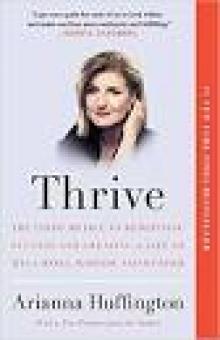


To really know what we want to do, we have to know ourselves, what we really value and what makes us truly happy and fulfilled. It’s not a surprise that when we define ourselves solely by our work and that work is taken away, we can find ourselves feeling lost and adrift, as happens to so many retirees. But if we realize that we’re more than our résumés, it will make for a much easier transition to a time when we stop adding new line items to those résumés.
Looking at other cultures is an extremely effective way to put these questions into perspective. As HuffPost has expanded around the world, I’ve had a chance to learn about how different businesses in different countries are introducing practices leading to a new way of working and living that’s less stressful, more sustainable, and more fulfilling. For example, in Australia the “gap year” has become a milestone for many young adults. Instead of going straight from high school to college and then straight into the career rat race, more than a quarter of Australians put off college for a year for a more unstructured time of exploration. “Parents fear a gap year may disrupt a student’s momentum,” said Andrew Martin, a professor at the University of Sydney, “but it is possible it is part of the momentum.” In September, Germany’s Labor Ministry commissioned a study on work-related stress; it could eventually lead to a ban on after-hours emails—a clear signal that Germany is taking seriously the dangers of a work culture built on stress, burnout, and constant connectivity.
Clearly it’s time to go from awareness to action. And that’s the purpose of this book.
The good news is that people are ready to make this transition. The evidence is all around us. This was brought home to me in April, just after the release of Thrive, when we convened our second Third Metric conference. We had held the first conference, in 2013, in my living room. We wanted it to be cozy, but so many people—over 300—showed up that it was downright intimate. It was a sign of how eager people are to take back control of their lives. And so for the second conference my cohost, Mika Brzezinski, and I found a bigger venue. And 2400 people showed up. Over the course of two days we heard from neuroscientists, doctors, musicians, writers, teachers, comedians, artists, and a yoga instructor who led what was probably Manhattan’s biggest yoga class.
What I’ve seen in the last year is that the desire for change is strong. We may have hit the snooze button a few times, but that wake-up call is gradually being heard. And today, in addition to having the will, we have the tools—tools that are both timely and timeless. As I explain in the book’s introduction, Thrive is structured to fix our broken definition of success. And there is no better time to start than today.
Introduction
ON THE morning of April 6, 2007, I was lying on the floor of my home office in a pool of blood. On my way down, my head had hit the corner of my desk, cutting my eye and breaking my cheekbone. I had collapsed from exhaustion and lack of sleep. In the wake of my collapse, I found myself going from doctor to doctor, from brain MRI to CAT scan to echocardiogram, to find out if there was any underlying medical problem beyond exhaustion. There wasn’t, but doctors’ waiting rooms, it turns out, were good places for me to ask myself a lot of questions about the kind of life I was living.
We founded The Huffington Post in 2005, and two years in we were growing at an incredible pace. I was on the cover of magazines and had been chosen by Time as one of the world’s 100 Most Influential People. But after my fall, I had to ask myself, Was this what success looked like? Was this the life I wanted? I was working eighteen hours a day, seven days a week, trying to build a business, expand our coverage, and bring in investors. But my life, I realized, was out of control. In terms of the traditional measures of success, which focus on money and power, I was very successful. But I was not living a successful life by any sane definition of success. I knew something had to radically change. I could not go on that way.
This was a classic wake-up call. Looking back on my life, I had other times when I should have woken up but didn’t. This time I really did and made many changes in the way I live my life, including adopting daily practices to keep me on track—and out of doctors’ waiting rooms. The result is a more fulfilling life, one that gives me breathing spaces and a deeper perspective.
This book was conceived as I tried to pull together all the insights I had gleaned about my work and life during the weeks I spent writing the commencement speech I was to give to the class of 2013 at Smith College. With two daughters in college, I take commencement speeches very seriously. It’s such a special moment for the graduating class—a pause, a kind of parenthesis in time following four (or five, or six) years of nonstop learning and growing just before the start of an adult life spent moving forward and putting all of that knowledge into action. It’s a unique marker in their lives—and for fifteen minutes or so I have the graduates’ undivided attention. The challenge is to say something equal to the occasion, something that will be useful during a charged time of new beginnings.
“Commencement speakers,” I told the women graduates, “are traditionally expected to tell the graduating class how to go out there and climb the ladder of success. But I want to ask you instead to redefine success. Because the world you are headed into desperately needs it. And because you are up to the challenge. Your education at Smith has made it unequivocally clear that you are entitled to take your place in the world wherever you want that place to be. You can work in any field, and you can make it to the top of any field. But what I urge you to do is not just take your place at the top of the world, but to change the world.”
The moving response to the speech made me realize how widespread is the longing among so many of us to redefine success and what it means to lead “the good life.”
“What is a good life?” has been a question asked by philosophers going back to the ancient Greeks. But somewhere along the line we abandoned the question and shifted our attention to how much money we can make, how big a house we can buy, and how high we can climb up the career ladder. Those are legitimate questions, particularly at a time when women are still attempting to gain an equal seat at the table. But as I painfully discovered, they are far from the only questions that matter in creating a successful life.
Over time our society’s notion of success has been reduced to money and power. In fact, at this point, success, money, and power have practically become synonymous in the minds of many.
This idea of success can work—or at least appear to work—in the short term. But over the long term, money and power by themselves are like a two-legged stool—you can balance on them for a while, but eventually you’re going to topple over. And more and more people—very successful people—are toppling over.
So what I pointed out to the Smith College graduates was that the way we’ve defined success is not enough. And it’s no longer sustainable: It’s no longer sustainable for human beings or for societies. To live the lives we truly want and deserve, and not just the lives we settle for, we need a Third Metric, a third measure of success that goes beyond the two metrics of money and power, and consists of four pillars: well-being, wisdom, wonder, and giving. These four pillars make up the four sections of this book.
First, well-being: If we don’t redefine what success is, the price we pay in terms of our health and well-being will continue to rise, as I found out in my own life. As my eyes opened, I saw that this new phase in my life was very much in tune with the zeitgeist, the spirit of our times. Every conversation I had seemed to eventually come around to the same dilemmas we are all facing—the stress of over-busyness, overworking, overconnecting on social media, and underconnecting with ourselves and with one another. The space, the gaps, the pauses, the silence—those things that allow us to regenerate and recharge—had all but disappeared in my own life and in the lives of so many I knew.
It seemed to me that the people who were genuinely thriving in their lives were the ones who had made room for well-being, wisdom, wonder, and giving. Hence the “Third Metric” was born—the third leg of the stool in living a successful life. What started with redefining my own life path and priorities led me to see an awakening that is taking place globally. We are entering a new era. How we measure success is changing.
And it’s changing not a moment too soon—especially for women, since a growing body of data shows that the price of the current false promise of success is already higher for women than it is for men. Women in stressful jobs have a nearly 40 percent increased risk of heart disease, and a 60 percent greater risk of diabetes. In the past thirty years, as women have made substantial strides in the workplace, self-reported levels of stress have gone up 18 percent.
Those who have just started out in the workforce—and those who haven’t even yet begun—are already feeling the effects. According to the American Psychological Association, the millennial generation is at the top of the chart for stress levels—more so than baby boomers and “matures,” as the study dubbed those over sixty-seven.
The Western workplace culture—exported to many other parts of the world—is practically fueled by stress, sleep deprivation, and burnout. I had come face-to-face—or, I should say, face-to-floor—with the problem when I collapsed. Even as stress undermines our health, the sleep deprivation so many of us experience in striving to get ahead at work is profoundly—and negatively—affecting our creativity, our productivity, and our decision making. The Exxon Valdez wreck, the explosion of the Challenger space shuttle, and the nuclear accidents at Chernobyl and Three Mile Island all were at least partially caused by a lack of sleep.
And in the winter of 2013, the deadly Metro-North derailment caused when William Rockefeller, the engineer at the controls, fell asleep, focused national attention on the dangers of sleep deprivation throughout the transportation industry. As John Paul Wright, an engineer for one of the country’s largest freight rail operators, put it, “The biggest issue with railroad workers is fatigue, not pay. We are paid very well. But we sacrifice our bodies and minds to work the long hours it takes to make the money, not to mention the high divorce rate, self-medicating, and stress.”
Over 30 percent of people in the United States and the United Kingdom are not getting enough sleep. And it’s not just decision making and cognitive functions that take a hit. Even traits that we associate with our core personality and values are affected by too little sleep. According to a study from the Walter Reed Army Institute of Research, sleep deprivation reduces our emotional intelligence, self-regard, assertiveness, sense of independence, empathy toward others, the quality of our interpersonal relationships, positive thinking, and impulse control. In fact, the only thing the study found that gets better with sleep deprivation is “magical thinking” and reliance on superstition. So if you’re interested in fortune-telling, go ahead and burn the midnight oil. For the rest of us, we need to redefine what we value, and change workplace culture so that working till all hours and walking around exhausted become stigmatized instead of lauded.
In the new definition of success, building and looking after our financial capital is not enough. We need to do everything we can to protect and nurture our human capital. My mother was an expert at that. I still remember, when I was twelve years old, a very successful Greek businessman coming over to our home for dinner. He looked rundown and exhausted. But when we sat down to dinner, he told us how well things were going for him. He was thrilled about a contract he had just won to build a new museum. My mother was not impressed. “I don’t care how well your business is doing,” she told him bluntly, “you’re not taking care of you. Your business might have a great bottom line, but you are your most important capital. There are only so many withdrawals you can make from your health bank account, but you just keep on withdrawing. You could go bankrupt if you don’t make some deposits soon.” And indeed, not long after that, the man had to be rushed to the hospital for an emergency angioplasty.
When we include our own well-being in our definition of success, another thing that changes is our relationship with time. There is even a term now for our stressed-out sense that there’s never enough time for what we want to do—“time famine.” Every time we look at our watches it seems to be later than we think. I personally have always had a very strained relationship with time. Dr. Seuss summed it up beautifully: “How did it get so late so soon?” he wrote. “It’s night before it’s afternoon. December is here before it’s June. My goodness how the time has flewn. How did it get so late so soon?”
Sound familiar?
And when we’re living a life of perpetual time famine, we rob ourselves of our ability to experience another key element of the Third Metric: wonder, our sense of delight in the mysteries of the universe, as well as the everyday occurrences and small miracles that fill our lives.
Another of my mother’s gifts was to be in a constant state of wonder at the world around her. Whether she was washing dishes or feeding seagulls at the beach or reprimanding overworking businessmen, she maintained her sense of wonder at life. And whenever I’d complain or was upset about something in my own life, my mother had the same advice: “Darling, just change the channel. You are in control of the clicker. Don’t replay the bad, scary movie.”
Well-being, wonder. Both of these are key to creating the Third Metric. And then there is the third indispensable W in redefining success: wisdom.
Wherever we look around the world, we see smart leaders—in politics, in business, in media—making terrible decisions. What they’re lacking is not IQ, but wisdom. Which is no surprise; it has never been harder to tap into our inner wisdom, because in order to do so, we have to disconnect from all our omnipresent devices—our gadgets, our screens, our social media—and reconnect with ourselves.
To be honest, it’s not something that comes naturally to me. The last time my mother got angry with me before she died was when she saw me reading my email and talking to my children at the same time. “I abhor multitasking,” she said, in a Greek accent that puts mine to shame. In other words, being connected in a shallow way to the entire world can prevent us from being deeply connected to those closest to us—including ourselves. And that is where wisdom is found.
I’m convinced of two fundamental truths about human beings. The first is that we all have within us a centered place of wisdom, harmony, and strength. This is a truth that all the world’s philosophies and religions—whether Christianity, Islam, Judaism, or Buddhism—acknowledge in one form or another: “The kingdom of God is within you.” Or as Archimedes said, “Give me a place to stand, and I will move the world.”
The second truth is that we’re all going to veer away from that place again and again and again. That’s the nature of life. In fact, we may be off course more often than we are on course.
The question is how quickly can we get back to that centered place of wisdom, harmony, and strength. It’s in this sacred place that life is transformed from struggle to grace, and we are suddenly filled with trust, whatever our obstacles, challenges, or disappointments. As Steve Jobs said in his now legendary commencement address at Stanford, “You can’t connect the dots looking forward; you can only connect them looking backwards. So you have to trust that the dots will somehow connect in your future. You have to trust in something—your gut, destiny, life, karma, whatever. This approach has never let me down, and it has made all the difference in my life.”
There is a purpose to our lives, even if it is sometimes hidden from us, and even if the biggest turning points and heartbreaks only make sense as we look back, rather than as we are experiencing them. So we might as well live life as if—as the poet Rumi put it—everything is rigged in our favor.
But our ability to regularly get back to this place of wisdom—like so many other abilities—depends on how much we practice and how important we make it in our lives. And burnout makes it much harder to tap into our wisdom. In an op-ed in The New York Times, Erin Callan, former chief financial officer of Lehman Brothers, who left the firm a few months before it went bankrupt, wrote about the lessons she learned about experiencing burnout: “Work always came first, before my family, friends and marriage—which ended just a few years later.”
Looking back, she realized how counterproductive overworking was. “I now believe that I could have made it to a similar place with at least some better version of a personal life,” she wrote. In fact, working to the point of burnout wasn’t just bad for her personally. It was also, we now know, bad for Lehman Brothers, which no longer exists. After all, the function of leadership is to be able to see the iceberg before it hits the Titanic. And when you’re burned out and exhausted, it’s much harder to see clearly the dangers—or opportunities—ahead. And that’s the connection we need to start making if we want to accelerate changing the way we live and work.
Well-being, wisdom, and wonder. The last element to the Third Metric of success is the willingness to give of ourselves, prompted by our empathy and compassion.
America’s Founding Fathers thought enough of the idea of the pursuit of happiness to enshrine it in the Declaration of Independence. But their notion of this “unalienable right” did not mean the pursuit of more ways for us to be entertained. Rather, it was the happiness that comes from feeling good by doing good. It was the happiness that comes from being a productive part of a community and contributing to its greater good.
There is plenty of scientific data that shows unequivocally that empathy and service increase our own well-being. That’s how the elements of the Third Metric of success become part of a virtuous cycle.
If you are lucky, you have a “final straw” moment before it’s too late. For me, it was collapsing from exhaustion in 2007. For New York Times food writer Mark Bittman, it was obsessively checking his email via his in-seat phone on a transatlantic flight, leading him to confess, “My name is Mark, and I’m a techno-addict.” For Carl Honoré, author of In Praise of Slowness: How a Worldwide Movement Is Challenging the Cult of Speed, it was contemplating “one-minute bedtime stories” for his two-year-old son to save time. For Aetna CEO Mark Bertolini, it was a skiing accident that left him with a broken neck and eventually led him to the rejuvenating practices of yoga and meditation. For HopeLab president Pat Christen, it was the alarming realization that, due to her dependence on technology, “I had stopped looking in my children’s eyes.” For Anna Holmes, the founder of the site Jezebel, it was the realization that the deal she had made with herself came at a very high price: “I realized, ‘Okay, if I work at 110 percent, I get good results. If I work a little harder, I’ll get even more out of it.’ The caveat of this success, however, had personal repercussions: I never relaxed.… I was increasingly stressed.… Not only was I posting once every ten minutes for twelve hours straight, but I also worked for the two and a half hours before we started posting and late into the night to prepare for the next day.” She finally decided to leave Jezebel. “It took over a year to decompress … a year until I was focusing more on myself than on what was happening on the Internet.”


