

Microsoft Word - THE COMPLETE ALIEN OMNIBUS, page 1
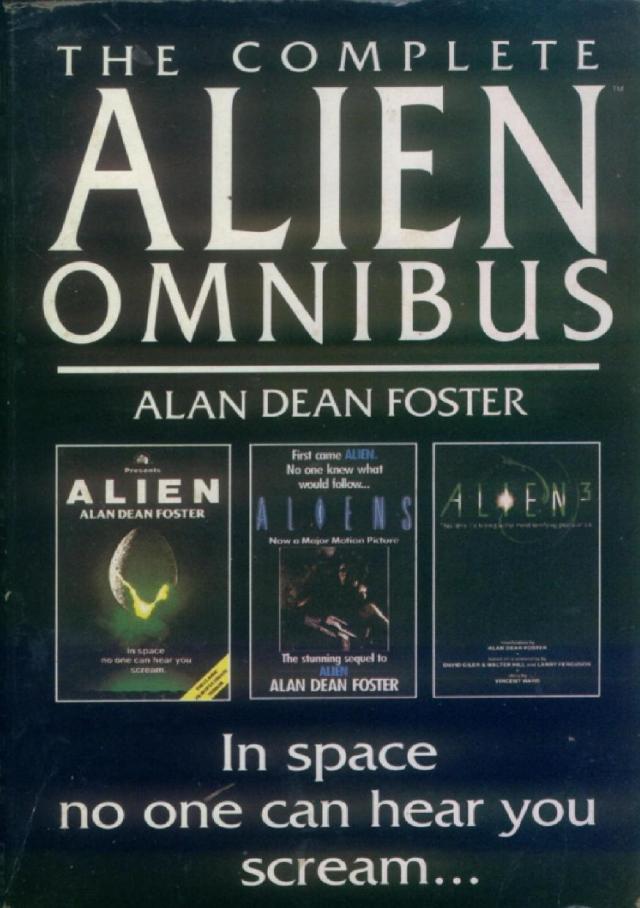


THE COMPLETE ALIEN OMNIBUS
ALIEN
Novelization by Alan Dean Foster
Screenplay by Dan O’Bannon
Story by Dan O’Bannon and Ronald Shushet
ALIENS
Novelization by Alan Dean Foster
Based on the screenplay by James Cameron
ALIEN3
Novelization by Alan Dean Foster
Based on a screenplay by David Giler
& Walter Hill and Larry Ferguson
Story by Vincent Ward
TM & © 1993 Twentieth Century Fox
Film Corporation
A Warner Book
Alien first published in Great Britain in 1979 by Futura Publication
TM & © 1979 by Twentieth Century Fox Film Corporation
Aliens first published in 1986 by Futura Publications
TM & © 1986 by Twentieth Century Fox Film Corporation
Alien3 first published in Great Britain in 1992 by Warner Books,
by arrangement with Warner Books, Inc, New York
TM & © 1992 by Twentieth Century Fox Film Corporation
This omnibus edition published by Warner Books 1993
by arrangement with Warner Books, Inc, New York
Reprinted 1993, 1994 (twice), 1995, 1996
TM & © 1993 by Twentieth Century Fox Film Corporation
All characters in this publication are fictitious
and any resemblance to real persons, living or dead,
is purely coincidental.
All rights reserved.
No part of this publication may be reproduced,
stored in a retrieval system, or transmitted, in any
form or by any means, without the prior
permission in writing of the publisher, nor be
otherwise circulated in any form of binding or
cover other than that in which it is published
and without a similar condition including this
condition being imposed on the subsequent purchaser
ISBN 0 7515 0667 2
Photoset in North Wales by
Derek Doyle & Associates, Mold, Clwyd
Printed in England by Clays Ltd, St Ives plc
Warner Books
A Division of
Little, Brown and Company (UK)
Brettensham House
Lancaster Place
London WC2E 7EN
ebook by tardismatrix
ALIEN
by
Alan Dean Foster
Screenplay by Dan O’Bannon
Story by Dan O’Bannon and
Ronald Shusett
For Jim McQuade
A good friend and fellow explorer
of extreme possibilities . . .
I
Seven dreamers.
You must understand that they were not professional
dreamers. Professional dreamers are highly paid, respected,
much sought-after talents. Like the majority of us, these seven
dreamt without effort or discipline. Dreaming professionally,
so that one’s dreams can be recorded and played back for the
entertainment of others, is a much more demanding
proposition. It requires the ability to regulate semiconscious
creative impulses and to stratify imagination, an extra-
ordinarily, difficult combination to achieve. A professional
dreamer is simultaneously the most organized of all artists and
the most spontaneous. A subtle weaver of speculation, not
straightforward and clumsy like you or I. Or these certain
seven sleepers.
Of them all, Ripley came closest to possessing that special
potential. She had a little ingrained dream talent and more
flexibility of imagination than her companions. But she lacked
real inspiration and the powerful maturity of thought
characteristic of the prodreamer.
She was very good at organizing stores and cargo, at
pigeonholing carton A in storage chamber B or matching up
manifests. It was in the warehouse of the mind that her filing
system went awry. Hopes and fears, speculations and half
creations slipped haphazardly from compartment to com-
partment.
Warrant officer Ripley needed more self-control. The raw,
rococo thoughts lay waiting to be tapped, just below the surface
of realization. A little more effort, a greater intensity of
self-recognition and she would have made a pretty good
prodreamer. Or so she occasionally thought.
Captain Dallas now, he appeared lazy while being the best
organized of all. Nor was he lacking in imagination. His beard
was proof of that. Nobody took a beard into the freezers.
Nobody except Dallas. It was a part of his personality, he’d
explained to more than one curious shipmate. He’d no more
part with the antique facial fuzz than he would with any other
part of his anatomy. Captain of two ships Dallas was: the
interstellar tug Nostromo, and his body. Both would remain
intact in dreaming as well as when awake.
So he had the regulatory capability, and a modicum of
imagination. But a professional dreamer requires a deal more
than a modicum of the last, and that’s a deficiency that can’t be
compensated for by a disproportionate quantity of the first.
Dallas was no more realistic prodreamer material than Ripley.
Kane was less controlled in thought and action than was
Dallas, and possessed far less imagination. He was a good
executive officer. Never would he be a captain. That requires a
certain drive coupled with the ability to command others,
neither of which Kane had been blessed with. His dreams were
translucent, formless shadows compared to those of Dallas,
just as Kane was a thinner, less vibrant echo of the captain.
That did not make him less likable. But prodreaming requires a
certain extra energy, and Kane had barely enough for
day-to-day living.
Parker’s dreams were not offensive, but they were less
pastoral than Kane’s. There was little imagination in them at
all. They were too specialized, and dealt only rarely with
human things. One could expect nothing else from a ship’s
engineer.
Direct they were, and occasionally ugly. In wakefulness this
deeply buried offal rarely showed itself, when the engineer
became irritated or angry. Most of the ooze and contempt
fermenting at the bottom of his soul’s cistern were kept well
hidden. His shipmates never saw beyond the distilled Parker
floating on top, never had a glimpse of what was bubbling and
brewing deep inside.
Lambert was more the inspiration of dreamers than dreamer
herself. In hypersleep her restless musings were filled with
intersystem plottings and load factors canceled out by fuel
considerations. Occasionally imagination entered into such
dream structures, but never in a fashion fit to stir the blood of
others.
Parker and Brett often imagined their own systems
interplotting with hers. They considered the question of load
factors and spatial juxtapositions in a manner that would have
infuriated Lambert had she been aware of them. Such
unauthorized musings they kept to themselves, securely locked
in daydreams and nightdreams, lest they make her mad. It
would not do to upset Lambert. As the Nostromo’s navigator she
was the one primarily responsible for seeing them safely home,
and that was the most exciting and desirable cojoining any man
could imagine.
Brett was only listed as an engineering technician. That was a
fancy way of saying he was just as smart and knowledgeable as
Parker but lacked seniority. The two men formed an odd pair,
unequal and utterly different to outsiders. Yet they coexisted
and functioned together smoothly. In large part their success
as both friends and coworkers was due to Brett never intruding
on Parker’s mental ground. The tech was as solemn and
phlegmatic in outlook and speech as Parker was voluble and
volatile. Parker could rant for hours over the failure of a
microchip circuit, damning its ancestry back to the soil from which
its rare earth constituents were first mined. Brett would patiently
comment, ‘right.’
For Brett, that single word was much more than a mere
statement of opinion. It was an affirmation of self. For him,
silence was the cleanest form of communication. In loquacious-
ness lay insanity.
And then there was Ash. Ash was the science officer, but that
wasn’t what made his dreams so funny. Funny peculiar, not
funny ha-ha. His dreams were the most professionally
organized of all the
matching his awakened self. Ash’s dreams held absolutely no
delusions.
That wasn’t surprising if you really knew Ash. None of his
six crewmates did, though. Ash knew himself well. If asked, he
could have told you why he could never become a prodreamer.
None ever thought to ask, despite the fact that the science
officer clearly found pro dreaming more fascinating than any
of them.
Oh, and there was the cat. Name of Jones. A very ordinary
housecat, or, in this instance, shipcat. Jones was a large yellow
tom of uncertain parentage and independent mien, long accustomed
to the vagaries of ship travel and the idiosyncrasies
of humans who travelled through space. It too slept the cold
sleep, and dreamt simple dreams of warm, dark places and
gravity-bound mice.
Of all the dreamers on board he was the only contented one,
though he could not be called an innocent.
It was a shame none of them were qualified as pro dreamers,
since each had more time to dream in the course of their work
than any dozen professionals, despite the slowing of their
dream pace by the cold sleep. Necessity made dreaming their
principal avocation. A deep-space crew can’t do anything in the
freezers but sleep and dream. They might remain forever
amateurs, but they had long ago become very competent ones.
Seven of them there were. Seven quiet dreamers in search of
a nightmare.
While it possessed a consciousness of a sort, the Nostromo did not
dream. It did not need to, anymore than it needed the preserving
effect of the freezers. If it did dream, such musings
must have been brief and fleeting, since it never slept. It
worked, and maintained, and made certain its hibernating
human complement stayed always a step ahead of ever ready
death, which followed the cold sleep like a vast grey shark
behind a ship at sea.
Evidence of the Nostromo’s unceasing mechanical vigilance
was everywhere on the quiet ship, in soft hums and lights that
formed the breath of instrumental sentience. It permeated the
very fabric of the vessel, extended sensors to check every
circuit and strut. It had sensors outside too, monitoring the
pulse of the cosmos. Those sensors had fastened onto an
electromagnetic anomaly.
One portion of the Nostromo’s brain was particularly adept at
distilling sense out of anomalies. It had thoroughly chewed this
one up, found the flavor puzzling, examined the results of
analysis, and reached a decision. Slumbering instrumentalities
were activated, dormant circuits again regulated the flow of
electrons. In celebration of this decision, banks of brilliant
lights winked on, life signs of stirring mechanical breath.
A distinctive beeping sounded, though as yet there were only
artificial tympanums present to hear and acknowledge. It was a
sound not heard on the Nostromo for some time, and it signified
an infrequent happening.
Within this awakening bottle of clicks and flashes, of devices
conversing with each other, lay a special room. Within this
room of white metal lay seven cocoons of snow-coloured metal
and plastic.
A new noise filled this chamber, an explosive exhalation that
filled it with freshly
scrubbed, breathable atmosphere.
Mankind had willingly placed himself in this position, trusting
in little tin gods like the Nostromo to provide him with the
breath of life when he could not do so for himself.
Extensions of that half-sentient electronic being now tested
the newly exuded air and pronounced it satisfactory for
sustaining life in puny organics such as men. Additional lights
flared, more linkages closed. Without fanfare, the lids on the
seven chrysalises opened, and the caterpillar shapes within
began to emerge once more into the light.
Seen shorn of their dreams, the seven members of the
Nostromo’s crew were even less impressive than they’d been in
hypersleep. For one thing, they were dripping wet from the
preservative cryosleep fluid that had filled and surrounded
their bodies. However analeptic, slime of any sort is not
becoming.
For another, they were naked, and the liquid was a poor
substitute for the slimming and shaping effects of the artificial
skins called clothes.
‘Jesus,’ muttered Lambert, disgustedly wiping fluid from her
shoulders and sides, ‘am I cold!’ She stepped out of the coffin
that preserved life instead of death, began fumbling in a
nearby compartment. Using the towel she found there, she
commenced wiping the transparent syrup from her legs.
‘Why the hell can’t Mother warm the ship before breaking us
out of storage?’ She was working on her feet now, trying to
remember where she’d dumped her clothes.
‘You know why.’ Parker was too busy with his own sticky,
tired self to bother staring at the nude navigator. ‘Company
policy. Energy conservation, which translates as Company
cheap. Why waste excess power warming the freezer section
until the last possible second? Besides, it’s always cold coming
out of hypersleep. You know what the freezer takes your
internal temperature down to.’
‘Yeah, I know. But it’s still cold.’ She mumbled it, knowing
Parker was perfectly correct but resenting having to admit it.
She’d never cared much for the engineer.
Damn it, Mother, she thought, seeing the goosebumps on
her forearm, let’s have some heat!
Dallas was toweling himself off, dry-sponging away the last
of the cryosleep gunk, and trying not to stare at something the
others could not see. He’d noticed it even before rising from
his freezer. The ship had arranged it so that he would.
‘Work’ll warm us all up fast enough.’ Lambert muttered
something unintelligible. ‘Everybody to your stations. I assume
you all remember what you’re getting paid for. Besides
sleeping away your troubles.’
No one smiled or bothered to comment. Parker glanced
across to where his partner was sitting up in his freezer.
‘Morning. Still with us, Brett?’
‘Yo.’
‘Lucky us.’ That came from Ripley. She stretched, turning it
into a more aesthetic movement’ than any of the others. ‘Nice to
know our prime conversationalist is as garrulous as ever.’
Brett just smiled, said nothing. He was as verbal as the
machines he serviced, which was to say not at all, and it was a
running joke within the septuple crew family. They were
laughing with him at such times, not at him.
Dallas was doing side twists, elbows parallel to the floor,
hands together in front of his sternum. He fancied he could
hear his long-unused muscles squeak. The flashing yellow
light, eloquent as any voice, monopolized his thoughts. That
devilish little sunhued cyclops was the ship’s way of telling
them they’d been awakened for something other than the end
of their journey. He was already wondering why.
Ash sat up, looked around expressionlessly. For all the
animation in his face, he might as well still have been in
hypersleep. ‘I feel dead.’ He was watching Kane. The executive
officer was yawning, still not fully awake. It was Ash’s
professional opinion that the exec actually enjoyed hypersleep
and would spend his whole life as £narcoleptic if so permitted.
Unaware of the science officers opinion, Parker glanced
over at him, spoke pleasantly. ‘You look dead.’ He was aware


