

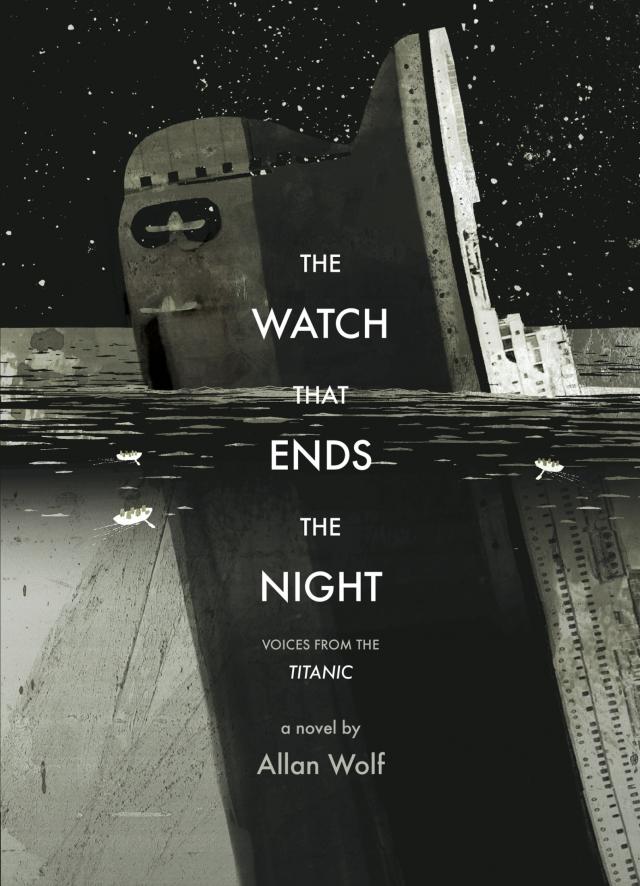
The Watch That Ends the Night, page 1


Praise for
THE WATCH THAT ENDS THE NIGHT
VOICES FROM THE TITANIC
A Claudia Lewis Award Winner
An American Library Association Best Fiction for Young Adults Selection
A Booklist Editors’ Choice
“Allan Wolf has imagined his way deep into the cold, dark waters of history and has come back carrying a couple of dozen voices that he discovered there, voices whose authenticity is not only convincing but compelling.” — Ted Kooser, former U.S. Poet Laureate and winner of the Pulitzer Prize
“A remarkable accomplishment.”
— Helen Frost, author of Crossing Stones and Hidden
“Gives voice to more than just the human participants.”
— The Wall Street Journal
* “Wolf’s carefully crafted characters evolve as the voyage slides to its icy conclusion; readers may be surprised by the potency of the final impact.”
— Publishers Weekly (starred review)
* “A multi-octave chorus of voices that is alternately — sometimes simultaneously — spirited, angry, frightened, and mournful. . . . Wolf leaves no emotion unplumbed, no area of research uninvestigated, and his voices are so authentic they hurt.” — Booklist (starred review)
“Cadence and language gives the whole work epic scope.”
— School Library Journal
* “Wolf draws on a prodigious amount of research to fully realize each character; they are real people just telling their stories, all the more poignant because readers know their fates and recognize prophetic comments along the way. . . . A lyrical, monumental work of fact and imagination that reads like an oral history revved up by the drama of the event.”
— Kirkus Reviews (starred review)
Copyright © 2011 by Allan Wolf
All rights reserved. No part of this book may be reproduced, transmitted, or stored in an information retrieval system in any form or by any means, graphic, electronic, or mechanical, including photocopying, taping, and recording, without prior written permission from the publisher.
First electronic edition 2024
Candlewick Press
99 Dover Street
Somerville, Massachusetts 02144
visit us at www.candlewick.com
For Dale and Evelyn
CONTENTS
PRELUDE
PREPARING TO SAIL
FIRST WATCH
SETTING OUT
SECOND WATCH
ONE LAST PORT
THIRD WATCH
THE OPEN SEA
FOURTH WATCH
FRIVOLOUS AMUSEMENTS
FIFTH WATCH
TURNING THE CORNER
SIXTH WATCH
WHISKERS ON THE LIGHT
SEVENTH WATCH
THE WATCH THAT ENDS THE NIGHT
POSTLUDE
MORNING
NOTES
AUTHOR’S NOTE
THE MYSTERY SHIP
CHARACTER NOTES
MORSE CODE MESSAGES
MISCELLANY
BIBLIOGRAPHY
ACKNOWLEDGMENTS
THE VOICES
OLAUS ABELSETH
THE IMMIGRANT
THOMAS ANDREWS
THE SHIPBUILDER
JOHN JACOB ASTOR
THE MILLIONAIRE
JOSEPH BOXHALL
THE NAVIGATOR
GEORGE BRERETON
THE GAMBLER
HAROLD BRIDE
THE SPARK
MARGARET BROWN
THE SOCIALITE
HAROLD COTTAM
CARPATHIA’SWIRELESS MAN
EUGENE DALY
THE BAGPIPER
FREDERICK FLEET
THE LOOKOUT
FRANKIE GOLDSMITH
THE DRAGON HUNTER
THOMAS HART
THE STOKER
LOUIS HOFFMAN
THE TAILOR
JOHN “JOCK” HUME
THE SECOND VIOLIN
THE ICEBERG
BRUCE ISMAY
THE BUSINESSMAN
CHARLES JOUGHIN
THE BAKER
LOLO
THE TAILOR’S SON
HAROLD LOWE
THE JUNIOR OFFICER
ISAAC MAYNARD
THE ENTRéE COOK
JAMILA NICOLA-YARRED
THE REFUGEE
THE SHIP RAT
E.J. SMITH
THE CAPTAIN
JOHN SNOW
THE UNDERTAKER
OSCAR WOODY
THE POSTMAN
April 20, 1912
SATURDAY
Aboard the cable ship Mackay-Bennett
ATLANTIC OCEAN
THE GRAND BANKS
600 MILES FROM HALIFAX, NOVA SCOTIA
JOHN SNOW
THE UNDERTAKER
Embalmers don’t typically make house calls.
If not buried with a splash from their ship,
most casualties at sea are brought to me
at the family parlor on Argyle Street.
In Halifax the water is unavoidable as death.
And death is unavoidable as the water.
Raised as I was in a Halifax funeral home,
you might guess I’d grow up to accept them both.
But I find the dead preferable to the sea.
The dead are more predictable.
To ease my queasy stomach,
I am lying down atop the empty coffins
stacked neatly across the Mackay-Bennett ’s decks.
Waves toss our small vessel as if it were a toy.
The journey has been cold and slow,
three days’ steaming with half a day to go.
As night falls, Captain Larnder informs me,
“We should be among the wreckage soon —
better sleep now, while you still can, Mr. Snow.
The sun will be up soon enough.”
Yes, I think. The sun will always come up.
Even after the entire ship of humanity
has struck its berg and sunk,
the sun will rise.
“Good night, Captain Larnder,” I say.
“Good night, sir. Rest well,” he replies.
Later that night, in my berth below,
I hear the ship’s engines finally quit.
Silence fills the dark, and I know
we have reached the spot where the Titanic foundered.
They are out there in the water. The bodies. Among the debris.
My name is John Snow.
You could say that my living is death.
I am the undertaker.
I have come for the bodies.
PRELUDE
PREPARING TO SAIL
MONDAY, APRIL 1, TO TUESDAY, APRIL 9, 1912
THE SHIP RAT
follow the food
follow the rats
scuttle, scuttle
follow the rats
scuttle, scuttle
follow the food
BRUCE ISMAY THE BUSINESSMAN
From all over Europe people are clamoring to buy tickets.
The titled aristocrat and the anonymous clerk.
The well-bred Brit with his old money,
the boorish American with his new money,
and the enthusiastic emigrant with little money at all.
Over dinner not so many years back,
my associate, Lord Pirrie, and I conceived
of a fleet of three immense sister ships
the like of which the world had never seen.
These ships would be larger than any other.
The interior decor would be, in a word, palatial,
thus attracting the most wealthy first-class passengers.
And to attract those with lesser means,
White Star Line’s second-class accommodation
would rival the Cunard Line’s first class.
Likewise our third class would be much nicer
(and more costly) than the norm.
This last detail is important.
While first class gives a ship prestige,
third class is an ocean liner’s bread and butter.
If the lower classes are so hell-bent on leaving the continent,
the White Star Line will be there to welcome them aboard —
for a price.
The millionaire thinks Titanic is a ship of pleasure.
The emigrant thinks Titanic is a ship of dreams.
But they are both wrong. For Titanic is not a ship at all.
Titanic is just good business. Very good business.
E.J. SMITH THE CAPTAIN
Whenever two words will do,
Mr. Ismay is certain to use ten.
I’m not necessarily a man of few words,
but to sum up Titanic I need just one:
big.
Ismay speaks of Titanic’s luxury:
her elegant lines, like a yacht for the gods;
her lush appointments; her state-of-the-art mechanics;
her ingenious safety features. Ismay and White Star
cut no costs to build her, I assure you of that.
But in matters of handling, she is mostly just big.
And my plan is to pilot her as I would any other big ship.
I will go as fast as I can and as straight as I can,
from one point to the next until we see New York Harbor.
THOMAS ANDREWS THE SHIPBUILDER
It seemed like a dream: the n
forever associated with Titanic!
Even as a young boy, I loved ships.
Lucky for me, my uncle William,
the great Lord Pirrie, was chairman of Harland and Wolff.
Naturally I visited the shipyard often,
and eventually I found work there.
But not as some high-ranking executive.
Uncle would not have that. No. At sixteen,
I began the five-year apprenticeship that would seal my fate.
It meant spending less time tending my bees,
but with my admittance into this shipbuilders’ hive,
everything else was of secondary importance.
No job was too small or menial
that I did not work at it for weeks, or months if necessary:
heater boy, riveter, catcher, holder-upper, and carpenter.
I learned from the joiners and cabinetmakers,
the shipwrights, the painters, the fitters, and smiths.
Belowdecks I watched the workings
of the stoker, the greaser, the trimmer.
Above I watched the workings
of the baker, the waiter, the steward.
My longest training came in the drafting department,
learning machine and freehand drawing, applied mechanics,
and the theories of naval architecture.
I adopted and improved upon my uncle’s designs.
And eventually the Titanic project was given to me.
I feel as though I built her with my own two hands.
And like her loyal minion, I will tend to her needs,
no matter the cost, whatever the tide.
THE ICEBERG
I am the ice. I see tides ebb and flow.
I’ve watched civilizations come and go,
give birth, destroy, restore, be gone, begin.
My blink of an eye is humankind’s tortoise slow.
Today’s now is tomorrow’s way back when.
Bright Arctic night gives way to coal-black morn.
Tall masts and canvas sails give way to steam.
One iceberg melts away. Another’s born.
I am the sum of all that I have seen.
I am the ice. I know the ebb and flow.
Ten thousand years ago, I fell as snow,
and as I fell, my bulk began to grow,
and as I grew, I watched as worlds arose.
The caveman’s spear, the woolly mammoth tusk,
arose and clashed and then returned to dust.
I am the ice. I’ve seen the ebb and flow.
I watched as Abraham and Moses spoke.
I watched the prophets met with wine or stone.
I watched as Christ was nailed upon the cross.
I watched Muhammad forced to flee his home.
I’ve watched the holy battle to and fro.
I am the ice. I’ve seen the ebb and flow.
Conceived by water, temperature, and time,
gestating within Greenland’s glacial womb,
I carved out massive valleys as I moved.
At last the frozen river made its way
and calved me with a splash in Baffin Bay.
Since then I’ve traveled southward many weeks,
for now that my emergence is complete,
there is a certain ship I long to meet.
OLAUS ABELSETH THE IMMIGRANT
Miss Marie Stene
Ørskog P.O.
via Ålesund, Norway
1 April 1912
Monday
My dearest Marie,
I cannot bear the thought of returning to North Dakota without you. I know that you do not trust steamships. But will you trust me?
Yours very truly,
Olaus
JAMILA NICOLA-YARRED THE REFUGEE
The day my father sold his beloved mill,
I knew we would be leaving Lebanon for good.
I finished packing my suitcase
only to discover I could not lift it.
Father turned to look at me struggling —
his one eye infected, his other just tired.
“Whatever you pack, Jamila, you must carry yourself.
Remember, ‘ The one who takes the donkey up to the roof
should be the one who brings it down.’”
It was Father’s favorite proverb.
I am my father’s youngest girl of three.
My two sisters, my older brother, and my mother
had already relocated to a place in America.
A place called Jacksonville, Florida.
That left just Father and me and my little brother, Elias.
Now, finally, it was our turn to flee Hakoor
and the mill that my father had worked all his life.
Our turn to flee the Ottoman Turks, who have ruined everything.
Everyone here is out of work, Muslim and Christian alike.
And rather than helping us, as they should,
the Turkish soldiers make our hard times worse.
They enter any house they like, taking whatever they want.
The livestock, the food, and the grain are not safe.
The women — and the girls — are not safe.
So I packed my suitcase onto the handcart.
And under cover of darkness we slipped away from Hakoor.
Father breathed heavily. Elias hummed a tune.
I walked in silence beside the cart,
trying not to look over my shoulder
as we descended our much-loved mountains.
JOHN JACOB ASTOR THE MILLIONAIRE
Imagine, if you will, the richest woman in the world . . .
sitting upon a donkey.
I have the photo to prove it: See here?
That beauty atop the beast is my new wife, Madeleine.
And she’s laughing, there upon a humble donkey,
as the ancient Sphinx looks on.
Wouldn’t the papers love to get ahold of this photo?
We wished to linger longer in the Valley of the Kings,
but it just wasn’t meant to be. A private matter had come up.
I sent my manservant to arrange the steamer.
Tickets for myself, my servant, my Madeleine,
my Madeleine’s nurse, and, of course, my dog:
he’s a rather large Airedale named Kitty.
A little joke there, you see. A dog named Kitty.
(Hem, hem.)
My man procured first-class accommodations for us
on what I was told is the most luxurious, well-appointed liner in the world.
The great Titanic! But I was a bit skeptical.
I’m something of a hotel man myself. (I own several.)
The name is Astor — John Jacob Astor the Fourth —
Colonel Astor. And they call me the richest man in the world.
That’s not all they call me, of course. . . .
They also call me spoiled. They call me idle.
They call me shallow and vain.
Then lecher began to appear on the menu.
And fornicator. And cradle robber.
Adulterer and blasphemer —
these latest monikers brought on in consequence
of my divorcing Ava Lowle Willing, that celebrated beauty.
Do not pity her. The feelings were mutual;
Ava Willing was all too willing to be done with me.
Well, the divorce caused shock enough in itself.
But when I married Madeleine within the year,
the outcry surprised even me.
You’d think I’d been found out as Jack the Ripper!
The churches cried out sacrilege. The papers cried out scandal.
I divorced a woman who despised me;
I married a woman who adored me.
Society calls that common? I call that common sense.
Somewhere between the Sphinx and the pyramids,
Madeleine discovered she was with child.
So naturally we were determined to return to New York,
and why shouldn’t we? I own half of it.
(Hem, hem.)
And what is more, New York is our home.
So let them ostracize us from their galas and teas.
I say make the most of your life while you can.
We may all of us be dead tomorrow.
Even the richest man in the world.
MARGARET BROWN THE SOCIALITE
Say what you will about John Jacob Astor, the man knows who he is —
even if the whole world thinks he’s someone else.
That’s how it is when you’re rich;
you’re fair game for every gossipmonger from Denver to Newport.
And believe me, I would know.
I can’t sneeze without reading about it in Town Topics.





