The Joy of Funerals, page 1


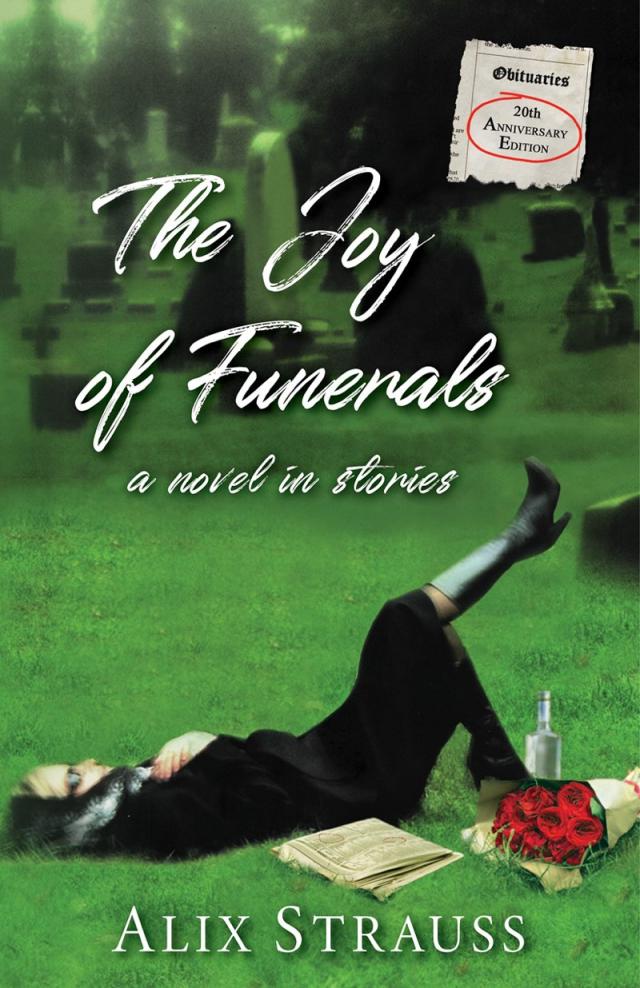
The Joy of Funerals
A Novel in Stories
Alix Strauss
The Joy of Funerals
Copyright © 2003 by Alix Strauss
All rights reserved. Printed in the United States of America. No part of this book may be used or reproduced in any manner whatsoever without written permission except in the case of brief quotations embodied in critical articles or reviews.
Palagram Press
New York, NY
bajekpublisherservices.com
Some of these stories first appeared in slightly different form in the following:
“Recovering Larry”: The Hampton Shorts Literary Journal
“Addressing the Dead”: The Idaho Review
“Swimming Without Annette”: Quality Women’s Fiction
“Shrinking Away”: The Jen Journal
Library of Congress Control Number 2023942494
Paperback ISBN: 979-8-9885000-1-8
ebook ISBN: 979-8-9885000-2-5
Originally published by St. Martin’s Press, 2003 and St. Martin’s Griffin, 2004
20th anniversary edition, Palagram Press, 2023.
Cover designed by Lily Tieu Phung Diep and Yvette Sin, WritersBlok
Author photo by Chris Callaway
Interior design by Liz Schreiter
For my grandmothers:
Pearl Wolfson Sugarman
1908-1981
Elizabeth Lyons Strauss
1904-1994
Women ahead of their time, taken too soon.
Contents
A Note from the Author
1. Recovering Larry
2. The Way You Left
3. Shrinking Away
4. Addressing the Dead
5. Post-Dated
6. Versions of You
7. Swimming Without Annette
8. Still Life
9. The Joy of Funerals
Acknowledgments
About the Author
A Note from the Author
In 2003, St. Martin’s Press released the first edition of The Joy of Funerals, which centers around Nina, a lonely, single, thirty-something Manhattanite who attends other people’s funerals. She goes in the hope of connecting with the mourners, to fill the deep emptiness created by the inability to connect with the people in her life. Along the way Nina meets eight other just as disconnected women at the funerals she attends, each who bring her closer to spiraling out of control. Stories and characters connect and overlap, while Nina’s quest to belong deepens.
When I first sat down to write this, I wanted to highlight how important and intense our need to connect with each other can be. I hoped to show the loneliness we can all feel as humans and the deep, innate and necessary desires we have for real relationships...and what can happen when those don’t exist.
In revisiting this work, the first time in 20-years, to prepare for its rerelease—or resurrection if you will, I was struck by how our need for true connections has only intensified. Many of us have been mentally, physically, and emotional starved for it—much like Nina, especially after a pandemic where we were forced into an unwanted lifestyle of solitude. Those lost years have only magnified our ache for organic, non-zooming, non-device driven, human-to-human interaction.
The Joy of Funerals originally started out as an essay for the “Lives” column in The New York Times Magazine regarding why I liked going to funerals—it’s because I’m an only child.
Actually, I am the only, only child. For as many generations as I can retrace, everyone in my family has had several children—except, of course, my parents, who decided to have just me.
Although each of my parents had a sibling, neither was especially close to them. Growing up, everyone’s family tree seemed like a strong, robust Oak; mine was more like a weeping willow, broken and hanging low. For me, there were no holiday dinners spent bonding over burned turkey and overcooked stuffing, no long-distance, late-night phone calls, no group vacations, no sharing of conquered milestones with family members. And so funerals became my only chance to bond with my relatives, many of whom I’d never met. Rather than a solemn event, I regarded them as reunions.
“Conversations pick up exactly where they left off years ago. And as we share stories of the recently deceased, a small puzzle piece slips quietly into place. It is this inner, imageless object I have been trying to complete for years. An empty space waiting to be filled with answers and acceptance. It is the “where do I belong?” and “where do I come from?” that is missing from my life. The longing for a connection to someone or something is a feeling I have never been able to let go of,” I wrote for the Times.
The novel was inspired by the essay and grew fictionally from there.
The Joy of Funerals was, and still is, an exploration of human behavior and longing. It’s about the great lengths we will go to get our needs met, and the isolation many of us encounter daily—regardless of being married, having children, dear friends and large families... For many of us we still feel misunderstood, left out, disconnected and unseen. And so here we are, two-decades later with a celebratory unveiling—a reintroduction to characters that still want to be heard, and still feel they have something to say.
Thank you for choosing to spend some time with these honest, raw, deeply wounded but amazingly strong women. I hope they speak to you. I hope they help fill up some of the emptiness you might be feeling, or at least let you know, you are indeed not alone.
xo,
Alix
The Lonely One offers his hand too quickly to whomever he encounters.
Friedrich Nietzsche
Recovering Larry
The scraping sound of the match and the crackling, toxic smell of plastic comfort me as I light the photo. Candles scent the air in the kitchen with lavender as I watch Larry’s beautiful face decompose and burn into tar, then turn to dark, powdery ash. Pictures of him are scattered on the Formica counter: Larry snorkeling on our honeymoon in Hawaii, Larry accepting an award, Larry in his college dorm. I breathe on the flame, encouraging it to seep through the glossy paper. Hot, red specks dance through gray sand, melting everything. I’m careful not to let any part of Larry fly away.
I collect the ashes from the fifteen photos with the precision of a surgeon, and scrape the thick, chalky powder into a pile. I then sprinkle my husband onto my bowl of cereal. It looks like charcoal confectioner’s sugar is smothering my Rice Krispies. I add 2% milk, stir, and eat. I start slowly, gathering wet clumps of Larry onto the spoon, bring it to my lips, open my mouth, and swallow. It tastes flaky and acidic. I don’t mind. I shove spoonful after spoonful into my mouth, metal clicking against teeth, unchewed food scraping against the back of my throat. I ingest him, feel him travel through my cells, nourishing them. I breathe for both of us. I lick the bowl clean, wash the remaining dishes and set them neatly in the holder by the sink.
Twenty minutes later, a retching nausea comes over me. I sit on the cold tile in my bathroom, my head against the ceramic bowl, refusing to spit him back out. I will not lose him twice. Saliva builds in my throat, bile in my stomach. My hands shake. I’m drenched with sweat. I try not to cry. I almost call out for him, half expecting to hear the clomping of his loafers against our wood floors, feel his hand around my forehead, another on my back.
Even though I’ve got to pee, I hold it in. I will not let one drop of him escape.
The nausea stops. All is calm. The buzzing in my head finally subsides. I dress in silence.
I met Samuel on Tuesday, Larry’s favorite day of the week.
We were both at the cemetery, and I caught him out of the corner of my eye, watched his body rock back and forth as he performed the Kaddish, then placed a rock by the freshly dug grave. Like Larry’s, there was no headstone yet. No identifying marks.
Before making a gesture of acknowledgment, I waited patiently for him to finish praying. I met his gaze, he gave me a small nod.
“Are you visiting your mother?” I asked, moving closer.
“My wife.”
We both looked in her direction, then to each other.
“You?”
“My husband,” I said.
“Oh.” His eyes avoided mine. “I’m sorry for your loss.” He kicked a stone with the tip of his black shoe. We watched it roll into the grass and stood there, silently waiting.
“Would you say a few words for me?” I asked, pointing to Larry’s grave, the soil still wet. “I don’t know any Hebrew prayers.” Jewish tradition states you must wait one year before the unveiling of a headstone. Larry was gone only three weeks. “I know my husband would appreciate it. He was more religious than I was.”
Samuel nodded and wiped a tear with the back of his hand. His face was kind. Lonely. I followed his rocking motion as he recited the prayer. Afterward, I reached for his hand, felt his skin, and thanked him. I had hoped to touch his prayer book, to run my fingers over the bumpy texture, even if just for a second.
Maybe then I could forget.
Later, we sat on a stone bench next to someone’s family plot. The Levines’. I wondered how they had died, and if they were watching as Samuel and I held hands.
He told me about his wife, how she had hemorrhaged while giving birth to their daughter.
It was mid-October. I was coatless and shivering. Samuel took off his jacket and draped it over my shoulders. As he did, l leaned in and kissed him. His lips were unfamiliar and smooth. Like soft butter, left out for baking. A wave of nausea crashed up against my throat. It pass
Samuel mumbled something in Hebrew as he buttoned his shirt, fingers trembling as he tucked it into his pants. He took his coat back from me, shook off the dirt, and walked away, head bent low, body hunched over. I brushed off small clumps of soil, pieces of shrub, and removed bits of dirt from my nails. I walked behind him, listening to the sound of crunching pebbles beneath our feet.
I sat in my car, shaking, smelling of someone else, as Samuel’s gray sedan pulled out of the cemetery.
At home, I listened to messages from friends whose husbands were still alive. I sifted through the mail, sorting it neatly into two piles: mine and his. Condolence notes towered over his measly stack of preapproved credit cards, offerings for car insurance, and a college reunion announcement. I added them to the other unopened letters piled neatly in a box by the window.
I watched leaves drop. I traced the initials on his date book and looked through his calendar, making notes of the engagements he wouldn’t be attending. I put on his stethoscope, felt the coolness of the metal against my chest, and listened. I wrote notes from him to me on his prescription pad.
I found Jacob paying respects to a grandfather he said he’d never met. “Every Sunday, we talk,” he told me. He wore a navy blue yarmulke with his name stitched in white letters. He told me he was a junior stockbroker and that his grandfather died in a fire while trying to get across the German border when Hitler was in power. Jacob’s father had the body transported to this cemetery thirty years ago. He showed me a photo of his grandparents: a black-and-white square with two smiling people seated on a horse. Then he added that neither he nor his father would ever buy German-made products.
It was easy with Jacob. All I needed to do was lick my lips, play with my hair a little, ask a few breathy questions in his ear.
I led him by the cuff of his monogrammed Oxford shirt to the back section of the cemetery near the old gravestones. We passed by rows and rows of tombstones, a sea of fading grays and tans, breaking apart and chipping. The grass was brown, the trees thin and barren.
While he undid his pants, my eyes focused on the headstone with a red sticker slapped on it. It stood out like a tattooed number. The name was partially covered by dead vines as if they were protecting the owner. All that was visible was … ose … erished mother … ghter and wife. No date. I tried to solve the puzzle as Jacob fiddled with the condom I’d brought.
Sex with Jacob was hurried and sloppy, and I wondered if I was his first. He looked about twenty, and wore a grin the entire time as he shouted, “I can’t believe this. I can’t believe this,” over and over. In the background I visualized him in a fraternity house, his brothers cheering him on to fuck the lovely lady. Go, Jacob. Go, Jacob. Go, go, their arms pounding the air, hands clenched into fists.
The sound of the train roared above our heads and collided with the chirping of birds and Jacob’s panting. For a moment, I thought my head would explode from the noise.
When it was over, his face was flushed, his eyes glassy. His yarmulke had fallen off, and I tucked it into my pocket before he could notice.
Afterward, Jacob thanked me profusely, extending his hand to help me up as I ran my fingers over the tight stitching. He wouldn’t think to check until he got home, maybe before stepping into the shower or at bedtime as he routinely reached up to unclip it. He would panic for a moment, and then he’d remember and think it a small sacrifice for what I had given him. In return, I would become the story he’d tell at bars, to his friends on the floor, or to impress girls.
He walked me to my car and asked if he could see me again.
“I’m married,” I told him. “Sorry,” and slammed the door.
Jacob stood by my car, waiting for me to change my mind, roll down the window, and give him my number.
I started the car and when I looked up at him, his face had crumbled to disappointment, his eyes had lost their glow. From my rearview mirror he looked like Larry did in college. Boyish and eager, dark hair tousled, his once-crisp shirt disheveled.
We met during my sophomore year at Michigan State at a Halloween party. Larry was dressed as a Rorschach test, his head poking through a white sheet smattered with black paint. He was tall with thick, wavy hair. He wore brown wire-rimmed glasses, and had a smart look about him.
Entry was free if you came dressed in a costume in keeping with your major. I had been studying the role of women in TV as part of my communications degree, and had dressed up like a cop. An ode to Cagney & Lacey.
“Tell me what you see,” Larry said, as he spread his arms out from his sides.
“Psychiatry major?” I asked, slightly tipsy from the punch.
Larry smiled. “Premed. Cardiology.”
“Shouldn’t you be dressed as a heart?”
“I won’t tell if you don’t.”
We smiled.
“You’re taking criminal law?”
I shook my head. “‘Women in TV’ class.”
“God, are we desperate to save ten bucks or what?” I watched him take a swig from his plastic cup as he surveyed the room of costumed students. “So, what do you see?” he repeated, still grinning.
“I see you asking for my number.”
When Larry would pick me up for a date, I’d get so excited, I’d run around my apartment, hands shaking, spewing nonsense to my roommates. Very often they’d have to put lipstick and mascara on for me while I sat on my hands and tried to calm down.
When the police came to my door last month, I thought perhaps Larry was pulling a prank. Our fifth anniversary was at the end of September, just two days away. I expected the cops to break into song, even cuff me and bring me to a romantic restaurant. I mentioned how similar their outfits were to the one I’d worn years ago as they told me about the accident. Larry’s car had collided with someone else’s, skidded off the road, and turned upside down. He died instantly, along with the others.
I almost showed them the photo of Larry and me at the party. They stood there, expressionless, asking if there was someone I wanted to call.
Roman was tall and broad, an unshaven immigrant from Yugoslavia. His hands were coarse and cold. He carried party-pink roses and wore a large cross around his neck. It dug into my chest as jagged twigs dug into my back. We kissed behind the mausoleum belonging to the Kesslers as he lifted my right leg up over his shoulder and slid his fingers deep inside me. He laid me down kindly on the ground, spread his large body over mine. His hands and arms were covered with long, black hair. His body was heavier than Larry’s. I hadn’t calculated on the additional weight. He felt thick, like peanut butter stuck to the top of my mouth. Every now and then my head bumped up against the smooth granite of the polished wall. I looked into his eyes, searching for recognition. Looked for traces of Larry. All I saw was a stranger in his forties, face pained, eyes glassy. He had deep lines between his brows as if he spent his whole day thinking. He smelled of day-old fish.
This was the second time I had seen him here. The first time was a week after Larry’s funeral. We had talked for a few minutes. His breathing was hurried, as if he had been running, and he swallowed the last words to each sentence, gulped them down as if someone else was listening.
We lay quietly in the grass. I rested my head on his stomach and watched the tips of houses appear and disappear behind the gate. I thought about how the color of the trees had changed from a bright plaid of yellow, red, and green to muted brown. As I copied Roman’s breathing, I wondered who would choose to live so close to a cemetery—and if there were any vacancies.