

Trashlands, page 29


The Walmart lot became a community, a camp, the first one where Mr. Fall would live. When the weather turned cold, some people began to build permanent structures out of wood they had found. It was flood wood. Swollen and warped, it would not hold, but the people did not know that.
This was before we knew about building with plastic, Mr. Fall would say when he told this story to children.
He was a teenager when his father died. From what, he would never know. Something that had no name, no diagnosis, and probably a simple enough cure: antibiotics, or oxygen, or even just rest. It was a fever illness, and it came on fast. His father was buried in the fields beyond the AutoZone. Then Mr. Fall had no one. He packed everything he or his father owned worth packing and strapped the bag to his back. He took the first ride out he could get, just people going elsewhere. Anywhere would do.
It was an easy decision to go. Moving, not thinking. He would never come back.
It would be hard to write that down, to help the people of the future—if there was some future where strangers would find this book, where they would want to read it—understand. Letting go—that was how you lived. Holding on too hard, too long, could end you, sure as an animal stuck in mud.
Later, he heard that people in the camp had overrun the Walmart. They had broken through the glass doors with homemade battering rams, taken cough syrup and canned food, what vegetables still arrived at the store: wilted, pale, and sandy. They took flats of bottled water held aloft on their heads. They were starving. Salvation seemed just below the glowing sign. Mr. Fall did not know if police came next with clubs and canisters of gas. If any of those men still had jobs, still served orders.
But he knew what had directed him to Trashlands, all these years ago: neon. The last sign of his father. The last light of family. Flickering, calling to him through the trees.
He steered the bus to it, the brightest light he had ever seen.
* * *
And yes, this neon, pink not white like the Walmart sign, had flickered on top of a building that ended up being a strip club. And yes, the light lit a junkyard with rats and bugs and a thousand dead cars. It was still a good place to stop.
Plastic stopped there, lapping at the banks of the river. They had been needed there, the work they all did: Mr. Fall’s teaching and Trillium’s tattoos. Coral had been important to the place—her friendship with the dancers, her kindness, her art. And Summer. Summer needed him. He needed her.
The light had been right. It had led him to love.
* * *
Summer wrapped cornmeal cakes in a plastic bag. She had been busy all morning, her movement in the kitchen waking Mr. Fall. The smell woke him too. The flour in oil, the sweetness of corn and the spiciness of insects. It had been dark when he stirred from the bed and moved to the counter to kiss her. Her outline looked purple and shadowy, and the hot plate, hooked up to a small solar panel, glowed.
“How long have you been up?”
“Awhile.” She lifted the meal cakes out of the oil with a spider strainer made from strips of woven water bottles. She had to work fast or the plastic would melt. Mr. Fall knew she worked to put her feelings somewhere, to put her sadness to use, getting things done. “He’s leaving today too.” She nodded at the screen door.
She had started a fire in the barrel outside, and a man sat before it.
Miami stared into the flames. He wasn’t wearing his glasses, and without them, Mr. Fall could see the bags beneath his eyes, the weary skin that aged him or indicated he too had suffered. Sleepless nights, nightmares, despite his apartment in the city, despite his job.
“He wants to get an early start,” Summer said.
“Does Coral know he’s leaving?”
She looked at Mr. Fall. The heat from cooking had stuck her bangs to her skin. He wanted to sweep the hair away and kiss her forehead. He wanted to go back to bed. He wanted to keep them all home and safe.
She said, “You’re going to have to tell her.”
* * *
There were no right times. There was only this time: Trillium was inspecting the tires around the back of the bus with Tahiti. The bodyguard had picked up eyeglasses from somewhere and was marveling at the details, finally able to see them. Foxglove, who had gotten up too early and kept complaining about it, nursed a mug of Kentucky coffeetree pods. Coral took the cakes Summer gave her and put them in her backpack. She looked up and saw Mr. Fall.
“The reporter’s gone,” Mr. Fall said. He needed to tell her before he said anything else, all the speeches he had prepared to say. “Miami. He left this morning, early. He wanted me to tell you—”
“He doesn’t need to,” Coral said. “I know.”
Mr. Fall looked at her, this person he had raised. He had taught her to read, to fish for plastic in the river, to light and bank a fire, to watch her back. But somehow she had learned other things too. How to love, even when there wasn’t much hope. How to see art in the plastic the dead had pitched into the river. How to see a thing as another thing: its potential, its new beginning as well as its end.
He remembered finding her in a Dairy Queen. So much of what he remembered was gone. So much seemed like it was never meant to be. Beautiful dreams that were never really beautiful, he would tell the children.
He never told Coral that she couldn’t have been in the building while it burned. She couldn’t have survived without a mark on her. Her baby hair, sparse as it was, didn’t even smell of smoke. No. She had been left there after the fire had cooled. Maybe her parents had started the fire or flocked to it, knowing the smoke would draw someone wanting to help—or more likely, someone hoping to find some salvage. Instead they found Coral, her hair the brightest thing for miles, so red it was almost electric.
Maybe it was all just too much. Maybe her mother had seen a decent enough spot and just let her baby go, swaddled in a fleece blanket with a card that bore her name sign.
In a way, he thought as he looked around the junkyard, Summer refilling Foxglove’s mug, Golden Toad clamoring on the big bus tires—he would have to shoo the child out of there—they were all abandoned. By their families, by their homes, by the way they had lived before.
Coral was looking at him. The sun rose higher in the sky, and with it he felt she was aging, gaining lines on her forehead, white through her hair. Maybe it was the harsh light, or leaving that made her seem wise. Not a child anymore.
“Do with your life what you wish now,” he told her. Part of the speech he had practiced. It had sounded different, in his head.
“I can’t do that.”
“As much as you can then, do it. Beyond surviving, what does it matter, Coral? Marriage, a job—you’re not bound by those things. They’ve never pushed down on you the way just living has. Be what you want,” he told her.
She tightened the straps of her pack. She had something clutched in one of her hands, a bit of paper. He couldn’t quite see what was written on it, but he thought...was it a bus ticket? How had she gotten that? He wanted to ask her about it.
He wanted to say, Go after Miami, if you want to.
He wanted to say, Go on your own.
There was no time. She tucked the paper away. “Thanks for teaching me, Dad.”
Summer said, “She’s gotta go, love.”
The others had already said their goodbyes. Trillium moved to get on the bus. Mr. Fall shook his hand, then embraced him. Both men felt thin to the other.
Golden Toad climbed onto Tahiti’s shoulders. Mr. Fall stooped to hug Coral one last time. She would never grow taller, she was too old. Whether this had been the height of her genes, her biological parents, or the result of malnutrition, exhaustion—his fault, he felt—he would never know.
Coral broke from the hug first. “Look out for my work.”
“I always will,” Mr. Fall said.
“Teach JT to read.”
“Good fucking luck with that,” Foxglove said.
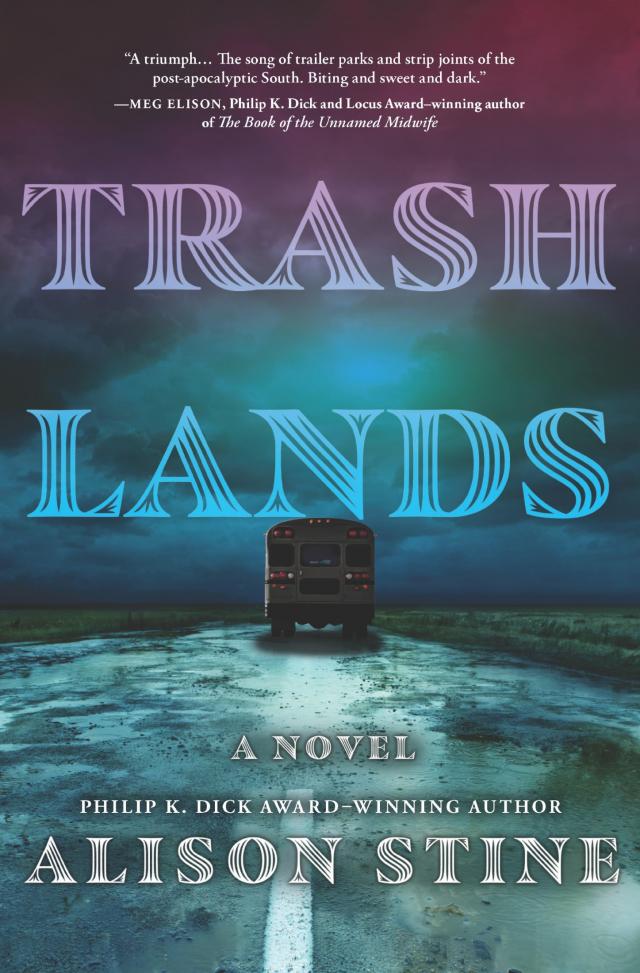
And that was it. Coral boarded the bus. Trillium closed the doors. The rubber pads made their familiar, soft sigh. Summer took Mr. Fall’s arm and they stepped back. Foxglove was waving, her hand in a fingerless, knitted plastic glove. Through the big front window, Mr. Fall could see Coral standing behind Trillium in the driver’s seat.
She should sit down. She should use the seat belt still attached, the buckle half-rusted to the one bench. He had taught Trillium to drive years ago and the man was careful, but the road would be bumpy. They would have to dodge fallen trees and cars and who knew what else—people probably. It was not Mr. Fall’s place to tell her these things. But still, he wanted to shout at the windshield. Drive safe!
Coral waved.
The bus backed up. One of its taillights still worked. The bus still made the beep beep sound. It would wake the others in the junkyard, alerting them, if they did not know already: Trillium and Coral were leaving.
Mr. Fall’s daughter, the artist, the girl who walked inside a whale, was going away.
Trillium honked the horn once, a stiff sound, creaky with disuse. Then the bus rattled down the hill, the last rainbow.
36
TRASHLANDS
Scrappalachia (OH)—Few outsiders have seen the hills of Scrappalachia. Those who live here were born here. They will likely die here, among the mountains, the bones of shacks, and the trees still standing. Most of the people in Scrappalachia work as scavengers. They have a name for the work they do, those who call this wild and winding place home, the work that has become their life, their children’s life, and their survival: plucking, so called because they “pluck plastic from the water,” according to Coral, a thirty-something woman who lives and works in a junkyard in what used to be southeastern Ohio.
Pluckers follow the “plastic tide,” as Coral called it in an interview. It is a transient life, with most working in crews or family units who travel together to two camps in the course of a year: a camp for warm weather and a camp for colder temperatures. They move to more hospitable ground as the weather changes, but also, they must go where the plastic is.
Tides move plastic, though floods can bring more or less to an area unexpectedly. Wildfires and earthquakes can destroy or scatter the contents of factories, trains, even small cities on the outskirts of the region.
Since the United Nations World Plastic Act, no new plastic has been made (legally), and all plastic objects must come from recycled sources. Pluckers provide this material, doing the difficult, often dangerous work of reclaiming plastic from the wild. There is plenty.
“I imagine we’ll be here forever,” Coral said one morning as she pulled plastic from the river historically called the Hocking, near her home.
Pluckers like Coral wade up to their waists in water that is often foul, discolored with toxic chemicals or runoff, or diseased. It is undrinkable. It is not unusual for pluckers to see dead animals or human corpses.
There are no showers or sanitation facilities at the camp where Coral lives. There is no grocery or medical facility. There is a school in a tent, an unlicensed midwife who does much of the doctoring for the residents, and a club.
A strip club called Trashlands.
Once plastic is retrieved, pluckers weigh it, and sell or barter it at open-air markets. There is no question: they are not getting a good deal. Plastic is still very much a buyer’s market, and those who salvage it can barely afford to live off what they make in trade.
Most of the pluckers at the Trashlands camp can read and write, thanks in no small part to a man called Mr. Fall, a former plucker and Coral’s father, who conducts lessons for the children of the camp. His only textbooks? An incomplete and badly damaged set of Encyclopedia Britannica, a reference book last in print in 2010, decades before the floods.
In many ways, Scrappalachia is repeating its past, when this region was called simply Appalachia. Back then, residents often worked manual labor jobs, in retail, in maintenance, and in the mines, which have mostly dried up.
Like the pluckers of today, miners worked long hours for meager wages, and, due to the remoteness of the region, were forced to spend much of their paycheck right back with their employers, purchasing food, clothing, and household goods at what was known as the company store.
The equivalent of the company store in the junkyard where Coral, Mr. Fall, and other pluckers live is Trashlands. It sells food, booze, and sex. An unlicensed, unregulated, and lawless place, formerly a theater, the club looms over the junkyard.
Most of the residents live in old cars. Music pumps from Trashlands constantly; the club never closes. The owner has managed to rig up old industrial air conditioners to solar panels and a generator, blasting cool air during the hottest times, which can get near tropical in the swampy, humid region.
Also connected to a generator is a giant pink sign on the roof of Trashlands, visible for miles, advertising the club—the first working neon this reporter has ever seen.
The sign, the music, and the club’s reputation seem to be working, bringing business into the area. The only strangers the junkyard ever sees are for the most part, men: here to lose a night or three at the club, to room in the lodgings upstairs, to spend plastic and possibly commission a tattoo of their name on the skin of one of the club’s more popular dancers, a young woman named Foxglove. [Foxglove refused to be interviewed on record for this story.]
If a strip club seems out of place for the region, you don’t know Scrappalachia.
Here, great beauty coexists with great pain, seemingly for millennia. The hills, mountains, trees, and cliffs of the region look majestic, yet are scarred with environmental and industrial devastation. Burned and demolished structures dot the landscape, much more so than in The Els, where buildings are quickly rebuilt to make the best use (and reuse) of precious land. In Scrappalachia, land goes to rot. People can too.
Summer, a woman in her forties who recently retired from dancing, described the junkyard as “a vortex. It sucks you in.” She said in an interview, “You get indebted, and it’s hard to get out.”
Dancers, like the miners before them, are expected to pay their employer for food, for costumes (if they don’t make the clothes themselves or barter from Summer, an accomplished seamstress) and for rent. Dancers, like the pluckers, live in abandoned vehicles or makeshift shacks rented to them by the owner of Trashlands, a man named Rattlesnake Master.
Rattlesnake Master owns the club, but he also claims to own the junk—a claim that seems dubious but also, in a place like Scrappalachia, difficult to challenge. And rent is steep.
“You don’t have anything left over at the end of your shift,” Summer said. “If you want to survive, you have to do other things.”
JT, the newest dancer at Trashlands, didn’t seem to mind. “I like the opportunity,” she said. “If I do more, I can make more. Back at the Strip, where I lived before, there wasn’t much. I was willing, but there wasn’t nobody to give me that chance to proof [sic] myself.”
In her limited free time, Coral, a single mother whose son was trafficked into plastic sorting labor several years ago, [see in a previous edition: “The Cost of Cheap Bricks? Children’s Lives”] makes art. She creates sculptures out of plastic too damaged or old to be recycled. One could imagine her pieces fetching a high price in The Els for those comfortable enough to collect art.
But in Scrappalachia, Coral gives her art away. She leaves it for strangers in the woods. She never goes back to see if her art has been appreciated, destroyed, or stolen. She’ll never know.
Though Coral does not like to talk about the art, she finally admitted, “It’s not about the money. It’s about doing something not connected to money. It’s not about surviving, I guess. It’s about living.”
It was startling for this reporter to find such inventiveness, artistry, and creativity in a place such as Scrappalachia. Though in The Els we have become accustomed to long lines for bread, in Scrappalachia, the people long ago learned to use insects for flour. Though El residents wait hours for our buses, which frequently break down, and we endure blackouts, brownouts, and long stretches without clean water, the residents of the junkyard have almost never known such luxuries. They’ve done more and they’ve done it with less.
We have dismissed—and this reporter includes himself—the people of this region as backward. We have assumed their ways to be strange and not our own. We have attributed one story to Scrappalachia: that of people left to sift through our trash, to make meager lives out of what we threw away.
But though there is one song at Trashlands, the same tuneless track played day and night at the club, there are many songs of the region.
The song of the child forced to grow up too soon. The song of the teacher who alters his whole life to save a stranger. The song of the mother who sacrifices for her son. And the song of this stranger, this outsider, forever changed.
[Ed Note: This piece was mailed in anonymously. Our longtime reporter is missing, presumed dead.]
37
Miami
In the darkness of the club, he’d found Coral. He had to fight his way through the curtain, ratty and stinking of mildew, that separated the club from the backstage, and there she was. Shivering in the costume she had pulled back up.
“Someone should get you a robe,” he said.
“Summer’s gone to get one.” Coral crossed her arms over her chest as if suddenly she realized he was there. “It was you, wasn’t it? You’re the man who bought out the show?”
“Yes.”
The thing about not wearing his glasses was that although he couldn’t see distances, he could see close-up even better, see to count her freckles, the heat that flashed across her cheeks. Her lips had been painted. Inky lines extended above and below her eyes, flicked on the tips. Up close, it looked garish. He could see she had a small scar on her temple.
This was before we knew about building with plastic, Mr. Fall would say when he told this story to children.
He was a teenager when his father died. From what, he would never know. Something that had no name, no diagnosis, and probably a simple enough cure: antibiotics, or oxygen, or even just rest. It was a fever illness, and it came on fast. His father was buried in the fields beyond the AutoZone. Then Mr. Fall had no one. He packed everything he or his father owned worth packing and strapped the bag to his back. He took the first ride out he could get, just people going elsewhere. Anywhere would do.
It was an easy decision to go. Moving, not thinking. He would never come back.
It would be hard to write that down, to help the people of the future—if there was some future where strangers would find this book, where they would want to read it—understand. Letting go—that was how you lived. Holding on too hard, too long, could end you, sure as an animal stuck in mud.
Later, he heard that people in the camp had overrun the Walmart. They had broken through the glass doors with homemade battering rams, taken cough syrup and canned food, what vegetables still arrived at the store: wilted, pale, and sandy. They took flats of bottled water held aloft on their heads. They were starving. Salvation seemed just below the glowing sign. Mr. Fall did not know if police came next with clubs and canisters of gas. If any of those men still had jobs, still served orders.
But he knew what had directed him to Trashlands, all these years ago: neon. The last sign of his father. The last light of family. Flickering, calling to him through the trees.
He steered the bus to it, the brightest light he had ever seen.
* * *
And yes, this neon, pink not white like the Walmart sign, had flickered on top of a building that ended up being a strip club. And yes, the light lit a junkyard with rats and bugs and a thousand dead cars. It was still a good place to stop.
Plastic stopped there, lapping at the banks of the river. They had been needed there, the work they all did: Mr. Fall’s teaching and Trillium’s tattoos. Coral had been important to the place—her friendship with the dancers, her kindness, her art. And Summer. Summer needed him. He needed her.
The light had been right. It had led him to love.
* * *
Summer wrapped cornmeal cakes in a plastic bag. She had been busy all morning, her movement in the kitchen waking Mr. Fall. The smell woke him too. The flour in oil, the sweetness of corn and the spiciness of insects. It had been dark when he stirred from the bed and moved to the counter to kiss her. Her outline looked purple and shadowy, and the hot plate, hooked up to a small solar panel, glowed.
“How long have you been up?”
“Awhile.” She lifted the meal cakes out of the oil with a spider strainer made from strips of woven water bottles. She had to work fast or the plastic would melt. Mr. Fall knew she worked to put her feelings somewhere, to put her sadness to use, getting things done. “He’s leaving today too.” She nodded at the screen door.
She had started a fire in the barrel outside, and a man sat before it.
Miami stared into the flames. He wasn’t wearing his glasses, and without them, Mr. Fall could see the bags beneath his eyes, the weary skin that aged him or indicated he too had suffered. Sleepless nights, nightmares, despite his apartment in the city, despite his job.
“He wants to get an early start,” Summer said.
“Does Coral know he’s leaving?”
She looked at Mr. Fall. The heat from cooking had stuck her bangs to her skin. He wanted to sweep the hair away and kiss her forehead. He wanted to go back to bed. He wanted to keep them all home and safe.
She said, “You’re going to have to tell her.”
* * *
There were no right times. There was only this time: Trillium was inspecting the tires around the back of the bus with Tahiti. The bodyguard had picked up eyeglasses from somewhere and was marveling at the details, finally able to see them. Foxglove, who had gotten up too early and kept complaining about it, nursed a mug of Kentucky coffeetree pods. Coral took the cakes Summer gave her and put them in her backpack. She looked up and saw Mr. Fall.
“The reporter’s gone,” Mr. Fall said. He needed to tell her before he said anything else, all the speeches he had prepared to say. “Miami. He left this morning, early. He wanted me to tell you—”
“He doesn’t need to,” Coral said. “I know.”
Mr. Fall looked at her, this person he had raised. He had taught her to read, to fish for plastic in the river, to light and bank a fire, to watch her back. But somehow she had learned other things too. How to love, even when there wasn’t much hope. How to see art in the plastic the dead had pitched into the river. How to see a thing as another thing: its potential, its new beginning as well as its end.
He remembered finding her in a Dairy Queen. So much of what he remembered was gone. So much seemed like it was never meant to be. Beautiful dreams that were never really beautiful, he would tell the children.
He never told Coral that she couldn’t have been in the building while it burned. She couldn’t have survived without a mark on her. Her baby hair, sparse as it was, didn’t even smell of smoke. No. She had been left there after the fire had cooled. Maybe her parents had started the fire or flocked to it, knowing the smoke would draw someone wanting to help—or more likely, someone hoping to find some salvage. Instead they found Coral, her hair the brightest thing for miles, so red it was almost electric.
Maybe it was all just too much. Maybe her mother had seen a decent enough spot and just let her baby go, swaddled in a fleece blanket with a card that bore her name sign.
In a way, he thought as he looked around the junkyard, Summer refilling Foxglove’s mug, Golden Toad clamoring on the big bus tires—he would have to shoo the child out of there—they were all abandoned. By their families, by their homes, by the way they had lived before.
Coral was looking at him. The sun rose higher in the sky, and with it he felt she was aging, gaining lines on her forehead, white through her hair. Maybe it was the harsh light, or leaving that made her seem wise. Not a child anymore.
“Do with your life what you wish now,” he told her. Part of the speech he had practiced. It had sounded different, in his head.
“I can’t do that.”
“As much as you can then, do it. Beyond surviving, what does it matter, Coral? Marriage, a job—you’re not bound by those things. They’ve never pushed down on you the way just living has. Be what you want,” he told her.
She tightened the straps of her pack. She had something clutched in one of her hands, a bit of paper. He couldn’t quite see what was written on it, but he thought...was it a bus ticket? How had she gotten that? He wanted to ask her about it.
He wanted to say, Go after Miami, if you want to.
He wanted to say, Go on your own.
There was no time. She tucked the paper away. “Thanks for teaching me, Dad.”
Summer said, “She’s gotta go, love.”
The others had already said their goodbyes. Trillium moved to get on the bus. Mr. Fall shook his hand, then embraced him. Both men felt thin to the other.
Golden Toad climbed onto Tahiti’s shoulders. Mr. Fall stooped to hug Coral one last time. She would never grow taller, she was too old. Whether this had been the height of her genes, her biological parents, or the result of malnutrition, exhaustion—his fault, he felt—he would never know.
Coral broke from the hug first. “Look out for my work.”
“I always will,” Mr. Fall said.
“Teach JT to read.”
“Good fucking luck with that,” Foxglove said.
And that was it. Coral boarded the bus. Trillium closed the doors. The rubber pads made their familiar, soft sigh. Summer took Mr. Fall’s arm and they stepped back. Foxglove was waving, her hand in a fingerless, knitted plastic glove. Through the big front window, Mr. Fall could see Coral standing behind Trillium in the driver’s seat.
She should sit down. She should use the seat belt still attached, the buckle half-rusted to the one bench. He had taught Trillium to drive years ago and the man was careful, but the road would be bumpy. They would have to dodge fallen trees and cars and who knew what else—people probably. It was not Mr. Fall’s place to tell her these things. But still, he wanted to shout at the windshield. Drive safe!
Coral waved.
The bus backed up. One of its taillights still worked. The bus still made the beep beep sound. It would wake the others in the junkyard, alerting them, if they did not know already: Trillium and Coral were leaving.
Mr. Fall’s daughter, the artist, the girl who walked inside a whale, was going away.
Trillium honked the horn once, a stiff sound, creaky with disuse. Then the bus rattled down the hill, the last rainbow.
36
TRASHLANDS
Scrappalachia (OH)—Few outsiders have seen the hills of Scrappalachia. Those who live here were born here. They will likely die here, among the mountains, the bones of shacks, and the trees still standing. Most of the people in Scrappalachia work as scavengers. They have a name for the work they do, those who call this wild and winding place home, the work that has become their life, their children’s life, and their survival: plucking, so called because they “pluck plastic from the water,” according to Coral, a thirty-something woman who lives and works in a junkyard in what used to be southeastern Ohio.
Pluckers follow the “plastic tide,” as Coral called it in an interview. It is a transient life, with most working in crews or family units who travel together to two camps in the course of a year: a camp for warm weather and a camp for colder temperatures. They move to more hospitable ground as the weather changes, but also, they must go where the plastic is.
Tides move plastic, though floods can bring more or less to an area unexpectedly. Wildfires and earthquakes can destroy or scatter the contents of factories, trains, even small cities on the outskirts of the region.
Since the United Nations World Plastic Act, no new plastic has been made (legally), and all plastic objects must come from recycled sources. Pluckers provide this material, doing the difficult, often dangerous work of reclaiming plastic from the wild. There is plenty.
“I imagine we’ll be here forever,” Coral said one morning as she pulled plastic from the river historically called the Hocking, near her home.
Pluckers like Coral wade up to their waists in water that is often foul, discolored with toxic chemicals or runoff, or diseased. It is undrinkable. It is not unusual for pluckers to see dead animals or human corpses.
There are no showers or sanitation facilities at the camp where Coral lives. There is no grocery or medical facility. There is a school in a tent, an unlicensed midwife who does much of the doctoring for the residents, and a club.
A strip club called Trashlands.
Once plastic is retrieved, pluckers weigh it, and sell or barter it at open-air markets. There is no question: they are not getting a good deal. Plastic is still very much a buyer’s market, and those who salvage it can barely afford to live off what they make in trade.
Most of the pluckers at the Trashlands camp can read and write, thanks in no small part to a man called Mr. Fall, a former plucker and Coral’s father, who conducts lessons for the children of the camp. His only textbooks? An incomplete and badly damaged set of Encyclopedia Britannica, a reference book last in print in 2010, decades before the floods.
In many ways, Scrappalachia is repeating its past, when this region was called simply Appalachia. Back then, residents often worked manual labor jobs, in retail, in maintenance, and in the mines, which have mostly dried up.
Like the pluckers of today, miners worked long hours for meager wages, and, due to the remoteness of the region, were forced to spend much of their paycheck right back with their employers, purchasing food, clothing, and household goods at what was known as the company store.
The equivalent of the company store in the junkyard where Coral, Mr. Fall, and other pluckers live is Trashlands. It sells food, booze, and sex. An unlicensed, unregulated, and lawless place, formerly a theater, the club looms over the junkyard.
Most of the residents live in old cars. Music pumps from Trashlands constantly; the club never closes. The owner has managed to rig up old industrial air conditioners to solar panels and a generator, blasting cool air during the hottest times, which can get near tropical in the swampy, humid region.
Also connected to a generator is a giant pink sign on the roof of Trashlands, visible for miles, advertising the club—the first working neon this reporter has ever seen.
The sign, the music, and the club’s reputation seem to be working, bringing business into the area. The only strangers the junkyard ever sees are for the most part, men: here to lose a night or three at the club, to room in the lodgings upstairs, to spend plastic and possibly commission a tattoo of their name on the skin of one of the club’s more popular dancers, a young woman named Foxglove. [Foxglove refused to be interviewed on record for this story.]
If a strip club seems out of place for the region, you don’t know Scrappalachia.
Here, great beauty coexists with great pain, seemingly for millennia. The hills, mountains, trees, and cliffs of the region look majestic, yet are scarred with environmental and industrial devastation. Burned and demolished structures dot the landscape, much more so than in The Els, where buildings are quickly rebuilt to make the best use (and reuse) of precious land. In Scrappalachia, land goes to rot. People can too.
Summer, a woman in her forties who recently retired from dancing, described the junkyard as “a vortex. It sucks you in.” She said in an interview, “You get indebted, and it’s hard to get out.”
Dancers, like the miners before them, are expected to pay their employer for food, for costumes (if they don’t make the clothes themselves or barter from Summer, an accomplished seamstress) and for rent. Dancers, like the pluckers, live in abandoned vehicles or makeshift shacks rented to them by the owner of Trashlands, a man named Rattlesnake Master.
Rattlesnake Master owns the club, but he also claims to own the junk—a claim that seems dubious but also, in a place like Scrappalachia, difficult to challenge. And rent is steep.
“You don’t have anything left over at the end of your shift,” Summer said. “If you want to survive, you have to do other things.”
JT, the newest dancer at Trashlands, didn’t seem to mind. “I like the opportunity,” she said. “If I do more, I can make more. Back at the Strip, where I lived before, there wasn’t much. I was willing, but there wasn’t nobody to give me that chance to proof [sic] myself.”
In her limited free time, Coral, a single mother whose son was trafficked into plastic sorting labor several years ago, [see in a previous edition: “The Cost of Cheap Bricks? Children’s Lives”] makes art. She creates sculptures out of plastic too damaged or old to be recycled. One could imagine her pieces fetching a high price in The Els for those comfortable enough to collect art.
But in Scrappalachia, Coral gives her art away. She leaves it for strangers in the woods. She never goes back to see if her art has been appreciated, destroyed, or stolen. She’ll never know.
Though Coral does not like to talk about the art, she finally admitted, “It’s not about the money. It’s about doing something not connected to money. It’s not about surviving, I guess. It’s about living.”
It was startling for this reporter to find such inventiveness, artistry, and creativity in a place such as Scrappalachia. Though in The Els we have become accustomed to long lines for bread, in Scrappalachia, the people long ago learned to use insects for flour. Though El residents wait hours for our buses, which frequently break down, and we endure blackouts, brownouts, and long stretches without clean water, the residents of the junkyard have almost never known such luxuries. They’ve done more and they’ve done it with less.
We have dismissed—and this reporter includes himself—the people of this region as backward. We have assumed their ways to be strange and not our own. We have attributed one story to Scrappalachia: that of people left to sift through our trash, to make meager lives out of what we threw away.
But though there is one song at Trashlands, the same tuneless track played day and night at the club, there are many songs of the region.
The song of the child forced to grow up too soon. The song of the teacher who alters his whole life to save a stranger. The song of the mother who sacrifices for her son. And the song of this stranger, this outsider, forever changed.
[Ed Note: This piece was mailed in anonymously. Our longtime reporter is missing, presumed dead.]
37
Miami
In the darkness of the club, he’d found Coral. He had to fight his way through the curtain, ratty and stinking of mildew, that separated the club from the backstage, and there she was. Shivering in the costume she had pulled back up.
“Someone should get you a robe,” he said.
“Summer’s gone to get one.” Coral crossed her arms over her chest as if suddenly she realized he was there. “It was you, wasn’t it? You’re the man who bought out the show?”
“Yes.”
The thing about not wearing his glasses was that although he couldn’t see distances, he could see close-up even better, see to count her freckles, the heat that flashed across her cheeks. Her lips had been painted. Inky lines extended above and below her eyes, flicked on the tips. Up close, it looked garish. He could see she had a small scar on her temple.


