

Barbara Isn't Dying, page 1


ALSO BY
ALINA BRONSKY
Broken Glass Park
The Hottest Dishes of the Tartar Cuisine
Just Call Me Superhero
Baba Dunja’s Last Love
My Grandmother’s Braid
Europa Editions
27 Union Square West, Suite 302
New York NY 10003
info@europaeditions.com
www.europaeditions.com
This book is a work of fiction. Any references to historical events, real people, or real locales are used fictitiously.
Copyright © 2021, Verlag Kiepenheuer & Witsch GmbH & Co. KG, Germany
First publication 2023 by Europa Editions
Translation by Tim Mohr
Original Title: Barbara stirbt nicht
Translation copyright © 2023 by Europa Editions
All rights reserved, including the right of reproduction in whole or in part in any form.
Alina Bronsky has asserted her right to be identified as Author of this work.
Art direction by Emanuele Ragnisco
instagram.com/emanueleragnisco
Cover design by Ginevra Rapisardi
Cover illustration © Rüdiger Trebels
ISBN 9781609458430
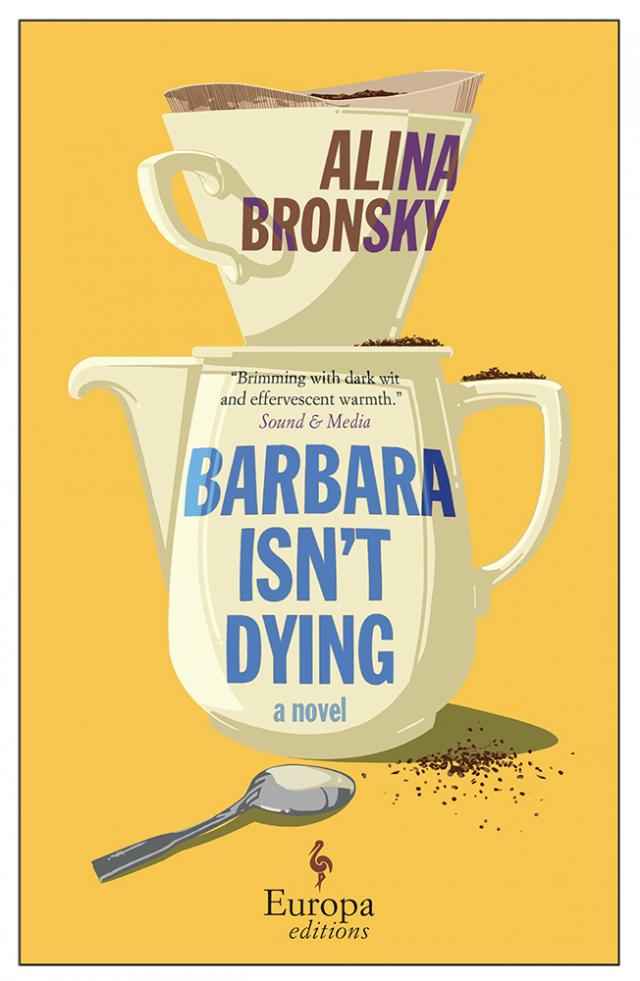
Alina Bronsky
BARBARA
ISN’T DYING
Translated from the German
by Tim Mohr
BARBARA
ISN’T DYING
When Herr Schmidt woke up early Friday and didn’t smell coffee, at first he thought Barbara might have died in her sleep. It was an absurd idea—Barbara was as healthy as a horse—though even more absurd was the possibility that she could have overslept. She never overslept. But when he turned over in bed and saw that the other half of the bed was empty, it seemed to him that the most likely explanation was that Barbara had keeled over dead on her way to the kitchen.
Herr Schmidt sat up and shoved his feet into his slippers. His nostrils flared longingly, missing the familiar aroma. Whatever happened to Barbara: if she had managed to put on the coffee beforehand, the scent would have wafted upstairs and reached the bedroom. Aromas can’t be contained. Herr Schmidt headed off, hoping his wife hadn’t fallen down the steps. Though presumably the noise would have awoken him. Or perhaps not: Barbara was a quiet woman, always had been.
He didn’t get far. An unfamiliar obstruction loomed before the half-open bathroom door. Herr Schmidt drew closer, recognized Barbara’s foot, and then the rest of her. She lay on the tile, looking at him out of one eye while the other slowly, and not completely, opened.
“Walter,” she said. “Give me your hand.”
Herr Schmidt leaned over her and tried to pull her up. Barbara groaned and pushed him away, which, given the demand to help her, seemed truly illogical. She turned onto her side, braced herself with her hands, and fought despairingly against gravity. Herr Schmidt grabbed her by her armpits and lifted her up. He threw one of her arms around his neck, walked her slowly back toward the bed step by step, and then hoisted her surprisingly heavy body onto the mattress. Her feet were still in her felt slippers, he removed them and placed them one next to the other on the bedside carpet.
“The coffee,” Barbara whispered.
“It’s fine,” said Herr Schmidt. “I don’t need it right this second.”
“But I do,” said Barbara.
This was surprising. Herr Schmidt went slowly down the stairs and looked around the kitchen. This was Barbara’s realm, the surfaces gleamed at him. For their golden anniversary he’d given her a kitchen renovation, a collective gift to make up for all the anniversaries and birthdays when he hadn’t given her anything, and for all the future ones when he also wouldn’t give her anything. The coffee machine stood next to the stove, the plug was removed from the wall for the dual purposes of safety and energy conservation.
Herr Schmidt plugged it back in. He tentatively opened a cabinet, and then the next one. He had never made coffee, something his daughter Karin and her best friend Mai laughed about during their visits.
“Papa, you really don’t know where the coffee is?”
“I don’t meddle in Barbara’s business just as she doesn’t meddle in mine.”
“And if she isn’t here? Or can’t do it?”
“Why wouldn’t she be here?”
“You can’t be serious, Papa. You don’t even know where the milk is.”
This, of course, was a ridiculous accusation. He knew milk belonged in the fridge, even if the bleached white garbage sold as milk these days could sit out in the sun for weeks without going bad. Real milk belonged in the fridge.
Herr Schmidt opened all the cabinets and then sat back down, looking from his chair at the cabinet on the left and then the one on the right: rice, oats, cream of wheat, polenta, what the hell was all of this stuff?
His next idea was to call Karin and ask her how to make coffee. As a woman she had to know that sort of thing. On the other hand, she would immediately suspect something was wrong. She’d ask questions and make a fuss. This in turn would displease Barbara, who surely didn’t want any excitement. Herr Schmidt closed his eyes, demoralized by his thirst for coffee.
Coffee was always ready when he entered the kitchen in the morning. The table was made, two plates, butter, a basket of rolls. He would sit down, Barbara would pour him a cup and add just the right amount of milk. He didn’t even know the exact ratio. When they went out to dinner, which they actually never did, she also put the cream in for him.
His gaze landed on the shelf of cookbooks. There were too many, nobody could possibly need all of them. German cuisine, another on German cuisine, French, Italian, vegetarian, baking with love, baking for Christmas, advanced breadmaking. Herr Schmidt leafed through a couple of them, no help at all.
Suddenly he had an inspired idea. The can of coffee jumped into his field of vision, he’d seen it a thousand times without realizing it. The coffee filters were right next to the can. Herr Schmidt put a filter in the plastic housing, filled it to the rim with the blackish-brown grounds, realized that finished coffee was water-based, carried the machine to the faucet, and tilted it slightly: some of the ground coffee spilled out. Once the rear reservoir portion of the machine had filled with water, Herr Schmidt put the device back on the counter and turned it on. The resulting gurgle assured him he’d succeeded.
He trudged upstairs step by step to look in on Barbara. It wasn’t her style to lie around on the bathroom floor in the morning, but she didn’t say anything more about it and kept her eyes closed. One needn’t discuss everything.
In the kitchen, the clear coffee pot was already half-full of oily, black liquid. Herr Schmidt tasted it and spat it out. He thinned the brew with tap water and added milk. His thirst was too strong, he drank the cup in one go, ignoring the initial hints of heartburn. Barbara, though, was picky when it came to food and drink, he couldn’t serve her swill like this.
He drained a second cup and thought it over.
Grocery shopping was Barbara’s thing, though sometimes she gave him a short shopping list if he was going to be out with the dog anyway. Usually he just had to pick up four bread rolls, two pretzel rolls, two poppy rolls, and two whole grain rolls at the bakery. That was a week’s worth, which Barbara froze and then defrosted day by day for breakfast. The bakery smelled of coffee at all times of the day, and in the corner of the shop a coffee machine wheezed. Herr Schmidt had always wondered what poor souls bought coffee there.
He headed off without Helmut, despite how much he wagged his tail and panted. Through the glazed glass door, Helmut’s reproachful look followed Herr Schmidt to the next street corner. Without the dog it took less than the usual eleven minutes to the bakery.
The bakery charged an outrageous 2 euros 80 for coffee. Herr Schmidt wasn’t stingy, on the contrary he believed that when it came to food items, quality had its price. The chubby gum-chewing clerk threw questions in his face that he cleverly dismissed with “Just the coffee.” He didn’t see why he should pay extra for milk when they had better milk at home. But he did buy a few rolls. He carried the paper bag down the street. Because he didn’t want to spill anything, he was markedly slower on the way back. Mendel from the neighboring house stood at his kitchen window staring and smiling. Herr Schmidt ignored him. At home, he poured the bakery coffee into a clean cup, added milk, tasted it. It was cold.
Barbara was still lying in bed. She opened her eyes as he approached her side of the bed, where he otherwise never went. For a moment the perspective surprised him, he saw his own messy side of the bed, the indentation of the back of his head on the pillow. It still wasn’t clear whether Barbara would manage to make the bed today. He handed her the coffee. She sat up on her elbows, tried it, and smiled a crooked smile.
“What?” asked Herr Schmidt. Only then did he notice a cut across her temple. He must have missed it before. It was already scabbed over, and he saw dried blood in her hair.
“Do you want to wash up?”
“Am I dirty?”
“Yes.”
He found a pale blue washcloth in the bathroom and wetted it. Barbara wiped her mouth and the wrong side of her face.
“I’m a bit weak,” she said.
“I can tell.” He didn’t want to sound cranky. He hadn’t had any breakfast yet and had already walked as much as he normally did all day.
On the way to the kitc
Herr Schmidt didn’t normally eat fleischwurst for breakfast, but he had no choice on this particular morning. He cut himself a thick slice. Of all the kitchen utensils, Herr Schmidt was handiest with the knife. He cut a pretzel roll, they were his favorite. The butter from the fridge proved hard, normally Barbara put it out as soon as she got up so it was waiting on the table at the right temperature. Herr Schmidt positioned a few yellow rectangles next to each other on the two halves of roll and then smeared some currant jam on top. Then he climbed the stairs yet again, nearly forgetting the plate. Barbara lay on her back, eyes closed, the damaged side of her face didn’t look good. Herr Schmidt placed the plate on her stomach. She opened her eyes.
“I’m not myself today, Walter.”
“You need to eat.”
“Maybe later.”
He reached with his hand and scratched the blood from her ear with the nail of his pointer finger. She didn’t flinch. The fleischwurst hadn’t sat well, it was too early for it, he needed his bread roll first. If Barbara wasn’t going to eat hers, perhaps he could take a bite.
The butter was too thick, gave the jam a fatty aftertaste that filled his entire mouth, but the fresh pretzel roll made up for it. He ate the entire half, gallantly gulping down the butter clumps.
“Walter.”
He flinched as if he’d been caught.
“I haven’t cooked.”
As if this wouldn’t have occurred to him on his own. “It’s still early.”
“Have a look in the freezer. Take out the soup with meatballs.”
He patted Barbara’s blanket reassuringly, needed to say something nice to her, as miserable as she looked.
“That’s my favorite.”
“You have to warm it up first, you know.”
Apparently she took him for an idiot.
“You have to eat, too, Barbara. I’ll bring you another roll.”
“Maybe later.” She closed her eyes again.
The freezer chest was full, of course. Barbara had bought it ten years before, when she said she no longer wanted to can everything, she wanted to freeze things, too. They had the garden, after all, and Karin had long since moved out by then. Sebastian didn’t visit often either and all he ever took home with him was a jar of marmalade and even that he took with an expression as if he were doing Herr Schmidt a personal favor. Eleven jars from this year stood on the shelf and seven from the year before, Herr Schmidt didn’t bother to keep count of the older ones.
Barbara had cooked too much of late, but perhaps they also ate less. Whatever was left over she froze so she could take a break now and then. Actually, though, she cooked every day regardless. One single time, four years ago, she took a trip to go hiking with one of her friends, without Herr Schmidt, and had left behind a list detailing which container he was supposed to defrost and when. Herr Schmidt hadn’t been opposed to the trip, but still remembered the helpless rage that seized him when he opened to freezer and pulled out an ice-covered vessel that hurt his fingers, the contents of which he was supposed to defrost and warm up according to a precise set of instructions. In silent protest he hadn’t followed Barbara’s guidelines, and instead of goulash had eaten stuffed cabbage, assuming it would not go unnoticed, would perhaps even annoy her. But when she returned, radiant, in a great mood, and tan, she hadn’t said a thing about it.
He opened the top of the freezer chest. The containers were carefully labeled with the dish and date. The soup with meatballs was on top, once again it hurt his fingertips to touch it. Herr Schmidt felt a brief flash of anger, though not as strong as the last time, more of a pinprick.
Barbara was never sick. In the first decade of their marriage he could barely believe it, because as a girl she hadn’t looked very healthy, thin, blond hair, pale face. He had his doubts back then, because a sickly wife would have been just too much. But her outward appearance was deceptive, because inside she was made of steel. When she was pregnant with the children, she hadn’t put her feet up a single time during the day, and two hours before giving birth she’d cleaned the kitchen. Each time she came home with a newborn baby, she immediately started cooking again. Once she had injured her wrist and had to cook left-handed, with thick bandages on the right. Even if she had made a bit of a mess of it as a result, Herr Schmidt never said a word.
Herr Schmidt filled the sink with hot water and submerged the container of frozen soup with meatballs. Helmut sat in front of his bowl and looked up at Herr Schmidt. Herr Schmidt looked back. Helmut whimpered and covered his muzzle with his paws.
Barbara held her hands in front of her eyes when Herr Schmidt opened the curtains. “The dog,” he said, trying not to look directly at her face, because it still wasn’t totally cleaned up.
“Oh,” said Barbara, even sitting up a bit. Her paleness stood out even more as she suddenly flushed in spots. “His ground meat is in the plastic container in the refrigerator, you have to brown it.”
“What do you mean, brown it?”
“Put it in the little pan, no oil, it’s non-stick. Then add oats and a potato.”
“But why brown it?”
“So he won’t get sick.”
“He’s a dog. Dogs eat garbage.”
“You know how his stomach is.”
Herr Schmidt didn’t know. “He doesn’t eat canned food?”
“God forbid, Walter.”
“You need to eat, too.”
“Maybe later.” She had closed her eyes again.
Helmut swatted him with his tail when Herr Schmidt entered the kitchen again.
“All right, all right.”
Herr Schmidt opened the fridge. It was tidy, eggs and milk on the door, the butter dish still out. In a bowl covered with cling wrap were the potatoes, cooked skin-on, from the day before. On a plastic container was a note that read, “For Helmut.” Did Barbara always have it like this, or had she already suspected yesterday that she was going to fall today? Herr Schmidt took off the lid, sniffed. Helmut romped around excitedly.
“Calm down!” shouted Herr Schmidt, to drown out the rumbling of his own stomach as much as anything else. He turned on the stove—child’s play—put a pan on the burner, dumped in the contents of the plastic container. Nothing happened at first. Herr Schmidt sat down, picked up yesterday’s newspaper. He’d forgotten today’s in the newspaper box because of Barbara. He read the lead piece again, it was something about Britain. Something smelled burnt, the pan was steaming. Herr Schmidt got up and grabbed it from the stove. Even though part of the ground meat was burnt and the rest was raw, it smelled good. Helmut howled.
“Calm down!” Herr Schmidt put the pan back on the burner and began to stir it until all of the meat first lost its color and then browned. Before he shook it into the bowl, he put a bit on a plate and salted it.
“Careful, it’s hot!” shouted Herr Schmidt as Helmut hurled himself at the meat. The dog didn’t listen, let a few crumbs fall, and then licked them up immediately. The bowl was empty in seconds flat.
“Boy, are you stupid,” said Herr Schmidt. “What are you going to do all day if you finish eating so quickly? Wait for dinner? You need to take it easy.”
Helmut wagged his tail.
Herr Schmidt’s gaze fell on the bowl of the potatoes. Barbara had mentioned them and said something about oats.
“You want potatoes?” He reached his hand out and showed Helmut a spud. “Look, from yesterday.”
Helmut turned away.
“Have it your way.” Herr Schmidt cut the potatoes as they were, cold and with the skin on, onto the meat on his plate, wondered if he should sprinkle oats on top, decided against it. He tried it and added more salt.


