

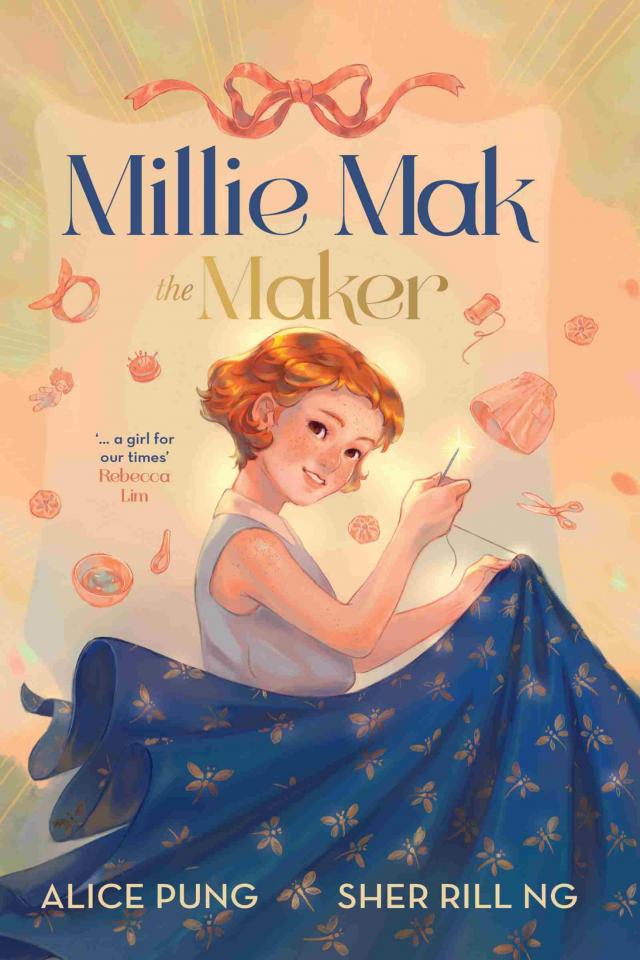
Millie Mak the Maker (Millie Mak, #1), page 1


Dedication
For Alice Sophie L — A.P.
For Carmen — S.R.N.
Contents
DEDICATION
STORY 1 GELATI PARTY
1 The Dream House
2 Sleeve Savers
3 The Garden
4 Veesa and Glee
5 Gelati Party
6 Making Amends
7 The Material Girl
8 The Tipping Point
9 Sunny Peaks
10 Chatelaine
STORY 1: BE A MAKER!
STORY 2 RITA THE BRAVE
1 Tearstopper
2 Egg Roly Poly
3 Blazers of Glory
4 The Warrior
5 Rita the Brave
6 Blue Jeans
7 Princess and the Lion
8 Hair Raisers
STORY 2: BE A MAKER!
ACKNOWLEDGEMENTS
ABOUT THE AUTHOR AND ILLUSTRATOR
PRAISE
COPYRIGHT
STORY 1
Gelati Party
CHAPTER 1
The Dream House
‘It’s not every day, walking down the street,’ said Granny, ‘that you find your dream home, is it, Millie?’
Millicent Mak stood in front of the nearly new double-storey house. She stood so close that if she wanted to she could reach out and touch the big bay windows and pebbled walls. The house had appeared overnight, almost as if by magic. She and Granny had been down this street hundreds of times and yet had never stumbled upon this grand beauty until today.
‘We must seize our chance!’ cackled Granny. ‘Millie, you wait here while I go fetch Pop to drive the getaway car. I’ll only be gone a wee while. When we get back, let’s move house! Hee hee.’ With a swish of her ruffled peasant skirt, Granny strode down the street.
While she sat on the kerb, Millie imagined owning this big white birthday cake of a home. She’d fix up the peeling roses on the stair bannisters — she could see them through the windows. She’d shine the floors. She’d install a spa bath and make matching cheery yellow curtains and cushions.
‘Oi!’ A loud holler interrupted Millie’s thoughts. Without thinking, she stretched one hand towards the roof and held it there.
When she turned around, she came face to face with three girls. Two had been in her class in Term One this year. The taller girl, Shanelle, had a voice like a shaking maraca, an annoying instrument that kept playing to its own tune in class when the music had stopped. Esme, the other girl, hung around Shanelle only because she seemed to have no other mates. The third was a much younger girl Millie had never seen before, with her hair in pigtails. One was drooping like a dead goldfish.
The little girl pointed directly at Millie’s new house.
‘Sorry,’ Millie apologised. ‘I saw it first. My pop’s coming with his car to pick this up.’
The younger girl’s mouth twitched. She looked as if she were about to cry.
‘Sorry,’ Millie said again, and really meant it.
‘Don’t be a sook, Safire!’ growled Shanelle. ‘Doll’s houses are for babies. Are you a baby?’
‘Ew, gross,’ said Esme. ‘Picking up other people’s junk off the kerb.’
‘It’s allowed,’ said Millie. ‘It’s Hard Rubbish Collection Day.’ As she blurted this out, Millie realised exactly what her grandparents were coming to help her pick up — rubbish. But she kept her hand firmly on the red plastic rooftop, knowing what wonders she and Granny could work on this object. ‘It’s for my little sister.’
Shanelle tapped one toe of her grey and red runners on the ground. ‘Miss Millie Mak, Mak, Mak,’ she softly sang, ‘lives in a shack, shack, shack.’
‘Hee hee,’ snorted Esme.
‘Takes all the crap, crap, crap,’ continued Shanelle a bit louder. ‘From the footpath, that no one wants back, back, BACK!’ She finished with a roar.
‘Ha ha, good one, Shanelle!’ crowed Esme.
Safire pointed again at Millie. ‘But I want the house!’ she wailed.
‘Listen, you dumb sook,’ said Shanelle, grabbing Safire by the arm, ‘if Mum sees you carrying on like this, you’re gunna get it.’ She turned to her friend. ‘Come on, Esme, let’s go.’
After they disappeared around the corner, Millie stood there, stunned. Her hand felt hot, so she took it off the roof. Her face felt hot too. She knew with absolute certainty and dread that Shanelle would tell the other kids about this when these first term school holidays were over. Shanelle was that sort of girl.
This year, Millie had no idea what sort of girl she was. She’d arrived at her new school, Sunny Peaks Primary, terrified that she was being watched all the time by the teachers and other students. Then after the first week, when Millie realised no one was actually watching her, that they were all too busy just carrying on with their own interests, she felt forgotten and ignored — and kind of resentful about those feelings.
Millie floated in and out of different groups at recess. There were always kids willing to let her join in, but she knew that if she was away for one day, or even a week, no one would have missed her very much. Also, now in Grade Five, kids were more serious than ever before, in everything they did — schoolwork, talking to one another and even when they were collecting and swapping the latest Bloom Buddies — free supermarket seed packets you could grow into flowers.
In fact, the only kids who seemed to be truly enjoying themselves were a younger gang who rummaged through school bins to find treats: half-eaten donuts, half-finished Big Ms, near-empty biscuit packets. The other kids called them ‘Bin Scabs’, but the Bin Scabs clearly didn’t care because they’d do it again the next day. They were careful not to be caught by the teacher on playground duty.
Millie discovered that she was all too easily embarrassed and cared an awful lot about what other people thought. At recess and lunch she just quietly swapped her seed packets and stood back, watching the other kids. Sometimes Millie wished she had the same gleeful freedom as the Bin Scabs. At least they seemed to be having fun.
Pop’s sky-blue car appeared. He parked and popped open the boot. ‘I wish your grandma would stop referring to this as the getaway car,’ he muttered as he strode out. ‘We’re not doing anything wrong. Just recycling the junk no one else wants. Lightening the load of the council collection truck. Doing them a favour, really.’
He spotted the dollhouse. ‘Whoa! That’s a real find!’
But before he could lift it up, Millie said quietly, ‘I don’t want it anymore, Pop.’
‘What?’
‘I don’t want it.’
‘But your granny pulled me away from the footy just to pick this up!’
‘I’m too old to play with doll’s houses.’
Granny stepped out of the car. ‘What’s all this fuss about then, eh?’
‘She says she doesn’t want it anymore, Moira. Says she’s too old.’
‘But it’s our dream home, Millie!’ said Granny. ‘Besides, you wouldn’t be playing with it. You’d be helping me restore it for Rosie. She’d love this.’
‘But it’s gross,’ Millie protested. ‘Who knows what germs could be on it?’
‘Now you’re sounding like your Ahma,’ Granny said crossly. ‘She’s always been a bit iffy about germs.’ Ahma was Millie’s other grandmother, who carried a small bottle of hand sanitiser whenever she stepped outside her home.
Millie watched as Granny and Pop lugged the doll’s house into the back of their old car. She felt guilty about not helping, but she didn’t know what other itchy-eyed nosy kids from her new school might be lurking around the corner. Granny triumphantly slammed the boot shut.
‘We’re Scottish, remember, Millie.’ Granny laughed. ‘And Scottish people love a free thing. Isn’t that right, Mike?’
‘She’s half-Scottish, half-Chinese, you know,’ Pop mumbled, ‘so not as crazy as you. I keep telling you, Moira, we got no room for more stuff at home.’
‘Bet your dad would agree with me, eh?’ said Granny. ‘The Chinese are also frugal and thrifty. These are good qualities. Waste not, want not.’
Pop sighed. ‘You can drop me back home,’ he said, ‘if you two want to continue in the car.’
This was exactly what Millie would normally have loved — she and Granny, cruising down the suburban streets, checking out footpaths for treasure they could rescue. But now, not so much.
Millie got in the car and sank low in her seat. ‘Let’s just go home, Granny.’
‘But, Millie!’ protested Granny. ‘Finders keepers, losers weepers, remember?’
How could Millie forget, when these days she felt like a loser and a weeper all the time?
Moving home and schools, turning ten in a few months’ time — these things made Millie feel so anxious. She never used to feel this way. She used to be excited about each coming year. She used to tell Granny everything, too. But the move had weighed Millie down. Pretending to drive a getaway car to nab rubbish might have been fun a year earlier but now was just embarrassing. Millie couldn’t wait for the day she’d be old enough that anything anyone said wouldn’t affect her as it now did.
When they arrived at Granny’s house, Pop set the new toy on the tiled kitchen floor. It looked even larger indoors. It would come up to Rosie’s chin, Millie guessed.
‘Ooh, Millie, look here at these lovely, lovely bay windows!’ Granny gushed. ‘This is a proper doll’s house, not like the terrible boxy ones they make these days. Imagine if we made a canopy bed and put it here.’ She pointed to the main bedroom.
Granny was a whizz at making things. In her kitchen, she had a plastic-bag holder sewn from a beautifully patterned tea-towel. She had a teapot shaped like Federation Square she’d made in a pottery workshop. She had a doorstop shaped like an owl she’d carved out of a block of wood found on a construction site. She had a door snake made of the red corduroy from a pair of Pop’s old trousers.
‘Hey, Granny, what are these little metal hinges for?’
‘Oh,’ said Granny, ‘to fold up the roof, I suppose. Most dollhouses fold in half for storage.’
‘No, I mean here.’ Millie pointed to the back of the dollhouse, between the two floors. ‘Also, why are there these two handles? And this latch?’
She and Granny fiddled around and folded the whole house in half like a book. Millie then turned the house onto its side and tried bending it in the middle. Both sides folded in half again, so that the first floor was folded into the second floor. Millie realised that the now-rectangular box could be closed at the top with metal latches and that the handles were for carrying it.
‘Oh. It transforms into a suitcase!’
The dollhouse was now the size of a case for a laptop computer.
‘This is a genius feat of engineering,’ Granny said. ‘We have found a real gem here. Did you know, Millie, that dollhouses were once valuable works of art and furniture before they became children’s toys? Only rich families had them. The most beautiful dollhouse in the world was one made for Queen Mary of Teck. And she was no child — it was for her fifty-seventh birthday!’
Millie imagined the thousands of builders, artists and craftsmen spending a year making Queen Mary’s dollhouse. The best writers writing tiny words in miniature books for the miniature library. The best cabinetmakers carving the wooden furniture. The tiny prams and jars of real sweets in the day nursery. Granny’s joy was infectious.
This was no longer a toy, Millie decided: it was a project. She assembled the suitcase back into its house form while Granny filled a bucket with water and disinfectant. They went to work with sponges.
As they cleaned, little details emerged that delighted Millie — flowers embossed in the front wall, a letter slot in the front door, a lattice swing that unfurled from the back verandah.
‘Uh-oh.’ Millie showed Granny the soggy flecks of coloured paper stuck to her sponge. ‘I wiped too hard. The carpet pattern’s come off.’
‘Aw, don’t worry about that. It was bound to happen — that rug was just an old sticker. I’ll knit a real miniature one.’ Unzipping her floral toiletries bag, Granny took out some pink, yellow and gold nail polishes. ‘Time for some painting, Millie.’ They spent the afternoon engrossed in dabbing little rosettes and daisies onto the walls and ceilings.
‘Granny, how about we string up some fairy lights in each room,’ Millie suggested, ‘so our house can light up at night?’
‘That is a wonderful idea! Pop can help us wire it up.’
How terrible to have no imagination, Millie thought. To look at that magnificent house on the footpath and just see junk. If Shanelle had just been nicer, Millie might have given up the dollhouse to her sooky sister who’d wanted it so badly. Millie was too old to play with it, and Rosie was still too young.
But as she painted gold varnish over a daisy stencil she’d cut herself and adhered to the wall, Millie was happy to be fixing this house up. After all, Pop was in his seventies and still always ‘fixing’ things in his tool shed. Millie wished that when she and Granny had finished renovating, Shanelle could see what a valuable thing they had. Something no one could ever buy at the shops.
CHAPTER 2
Sleeve Savers
Millie’s dad stood in the doorway in his work uniform — a green waterproof jacket with DASH INC printed on the sleeves and back. His umbrella, still wet, lay on the front mat like a dead bat. Setting his helmet and delivery box on the floor next to the broken umbrella, he stretched out his arms.
‘I’m home, my little orangutans!’
All three of his girls had red hair in different shades — Millie’s mum’s was bright orange, Millie’s dark red, and Rosie’s strawberry-blonde. None of them took any offence at his nickname — Rosie because she loved animals, Millie because she secretly liked how her dad never minded her mischief, and Millie’s mum because she wanted a better spirit-animal for herself.
‘I’m more like a gorilla!’ she growled as she stomped towards him. ‘Twenty times stronger than your average human — and you, in fact.’ She wrapped her arms around Millie’s dad. Even though he was a head taller, she lifted his feet clean off the ground.
‘Whoa,’ said Millie’s dad, ‘those old people you work with sure have made you strong.’
‘Be careful!’ Ahma cried, emerging from the kitchen, holding onto a soup ladle. ‘Be careful, Diane, he’s too heavy. You’ll hurt your back!’
‘Put me down, woman.’ Millie’s dad laughed. ‘But gently, or I’ll fall and squash the pizzas!’
Pizzas? Millie’s head shot up just as her mum carefully set her dad down.
‘Finish your soup first: I spent all afternoon stewing it,’ said Ahma. ‘I’m going to put these pizzas in the living room for later. There’s not enough room for them on this table.’
‘Awww, Ma,’ grumbled Millie’s dad, but he sat at the table with everyone else, dutifully picked up his porcelain spoon and dug into his own bowl of soup.
To be honest, Millie was also a bit tired of Ahma’s nutritious stews full of meat, vegetables and goji berries, but she knew better than to argue with her grandmother.
‘The last delivery was a dud,’ said Millie’s dad. ‘Some idiot ordered three pizzas to his enemy’s house, who then refused to pay. Instead of asking me to return the pizzas, the restaurant just let me keep them.’ This was one of the great things about Millie’s dad’s job. He sometimes brought home free meals.
Millie’s new home was at the Sunny Peaks flats, where she lived with her parents, her two-year-old sister Rosie and her dad’s mum Ahma. Rectangular and four storeys high, each block housed sixteen units. The front of each of the six blocks of flats had a huge concrete slab of a different ice-cream colour — pink, yellow, light blue, orange, lavender and green. Millie’s flat was in the Green Block, but the green was so old it was now more like mint-choc-chip ice cream, flecked with strange dark-brown stains. Her parents had moved to be closer to the Alina Sylvan Aged Care Home, where Millie’s mum worked, and to be closer to Granny and Pop.
Their flat was always warm inside, and smelled a bit like liquorice, because Ahma often boiled herbal remedies for the family and kept packets of aniseed in the cupboard.
‘So what did you do with Granny today?’ Millie’s mother asked her.
‘Not much.’ Millie poked at the carrot circles in her bowl of soup.
‘Come on, you must have done something.’
Because Ahma was now at the table, Millie didn’t want to say too much. ‘We went for a walk.’
‘Aha!’ Ahma narrowed her eyes. ‘I know why you went for a walk.’ She raised her own spoon up like a flag. ‘Because I know exactly what day it is. Hard Rubbish Day! Lucky you didn’t drag home any more germy-wormy junk.’
Millie didn’t tell Ahma about the dollhouse she’d left at Granny’s.
‘Whatever you found, you probably left it at your other granny’s,’ said Ahma. ‘She certainly doesn’t mind a messy house.’
‘Down!’ demanded Rosie from her high-chair. Ahma had finished feeding her, and she was getting fidgety. ‘Down!’ Ahma lifted Rosie up and out of her chair, and she toddled off. Probably to find the remote control, thought Millie. Rosie loved the remote control so much that her dad had to wrap it in clingwrap in case she spilled milk on it or dunked it in the loo.
‘We booked you into that holiday program you’ve always wanted to go to,’ said Millie’s mum.
Millie sat up straighter. ‘You mean Awesome Explorers?’
Their ads always showed good-looking teenagers taking kids by tram to see the latest movies in the city or to the Boing Boing trampolining centre. Even their incursions were amazing: Callum from Callum’s Cupcake Creations coming in to teach a cooking lesson, and Marita Cheng from Robogals showing them how robotics worked. Millie knew the holiday program took in kids from all different schools, so she might even see one or two from her last school there. Millie didn’t even care if she saw Shanelle there.


