The Invisible Hour, page 22


He closed his eyes so that he might imagine Mia asleep in the grass the first time he saw her. He heard the birds outside his window, swifts and swallows and sparrows, all nesting in the eaves of the Jack Straw Tavern. Nathaniel would think about the novel for years, and then he would write in earnest. He would compose The Scarlet Letter like a man possessed, finishing in only a few months. Following the novel’s publication, on March 16, 1850, after having been overlooked and thought to be a minor writer, he would be the author of an instant bestseller. One critic said the novel was a fable of a guilty heart, and perhaps this was true. It was his burden and his apology all in one. He would take the first copy that was published, come to the library in Blackwell, and sit at the long table to inscribe his dedication before setting the book high up on the shelf.
To Mia, If it was a dream, it was ours alone and you were mine.
Now he dressed and sat on a wooden chair by the desk. The end of one story is the beginning of another. He had always known that to be true. Soon enough the sky was brightening and the birds in the bushes outside his window began to call as dawn opened across the horizon. It was the next day, the start of the future. He turned away from the window. The whole world was out there, but it was also here in this room. The world was at his fingertips. That was when he began to write.
* * *
MIA NAVIGATED THROUGH THE woods, a forest she knew by heart. There were blackberry bushes that were thick with fruit, in the very same place when she was a girl. The women used to pick the berries to make pies, which they sold at the farmers’ market. The children always begged for a taste, but Joel hadn’t believed in sweets, or in spoiling children, or in playing favorites. He’d only believed in himself.
When Mia walked out of the woods she saw the grand vista that matched the scene in the painting she had folded into her skirt pocket. The watercolor had been handed down through the generations and was a perfect rendering of the mountain and the untouched land that surrounded the peak. Mia went into the old barn, built by the first settlers, used to store hay. It was the same barn where she used to go to read, and she knew all of its hiding places; she tucked the painting beneath a loose board. Then she went outside and waited. She knew he’d appear in his own good time. He’d make her wait, and that was fine. She had been waiting for quite a while.
Joel came up the hill as the light was breaking the sky open. He had the book, but he also carried a rifle under his arm, bought at the back of the grocery store in town. “Just in case,” he said when he showed her the gun. “You’d be stupid to trust me, but I’d also be stupid to trust you. You’ve done something to the book.” He tossed it to her. “You’ve put some sort of spell on it. It’s disappearing. Will it still take us back?”
When Mia opened it, half of the words were gone. “The words will return when I leave.”
“When we leave,” Joel reminded her. “I’m not staying here. I’m going back to my farm.” He pointed at the ground with the rifle. “Get down, because you’re not going anywhere if I don’t have the painting.”
Mia knelt before him in the grass. This was what he’d done on the day he burned her books, when he locked her in the barn, when he cut off her mother’s long black hair.
Sparrows winged overhead. A low whistle sounded, not a bird singing, but a man calling to his dog on a nearby farm. The collie had wandered and now began to trot toward them through the tall grass. He came up to Joel, barking like mad. There were dogs such as these all over the Berkshires, known for their fierce loyalty. This one had taken an immediate dislike to Joel, who raised the gun.
Mia rose to her feet and grabbed the dog by its collar, which was little more than a rope. “Stay here, boy,” she said. She wanted nothing to interfere with her plan. She had left her gold earrings, as well as a silver inkwell from the inn, hidden beside the painting. She wanted to make certain when the sheriff came, he would be catching a thief. The note she’d left would likely have been read by now, and it was quite possible Joel would be arrested by the end of the day.
Find him where I have left him in the barn and you will find what this thief has stolen. Be careful. He is dangerous.
“We don’t have much time,” she told Joel. “The painting is in the barn.”
“Don’t play with me. Where in the barn?”
“Beneath the loose board at the rear. Where I hid my books.”
“Do not move,” he warned her.
But once Joel had gone after the painting, Mia let go of the dog, and she ran to the barn door. He’d been wrong to trust her, to think she was still a girl who would do as she was told. She slid the wooden lock shut, shifting her weight against it to fasten it. It was a strong lock, far newer than it had been when Mia escaped. From inside the barn she could hear Joel’s shouts. He was so loud and fierce he frightened the blackbirds from the trees. He called out what he would do to her when he escaped, but after she walked down the hill Mia couldn’t hear him anymore. She didn’t have to listen to him. No one did.
In the year when she was fifteen, she might have drowned, her body dragged back to shore by the same men who had carried her mother’s body across the lawn; she might have been invisible, buried behind the wire fence, but that was a lifetime ago. She would have the life she chose, just as her mother had intended for her, just as she intended for her own child.
Mia lifted her eyes to the mountain. The wind had picked up and clouds were moving across the sky. How was it possible for her to have never noticed how beautiful it was here? Years from now Carrie would discover the painting left in an old barn she inherited, and she would become a painter, insisting that she must have already been an artist in another time. The Community would come to be, and Ivy Jacob would find herself there one night when she didn’t know where else to go, and Mia would live the first part of her life here and she would always remember that she was loved by someone from the very start. The best thing that ever happened to me was you, Ivy had whispered to her that night in the woods when they walked invisible.
Mia wished that her mother could see how beautiful this place had been before it was ruined by shoddy buildings and barns, with wire fencing to keep local people out and the members of the Community in. She wished she could thank Ivy for allowing her to go to the library, for telling her stories in the woods, for wanting more for her. Now Mia wanted her own daughter to know a world where she could go to school, and travel on her own by train, and walk down a city street on a summer evening, and read any book she chose from the shelves of a library.
In no time it would be autumn, the season when Mia always scanned the trees, in search of the first red leaves. At last, she came to the site where the cemetery would be. For now, it was simply a patch of land overrun with mulberries and yarrow, hyssop and wild chives, along with the first of the ferns that would someday take over the area. The fields all around were filled with sunflowers, and the sound of bees was all that Mia could hear. She was grateful for the shade of the huge beech tree, and she leaned her back against its trunk as she sat in the bank of ferns. She thought about the day that she’d believed would be her last day on earth. How lucky she’d been to have walked into a library. How grateful she was to hold the book in her hands.
The world was waking, slowly and then all at once. Birdsongs, the whir of beetles, the wind in the trees. Mia could hear the horses on a nearby farm. The collie dog was racing through the field on his way back home, but when he spotted her, he came toward Mia, a flash of black and white. He was the same breed that could always be found in Blackwell, the kind that had been at the farm, smart, reliable dogs that didn’t need much attention and were always loyal. The night she ran away, none of the dogs had barked. They had allowed her to be invisible, and she had started her life over. This would be the third life, the one she would keep, the one she was meant to have.
“Hello there,” Mia said when the collie came to greet her.
The dog sniffed, curious, but when he heard his owner whistling on the nearby acreage, he took off through the grass. Mia could see how her mother might have thought she had arrived at a place that was west of the moon. West of the moon was where you journeyed to meet the person you loved, the one you would never forget. Mia wanted to remember everything when she left here. How cold the water was in the river, how long his kisses lasted, how quick the crickets’ song was, until it wasn’t a song at all, just one great chime of summer’s ending. She would always be thankful that she had reached for Nathaniel’s book in the library and read it in the barn and that she had stepped into the world he had created out of paper and ink. Luck can be many things, and she carried her luck with her, she carried it in a book.
Once upon a time, she would tell her daughter, I loved you more than anything. I loved you more than life itself. I loved you enough to find whatever awaits us, no matter what it might be, no matter where. We can go as far as we need to, even if it’s west of the moon. Sometimes walking away is the bravest thing you can do. When you get there, you’ll know where you are.
ACKNOWLEDGMENTS
Endless thanks to Amanda Urban, Ron Bernstein, Marysue Rucci, Libby McGuire, and Dana Trocker.
Thank you to Nicole Dewey.
Thank you, Andy Jiaming Tang.
Thank you to the team at Atria Books.
My deepest gratitude to my friends who saw me through the writing of this book, especially Jill Karp, Diane Ackerman, and Laura Zigman.
Thank you, Nina Rosenberg, for a lifetime of Saturdays.
Thank you to Madeleine Wright for assistance in all matters.
Thank you to the corners in my life, Madison Wolters, Karina van Berkum, and Deborah Revzin. And to David Revzin, honorary.
Many thanks to Megan Marshall for her early reading of this book.
Thank you to Stephen King.
Gratitude to the staff of The Old Manse in Concord and to the staff of The House of the Seven Gables in Salem.
A huge thank you to all of the bookstores who have supported my work from the start.
My heartfelt thanks to the librarians who allowed me to take out as many books as I wanted.
To my readers, eternal gratitude.
To my mother. Now I know the love between us was never invisible, even when I didn’t see it. I see it now.
Further Reading:
Nathaniel Hawthorne in His Times, James R. Mellow
The Peabody Sisters, Megan Marshall
The Scarlet Letter, Nathaniel Hawthorne
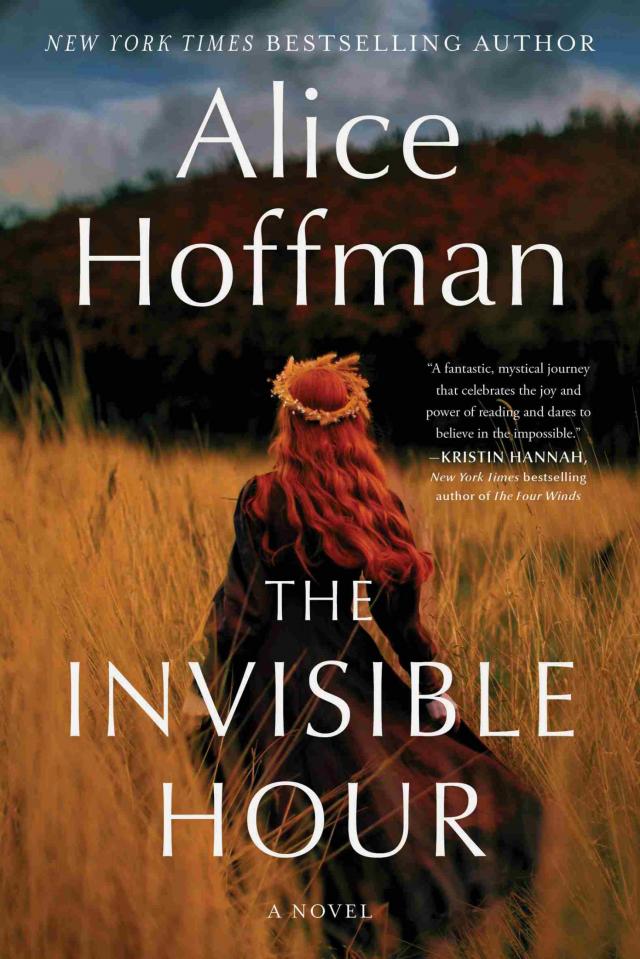
The Invisible Hour
by Alice Hoffman
This reading group guide for The Invisible Hour includes an introduction, discussion questions, ideas for enhancing your book club, and a Q&A with author Alice Hoffman. The suggested questions are intended to help your reading group find new and interesting angles and topics for your discussion. We hope that these ideas will enrich your conversation and increase your enjoyment of the book.
Introduction
From the beloved New York Times bestselling author of The Marriage of Opposites and the Practical Magic series comes an enchanting novel about love, heartbreak, self-discovery, and the enduring magic of books.
Topics & Questions for Discussion
We first meet Mia in the prologue as she tries to escape The Community. How does the prologue set the tone for the rest of the story?
Ivy tells people she grew up “west of the moon.” Where does this phrase come from and why do you think this is her response?
Joel proposes to Ivy very quickly upon her arrival at The Community. What drew him to her and what were her motivations for accepting?
The relationship between Helen and Ivy feels similar to Mia’s with Sarah and Constance. How do they mirror each other? What, if any, are the major differences of these relationships?
Helen tells Mia that Ivy “should have had the choice to decide what to do with her own body and her own fate”. The theme of choice is brought up throughout the story. Discuss the choices presented to Ivy when she found out she was pregnant (sent away, adoption, runaway, marriage to the father). How has this scenario changed or not over time?
How do the settings—Boston, Concord, New York—act as characters within the story?
Each female character has her own version of strength—Ivy choosing to leave her home and start over, Constance and Sarah building their family and later dealing with loss, Elizabeth’s familial loyalty, and Mia rescuing herself—as the reader, do you relate to any of these women? If so, please discuss who and why.
Discuss Nathaniel’s need to be a writer even throughout his depressive episodes. Do you think writing brought him a sense of comfort or dread? How were his sisters integral to his success?
Elizabeth brings Mia to the Hill of Death. What was her motivation to do so? Why is Elizabeth so skeptical of Mia? Where does her mistrust stem from?
Discuss Joel’s ultimate demise. How is he bested by women for the final time?
Why do you think Mia returned to Nathaniel’s time? What was she hoping to achieve?
How is Mia’s choice to raise her daughter alone similar to Ivy’s choice? Do you believe Mia learned from her mother’s mistakes?
Enhance Your Book Club
The library acts as a sanctuary for Mia and continues to be so as she grows up. Have libraries been a part of turning you into a reader? What are some of your favorite memories including a library? Visit your local library and see what programs they may have.
The Invisible Hour is a fictional story of how The Scarlet Letter came to be. Pick up a copy and read (or reread) the Scarlet Letter and see if you can pick out the similarities between the Puritans and The Community.
Many of the places mentioned in The Invisible Hour are real places, like The House of the Seven Gables. Plan a trip to Salem and explore where Nathaniel Hawthorne lived—or check out more information at 7gables.org
A Conversation with Alice Hoffman
Q: Why Nathaniel Hawthorne as a love interest?
A: Nathaniel Hawthorne was said to have been extremely handsome, as handsome as Byron, and he was also charming even though he was known to be shy. He was a doting husband and father, and he wrote about the rights of women. What’s not to love?
Q: What draws you to writing stories so deeply set in Massachusetts?
A: I’ll always be a New Yorker, but for me Massachusetts is filled with magic. Massachusetts has a great literary history. It’s also beautiful and mysterious and my adopted home.
Q: Did you set out to write a novel so deeply rooted in women’s empowerment? How did it evolve to include time travel?
A: I started to think about The Scarlet Letter and how modern-day issues for women are not that foreign from issues in that time period. I’m not certain I realized when I first read Nathaniel Hawthorne’s great novel what the deeper meaning of his heroine’s situation is—she has no say over her body or her choices and yet, she does make her own choices. It’s a very brave book.
I’ve always wanted to time travel and been drawn to books about time travel. I think during the time of Covid, when I was writing this, more than ever I want it to be in another time period.
Q: What do you hope readers take away from The Invisible Hour?
A: I hope they find hope in The Invisible Hour something I was and still am searching for.
Q: Each female character in the story has her own strength—is there one you most identify with?
A: I think as the author, I identify with all the characters because they’re all part of my consciousness. But I definitely realize that I was writing about my own relationship with my mother because I think that the mother-daughter relationship is the most complicated and interesting.
Q: What inspired you to write this specific story?
A: As a reader, I wanted to write about how books can change your life.
Q: Just for fun—is there an author you wish you could travel in time to?
A: Oh, I’d love to travel back in time and talk to the Brontë sisters.
Q: Are you working on anything new you can share with your readers?
A: I am working on a biblical book, so it’s completely different and it’s about two women who have never been able to tell their own stories.
More from the Author
The Book of Magic
Magic Lessons
The World That We Knew
Echoes
Faerie Knitting
The Rules of Magic
ABOUT THE AUTHOR
ALICE HOFFMAN is the author of more than thirty works of ficton, including The Book of Magic, Magic Lessons, The World That We Knew, Practical Magic, the Reese’s Book Club pick The Rules of Magic, the Oprah’s Book Club selection Here on Earth, The Red Garden, The Dovekeepers, The Museum of Extraordinary Things, The Marriage of Opposites, and Faithful. She lives near Boston.
SimonandSchuster.com
www.SimonandSchuster.com/Authors/Alice-Hoffman
@AtriaBooks @AtriaBooks @AtriaBooks
ALSO BY ALICE HOFFMAN
The Book of Magic
Magic Lessons
The World That We Knew
The Rules of Magic
Faithful
The Marriage of Opposites
The Museum of Extraordinary Things
The Dovekeepers
The Red Garden
The Story Sisters
The Third Angel
Skylight Confessions
The Ice Queen
Blackbird House
The Probable Future