Coq, page 24


“Blue.”
“It just seems crazy to me that you waited for nothing.”
“J’étais fou amoureux.”
There’s a tiny brass shovel on a trophy mount, centered on his desk. I can’t read the engraving. Émile notices me eyeing it.
“Charity work,” he explains.
I think of Oak Island. All the years those men sacrificed in pursuit of treasure. The earth they’ve disturbed, the nests they’ve tipped, the trees they razed and all the things they may have missed: grad ceremonies, game nights, goodbyes. Last times.
“People make hope out to be so noble,” I say. “But it’s not. It’s deceiving.”
Émile smiles, touches my shoulder. “You’re just like her.”
I am? How? Was my mother exasperated? Negative? “Rarely peaceful,” as Joan observed?
“Contemplative,” he explains. “Always thinking. Comme un philosophe.”
I feel the wretched, stinging, healing, high of tears. This is how I’ll remember her now. In the uncertainty. In the questions I can’t answer, the things I can’t explain. I twist Mom’s ring from my finger. “Would you like this, Émile?” I hold it up to the bleachy light. An appreciative nod and the ring disappears inside a tight mottled fist. For a moment, a needle of regret. I want it back. I want her back, but I see in Émile’s weary expression, his desperate fist, the ring is exactly where it belongs. Home.
“What’s going on?” Dad appears in the doorway. I’m still startled by his shorn head. How it makes him look both tough and vulnerable. A war vet. A love vet. And then he sees her portrait.
“Is that Mom?” Dan pushes Dad out of the way and gazes up at the painting.
“Grandma was hot,” Joan says.
They’re all here.
“You should check out the roof,” Wes says with a hint of pleading, clutching Célestine’s hand. “Dad’s still up there.”
“I’ll go up in a minute.”
Emma ponders the portrait, stroking the lichen tufts of hair on Bobo’s head. “Dad said she was old.”
“When she died,” Dan corrects.
“People grow up and they change,” Liam adds, placing a brotherly hand on Emma’s shoulder.
“Like Harrison,” Emma says.
“Harrison, Grandpa, Mom . . .” His voice trails off and his phone pings.
I use the interruption to propose a toast. “We don’t have glasses,” Joan says.
“I can feex zat.” Émile races out of the study and returns with a tray of crystal champagne flutes and a bottle of Moët & Chandon. “I’ve been saving zees for une occasion spéciale.”
Hopefully not for sixty years. He pours the champagne, distributes the glasses. Emma gets Perrier.
“To Janice,” he says, holding up a glass.
I raise my glass. She would have liked to come to the party.
forty-seven
There’s a small window at the top of the stairs, the kind you’d find on a ship. All I see is blackness. I picture the ocean. Felix in his yellow rain jacket leaning over the side of a boat, lowering an underwater camera into the darkness. Or maybe, lowering his arm, so he can feel the sea’s secrets lap across his hand one last time. I imagine his iv-pricked hand, his hospital bed angled and adjusted to scientific perfection, the white room, the tidy blankets, his fingertips activating the valve to begin the end, the sound of the ocean tumbling from an invisible speaker easing him to sleep. Low tide.
How could his case for medical assistance in dying have been refused in Canada? How can an oceanographer die in landlocked Switzerland? How can he die alone?
The door swings open.
“You okay?” Glen takes my hand. “Come see.”
He leads me to the edge of the roof. The city of lights. Golden, magnificent, somber. Music in the distance. Empty streets, shuttered blinds, a bicycle locked to a tree.
“When I was in China, I punctured a tire. Of course, there was only one bike shop in the area and they didn’t have the right size tube. A cyclist I’d met in the Tibetan highlands suggested I order a new one from TaoBao, which is like the Chinese Amazon, but I was freaking out because the site said it would take three to five business days and my visa was expiring in three.”
A cloud, all popcorn edges and white face paint, drifts by. “So, what did you do?”
“When it didn’t arrive on the third day, I had to make a decision. Go to the embassy and apply for an extension on my visa, ditch my bike for some cheap replacement, or fix the tire.”
“You’re terrible at fixing things.”
“Was terrible,” he says. “But I needed to try. Even if it wasn’t perfect.”
“Aren’t you supposed to carry a spare? Or a patch?”
“No spare, and I’d given my last patch to Vivienne. That’s how we met.”
I think of Vivienne now, somewhere out there with her Moulin Rouge voice and dusty bike. She was the one who knew Wes and Célestine would end up at the Wall of I Love Yous that night at the Eiffel Tower. Would she have also predicted that Glen and I would end up here, on Émile’s rooftop surrounded by plants and constellations?
“How’d you do it?”
“Sandpaper and glue. That got me within three kilometres of the border. After that I had to fill the hole with grass and I had to ride so slow that I could barely keep from tipping over, from crashing. By the time I crossed into Laos, the tire was completely flat.” He laughs at the memory. “But it felt so good to have fixed something. It felt so good to have tried.”
“I broke the heart,” I say, running my fingers over the silk pouch. “It got crushed in my pocket during the protest.”
“It can be fixed,” Glen says.
“Felix’s going to Switzerland to die. Alone. Like Émile’s probably going to die with no one beside him to tell him he mattered.”
“You love him.” Glen says. “Felix.”
“I don’t know what to call it. It all feels kind of the same right now: grief, joy, sorrow, love. It all aches.”
Glen nods. We gaze at the street below. It’s going to rain.
A couple exits a building and briskly crosses the street, as if they know a downpour is imminent. I wonder if they’re married, divorced, illicit, or new.
“You have to go,” Glen says. “To Switzerland. I’ll get the kids home. I’ll deal with school and soccer. You just . . . go. I’ve always done what I needed to do and I know it probably prevented you from being able to do the same. And I’m sorry. I wish it hadn’t taken me ten years and sixteen thousand kilometres to see that, but it did and it changed me. I hope it can change you too.”
He doesn’t know I’ve already changed. Because of Felix. Like the lid of a jar someone loosens so you can open it.
“I have to go with him.”
Glen holds my face and kisses it. It’s the kiss you give when you know someone’s coming back. He heads for the stairs. “I’ll see you when you get home.”
The first drops of rain ping like dimes off the eaves and the couple takes cover under a print shop awning. Émile’s plants buckle and crimp in the wind and a maple seed blows over the tip of my shoe. A memory of my mom splitting one of the seeds and sticking it on her nose, another on mine. I smile, shielding my phone from the rain, and text Felix: I’m coming with you.
He replies with prayer hands. I dig through my purse to find Mom’s pewter prayer hands resting at the bottom in the everyday dust. Felix and I exchange logistics and I call Mallory to ask her to change my flight. The rain picks up and turns the city into a gauzy golden glow. I raise my face to the clouds. A crack of thunder and then the sky peels away.
I run for the stairs, wring out my clothes, and shake my wet hair. I quietly close the rooftop door behind me and listen. Down below, they are singing her funeral song: “Under the Boardwalk.” Émile was playing it earlier, when I’d called from the square. I head down the pink stairs to the landing. He is belting the chorus like he himself is under a boardwalk and it becomes clear as a headstone: this was not just mom’s funeral song; it was their love song.
I walk down the hall to where the party’s erupted: in the kitchen. Dan sings off-key, Mona claps, Dad conducts. The teens sip champagne. Emma tosses Bobo up and down until it hits the ceiling. Happy tears run down Émile’s cheeks. Everybody wears stolen berets in kaleidoscope colours.
I hug my wet clothes to my chest and try not to focus on tomorrow, on Felix, on goodbyes, on all the grief I’ve signed up for. Instead, I picture the gravestone with the lipstick prints, ticket stubs, and secret notes. The only thing Sartre got right: life begins on the other side of despair.
Acknowledgements
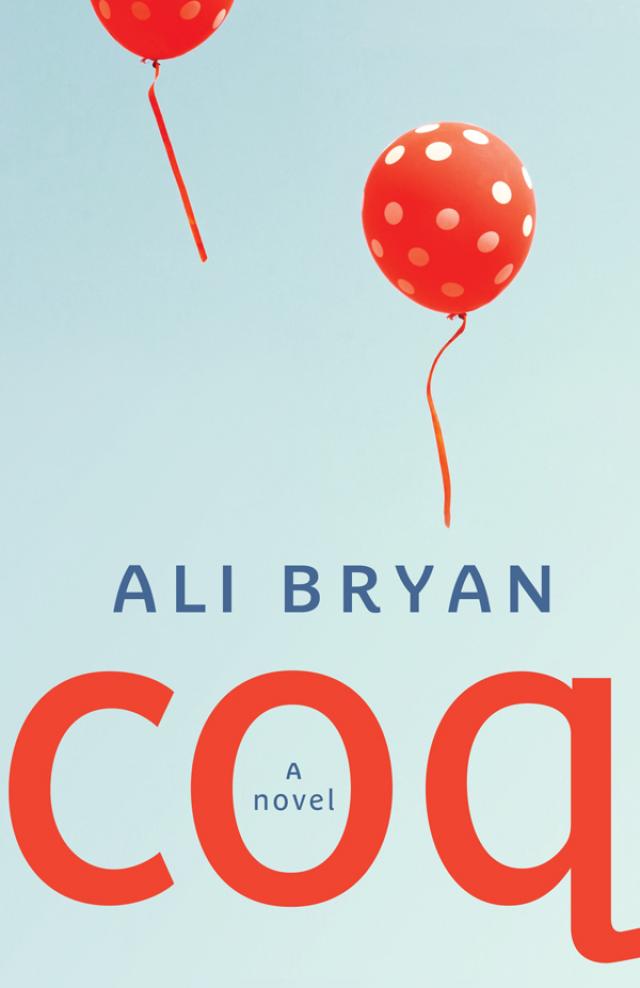
A giant cockscomb of gratitude to the one-and-only Kelsey Attard of Freehand Books: tireless advocate, champion and editor extraordinaire. I owe you a lifetime of acknowledgments for always being in my corner. Huge shout out to my agent, Stacey Kondla, for placing my work with heart and hustle and to Natalie Olsen for designing the cover to Coq. You always get it “right” and then some. Mad love to my writing peeps, my adored first readers: paulo da costa and Judith Pond, who push my writing in all directions and into new and otherworldly places, from the catacombs of Paris to the moon. Bradley Somer, the best Brad, brilliant writer, generous friend, confidant, mentor, poutine aficionado. Leanne Shirtliffe, my fiercely loyal friend, poet, changemaker, soul whisperer. And the profound Elizabeth Withey, who I deeply admire and simply love to be around. I still think of our grizzly bear encounter. I still think of your response.
* * *
Highest fives to Naomi Lewis for naming Bebe the rat and David Frevola for naming Petit Vert.
* * *
Heartfelt thanks to my readers and friends. Those who have purchased, read, and shared all of my work, all of my books. Those simple acts of affirmation have kept me going. At times they’ve kept me alive.
* * *
My family: Big Frat. God, I love you. Through the endless grind, the joy and the sorrow, the wtfs and hallelujahs. My kids, Pippa, Hugo and Odessa. Each of you enlighten me through your reckless pursuit of being. I love learning from you, I love loving you. Alfie, your quiet presence is a balm. Mom, Dad, Amy, and Mandy: my pillars, my DNA, my heart, my soul. Reta, for all the affection, all the support. And to all the members of my writing community, my soccer teammates, and friends, I’m so grateful you’re in my life. And a final hats off to the 5:00 am crew at the Signal Hill Centre Tim Horton’s for fuelling this book.
* * *
For where your treasure is, there your heart will be also. Matthew 6:21
Ali Bryan is an award-winning novelist and creative nonfiction writer who explores the what-ifs, the wtfs and the wait-a-minutes of every day. Born and raised in Halifax, Nova Scotia, she now lives in the foothills of the Canadian Rockies on Treaty 7 Territory, where she has a wrestling room in her garage and regularly gets choked out by her family. Coq is her fourth novel. For more, visit www.alibryan.com or @alikbryan on IG.
Ali Bryan, Coq