

The Essential Hamilton, page 1


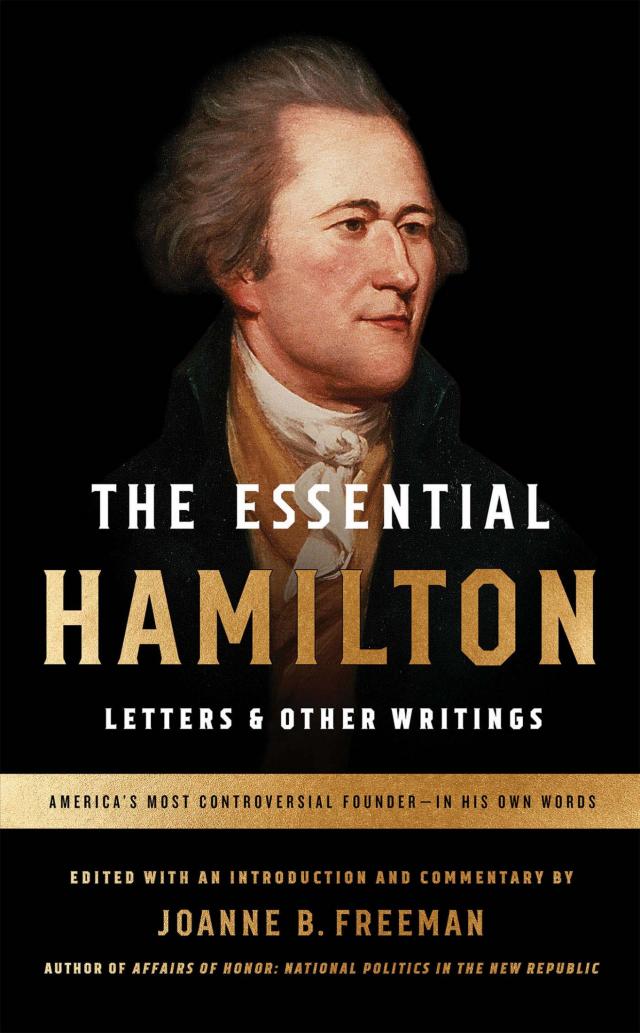
THE ESSENTIAL
HAMILTON
LETTERS & OTHER WRITINGS
AMERICA’S MOST CONTROVERSIAL FOUNDER —
IN HIS OWN WORDS
EDITED WITH AN INTRODUCTION AND COMMENTARY BY
JOANNE B. FREEMAN
THE LIBRARY OF AMERICA
Introduction copyright © 2017 by Joanne B. Freeman.
Volume compilation, notes, and chronology copyright © 2017 by
Literary Classics of the United States, Inc., New York, N.Y.
All rights reserved.
No part of this book may be reproduced in any manner whatsoever without
the permission of the publisher, except in the case of brief
quotations embodied in critical articles and reviews.
Library of America also publishes Alexander Hamilton: Writings (hc: 1,108 pages), edited by Joanne B. Freeman, volume #129 in the LOA series. For a full table of contents and more information visit our website at www.loa.org.
Distributed to the trade in the United States
by Penguin Random House Inc.
and in Canada by Penguin Random House Canada Ltd.
Library of Congress Control Number: 2016960141
ISBN 978–1–59853–536–5 (print)
ISBN 978–1–59853–454–8 (ebook)
First Printing
The Essential Hamilton: Letters & Other Writings
is published with support from
THE BODMAN FOUNDATION
Contents
Introduction
THE WEST INDIES, THE REVOLUTION, AND THE CONFEDERATION, 1769–1786
To Edward Stevens, November 11, 1769
“My Ambition Is Prevalent”
To The Royal Danish American Gazette, September 6, 1772
Account of a Hurricane
A Full Vindication of the Measures of the Congress, December 15, 1774
To John Jay, November 26, 1775
The Danger of Trusting in Virtue
To John Jay, March 14, 1779
Enlisting Slaves as Soldiers
To John Laurens, c. April 1779
Hope for a Wife
To John Laurens, January 8, 1780
“I Am Not Fit for This Terrestreal Country”
To Elizabeth Schuyler, August 1780
“Examine Well Your Heart”
To James Duane, September 3, 1780
“The Defects of Our Present System”
To Elizabeth Schuyler, September 25, 1780
The Plight of Mrs. Arnold
To Elizabeth Schuyler, October 2, 1780
The Fate of Major André
To Margarita Schuyler, January 21, 1781
Advice About Marriage
To Philip Schuyler, February 18, 1781
A Break with Washington
To James McHenry, February 18, 1781
Washington Will Repent His Ill-Humour
The Continentalist No. III, August 9, 1781
To George Washington, February 13, 1783
The Prospect of a Mutiny
To James Hamilton, June 22, 1785
“I Feel All the Sentiment of a Brother”
FRAMING AND RATIFYING THE CONSTITUTION, 1787–1789
Plan of Government, c. June 18, 1787
Speech in the Constitutional Convention on a Plan of Government, June 18, 1787
To George Washington, July 3, 1787
“The Critical Opportunity”
Conjectures About the New Constitution, c. late September 1787
The Federalist No. 1, October 27, 1787
The Federalist No. 15, December 1, 1787
The Federalist No. 35, January 5, 1788
The Federalist No. 70, March 15, 1788
To James Madison, May 19, 1788
Coordinating a Campaign
The Federalist No. 78, May 28, 1788
The Federalist No. 84, May 28, 1788
Speech in the New York Ratifying Convention on Interests and Corruption, June 21, 1788
To George Washington, September 1788
Convincing Washington to Serve
To George Washington, May 5, 1789
Presidential Etiquette
SECRETARY OF THE TREASURY, 1789–1795
To Lafayette, October 6, 1789
“I Hazard Much”
To Henry Lee, December 1, 1789
“Suspicion Is Ever Eagle Eyed”
FROM Report on Public Credit, January 9, 1790
Opinion on the Constitutionality of a National Bank, February 23, 1791
To Philip A. Hamilton, December 5, 1791
“A Promise Must Never Be Broken”
To Edward Carrington, May 26, 1792
“A Faction Decidedly Hostile to Me”
An American No. I, August 4, 1792
To George Washington, September 9, 1792
Responding to a Plea for Peace
To an Unknown Correspondent, September 26, 1792
An Embryo-Cæsar
Draft of a Defense of the Neutrality Proclamation, c. May 1793
Pacificus No. I, June 29, 1793
To Andrew G. Fraunces, October 1, 1793
“Contemptible As You Are”
To Angelica Hamilton, c. November 1793
Advice to a Daughter
Tully No. III, August 28, 1794
To Angelica Church, October 23, 1794
“Wicked Insurgents of the West”
To Angelica Church, December 8, 1794
“A Politician, and Good for Nothing”
Memorandum on the French Revolution, 1794
To George Washington, February 3, 1795
Resigning from Office
FEDERALIST LEADER AND ATTORNEY, 1795–1804
To Rufus King, February 21, 1795
A Threat to the Public Credit
To Robert Troup, April 13, 1795
“Public Fools”
Memorandum on the Design for Seal of the United States, c. May 1796
To George Washington, July 30, 1796
A Draft of the Farewell Address
To William Hamilton, May 2, 1797
Introduction to an Uncle
The “Reynolds Pamphlet,” August 25, 1797
To Elizabeth Hamilton, November 19, 1798
“My Good Genius”
To Theodore Sedgwick, February 2, 1799
The Problem of Virginia
To James McHenry, March 18, 1799
Displaying Strength “Like a Hercules”
To Charles Cotesworth Pinckney, December 22, 1799
The Death of Washington
To Martha Washington, January 12, 1800
“So Heart-Rending an Affliction”
To John Jay, May 7, 1800
An Electoral Stratagem
To Theodore Sedgwick, May 10, 1800
Withdrawing Support from Adams
To John Adams, August 1, 1800
Response to an Accusation
To William Jackson, August 26, 1800
“The Most Humiliating Criticism”
Rules for Philip Hamilton, 1800
To Gouverneur Morris, December 26, 1800
Jefferson over Burr
To John Rutledge Jr., January 4, 1801
Anxiety About the Election
To James A. Bayard, January 16, 1801
Burr Has “No Fixed Theory”
To Gouverneur Morris, February 29, 1802
“Mine Is an Odd Destiny”
To Benjamin Rush, March 29, 1802
The Death of Philip Hamilton
To James A. Bayard, April 1802
The Christian Constitutional Society
To Charles Cotesworth Pinckney, December 29, 1802
“Refuge of a Disappointed Politician”
To Elizabeth Hamilton, March 17, 1803
“A World Full of Evil”
To Timothy Pickering, September 16, 1803
Explaining a Plan of Government
THE DUEL, 1804
From Aaron Burr, June 18, 1804
Origins of a Dispute
To Aaron Burr, June 20, 1804
Declining to Avow or Disavow
From Aaron Burr, June 21, 1804
New Reasons for a Definite Reply
To Aaron Burr, June 22, 1804
“Expressions Indecorous and Improper”
From Aaron Burr, June 22, 1804
“The Course I Am About to Pursue”
Response to a Letter from William P. Van Ness, June 28, 1804
Statement Regarding Financial Situation, July 1, 1804
To Elizabeth Hamilton, July 4, 1804
“Fly to the Bosom of Your God”
Statement Regarding the Duel with Burr, c. July 10, 1804
To Theodore Sedgwick, July 10, 1804
“Our Real Disease; Which Is Democracy”
To Elizabeth Hamilton, July 10, 1804
An Obligation Owed
Joint Statement by William P. Van Ness and Nathaniel Pendleton, July 17, 1804
Statement by Nathaniel Pendleton, July 19, 1804
Statement by William P. Van Ness, July 21, 1804
Chronology
Note on the Texts
Notes
Index
Introduction
BY JOANNE B. FREEMAN
Alexander Hamilton had a lot to say. Always. Although not yet fifty when he died, he left behind more than ten thousand letters, newspaper essays, reports, and pamphlets. As published by Columbia University Press from 1961 to 1987, his writings fil
The Essential Hamilton offers a carefully chosen selection of his writings, including an abundance of personal letters from throughout Hamilton’s life, along with a few of his pamphlets, some newspaper essays, and a representative sampling of his major papers as Secretary of the Treasury. Taken together, they are a window into Hamilton’s brief and crowded life.
That life is worth exploring for many reasons. One of the nation’s leading Founders, Hamilton profoundly shaped the new republic. It’s impossible to understand the nation’s founding without considering his policies and politics—though it’s important to note that he was one voice among many, a reminder that the United States was born of debate and compromise, core components of a democratic politics. Given his flaws and excesses, studying Hamilton is also a reminder that the Founders were all too human, and therefore fallible; there was no guarantee that their experiment in government would succeed. And of course, Hamilton’s dramatic life makes for good reading. Born in obscurity in the Caribbean, battling seemingly unbeatable odds, a one-man army of game-changing policies with a risqué love life who fell meteorically from power and died in a duel: Hamilton’s trajectory of highs and lows seems like the stuff of fiction.
The best way to get to know this complex character is through his writings, though the portrait that emerges isn’t always favorable: Hamilton was a notoriously difficult man. His politics and policies alone earned him a lifetime of controversy; in many ways, he was an unapologetic extremist. In a nation that had just broken away from a monarchy and was wary of centralized power, Hamilton was an unfailingly ardent advocate of a strong national government. Some considered him a monarchist aiming to subvert the newborn republic. Others distrusted his dealings with moneyed men and his obvious interest in courting the wealthy and powerful to support the new government. And many disapproved of his habit of seeking military solutions to political problems; he was sometimes far too eager to stifle political protest with armed force. For these reasons and more, Hamilton was the lightning rod of Washington’s administration.
His politicking was no less abrasive. Hamilton practiced a hard-edged style of politics, savaging his foes in newspapers and pamphlets while aggressively advancing his plans behind the scenes. His relentless promotion of his financial program as Secretary of the Treasury inspired an organized and angry opposition in the national government and beyond. Alarmed at Hamilton’s focus on centralizing power and attracting moneyed men, Secretary of State Thomas Jefferson and Representative James Madison actively opposed him, inviting newspaper editor Philip Freneau to move to the nation’s capital to start the anti-Hamiltonian National Gazette. Congressional opponents also took a strong stand, combatting Hamilton’s proposals and accusing him of financial malfeasance. By 1792, Hamiltonian Federalists and Jeffersonian Republicans were at war—a war that would worsen as the escalating French Revolution tangled domestic politics on American shores.
It’s tempting to sum up the period’s politics as a dramatic clash of titans: Hamilton versus Jefferson, the brash attack dog versus the congenial Virginia gentleman. But the divide between the two men was more than personal. They represented opposing views of the nation’s future that extended far beyond them. Many—like Jefferson—desired a limited national government and a largely agrarian nation, and trusted a more democratic politics. Others—like Hamilton—envisioned a manufacturing nation headed by a powerful national government, and distrusted the tides of democracy. Convinced that Hamilton’s policies would create a New World polity as corrupt as its Old World predecessors, Jeffersonian Republicans never wavered in their opposition. Hamiltonian Federalists didn’t waver in fighting back. Hamilton’s fist-clenched belligerence throughout this conflict and beyond is amply apparent in his writings.
Combine Hamilton’s policies and politicking with his strong personality—impulsive, touchy, arrogant, ambition-driven, and rarely heeding (or even asking for) advice—and you begin to see why he lived a life of conflict. When restrained and channeled, these qualities fueled his remarkably rapid rise to power. But taken too far, they were self-destructive. It’s for good reason that over the course of his life, Hamilton was involved in ten affairs of honor (near-duels) before his fatal duel with Aaron Burr, probably an all-time record for a first-rank Founder.
Elizabeth Hamilton was by his side through it all. The second daughter of wealthy New York landholder Philip Schuyler, she was a calming presence and a pillar of strength in Hamilton’s all too harried life. His letters to her in this edition show the highs and lows of their relationship, from their flirtatious courtship to their close companionship of later years. Hamilton’s notorious “Reynolds Pamphlet” also appears in these pages. An attempt to refute charges of illicit financial speculation by confessing to adultery, it did his reputation no favors. Brash, defensive, stunningly frank, and argued with lawyerly precision, it puts many of Hamilton’s strengths and weaknesses on display.
As a friend, Hamilton could be equally trying, though he could be warm and charming when he chose. This was particularly true in his wartime friendship with his fellow aide-de-camp John Laurens. A newcomer to North America with few connections and little money or influence, Hamilton poured his fears and frustrations into letters to Laurens; these letters—many of them included in this edition—are among Hamilton’s most open and emotional. Hamilton’s letters to Elizabeth’s older sister Angelica are equally revealing. Accomplished and savvy with a razor-sharp wit, Angelica was Hamilton’s match in many ways. His playful letters to her give a taste of their flirtatious friendship.
Hamilton’s complex relationship with George Washington also unfolds in these pages. The two men got to know each other during the Revolution, with Hamilton working by Washington’s side as an aide-de-camp. Over time, they grew to trust and respect each other, each man discovering the other’s strengths and weaknesses. They were allies more than friends, with a shared sense of the urgent need to bolster what they believed to be the nation’s weak foundations. During his first term as president, Washington struggled mightily to remain neutral in the war between his Secretary of the Treasury and his Secretary of State. But in the end, Washington’s preference for Hamilton’s views was clear.
This isn’t to say that their relationship was always sunny. Hamilton was never comfortable with authority figures, and he sometimes chafed at his dependence on Washington, as in 1781, when he quit his post as Washington’s aide after a petty argument; Hamilton’s defensive account of that dispute is in these pages. And during Washington’s presidency, Hamilton sometimes pushed beyond where Washington was willing to go. But overall, their political partnership was firm and long-standing, profoundly shaping the nation’s first decade under the Constitution.
There’s more in these pages. We see Hamilton as the affectionate father of eight children (though Elizabeth did most of the work in raising the Hamilton brood). We see the decline of his political career, and the sadness that infused his later life. And finally, we see the unfolding of his fatal duel with Aaron Burr; their letters of negotiation, along with their seconds’ accounts of the duel, bring Hamilton’s life—and this collection—to a close.
A Brief and Crowded Life
To fully understand Hamilton’s writings, you have to read them in the context of his life, because his life course was shaped by his origins. Hamilton was an ambitious striver in a world of rigid social rankings. Although this hierarchy was beginning to crumble in late eighteenth-century America, for a poor and illegitimate orphan from the Caribbean, gaining status and position took work.
That work started early. When Hamilton was seventeen, working as a trading company clerk on the island of St. Croix, his obvious intelligence and writerly skill inspired locals to collect a charitable fund to send him to North America for an education. As luck would have it, he arrived in New York City just as the American Revolution was getting under way. Plunging into the struggle while still a student at King’s College (now Columbia University), he championed the colonial cause in pamphlets. One of them—“A Full Vindication of the Measures of Congress”—is included in this collection.
But although Hamilton’s greatest strength was the power of his prose, it was military glory that inspired his passions in these early years. As a fourteen-year-old living on St. Croix, he confessed as much to his friend Edward Stevens, noting: “I wish there was a war.” To Hamilton, an officer’s commission would be his gateway to the world, getting him out of the Caribbean and giving him a chance to make a name for himself.


