

Dark Matter Presents Monstrous Futures, page 1


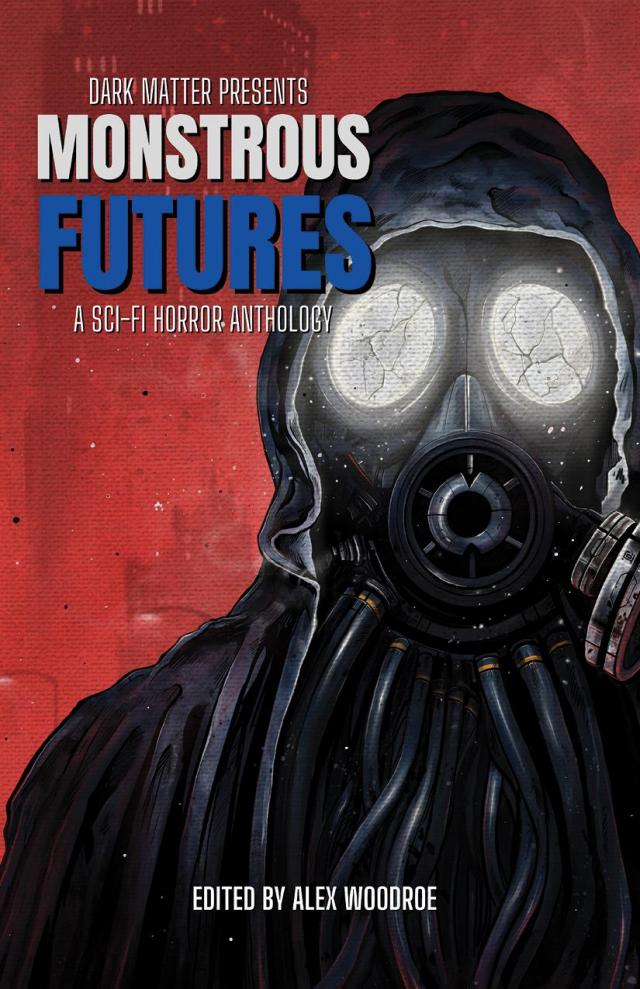
DARK MATTER PRESENTS
MONSTROUS
FUTURES
A SCI-FI HORROR ANTHOLOGY
Copyright © 2023 Dark Matter INK, LLC
Introduction copyright © 2023 Andrew F. Sullivan
Pages 350–352 constitute an extension of this copyright page.
This book is a work of fiction. Any reference to historical events, real people, or real places are used fictitiously. Other names, characters, places, and events are products of the author’s or artist’s imagination, and any resemblance to actual events or places or persons, living or dead, is entirely coincidental.
First Dark Matter INK paperback edition April 2023.
All rights reserved. No part of this book may be reproduced or used in any manner without the prior written permission of the copyright owner, except for the use of brief quotations in a book review.
Edited by Alex Woodroe
Book Design and Layout by Rob Carroll
Cover Art by Olly Jeavons
Cover Design by Rob Carroll
ISBN 978-1-958598-07-8 (paperback)
ISBN 978-1-958598-21-4 (eBook)
darkmatter-ink.com
DARK MATTER PRESENTS
MONSTROUS
FUTURES
A SCI-FI HORROR ANTHOLOGY
EDITED BY
ALEX WOODROE
Contents
Introduction
By Andrew F. Sullivan
Once a Traveler
By Christi Nogle
The Least I Can Do
By Koji A. Dae
Normalcy Protocol
By Kevin M. Folliard
Fully Comprehensive Code Switch
By M. H. Ayinde
I Promise I’ll Visit, Ma
By Kanishk Tantia
A Flicker
By Emily Ruth Verona
About a Broken Machine
By Catherine Kuo
Consider This an Opportunity
By J. A. W. McCarthy
Shiny™ People
By Rae Knowles
Dissection
By Rich Larson
Who Sees All
By Avra Margariti
Father Figure
By Lisa Short
How I Creak for You
By Aigner Loren Wilson
Inter-Dimensional Travel Solutions
By M. Elizabeth Ticknor
Kavo, Beta (Eat, Child)
By Simo Srinivas
A Smooth Handover
By Ashleigh Shears
Kill Switch
By Wailana Kalama
The Wrong Mall
By Ivy Grimes
Nanny Clouds
By Kay Hanifen
Scary Canary Actuary
By D. Roe Shocky
Subscribers Only
By Yelena Crane
All the Parts of a Mermaid That I Can Recall
By S. J. Townend
The Body Remembers
By P. A. Cornell
A Front Row Seat for Miss Evelyn
By D. A. Jobe
The Burn-Outs
By Hugh A. D. Spencer
Would’ve, Could’ve, Should’ve
By Andrea Goyan
You Don’t Have to Watch This Part
By Rodrigo Culagovski
For Those Not Yet Lost
By Kaitlin Tremblay
My Strengths Include Customer Service and Teamwork
By Lew Furber
About the Authors
Content Warning
This anthology contains content that may be unsuitable for certain audiences. Stories include foul language, disturbing imagery, and graphic depictions of sex and violence. Reader discretion is advised.
Introduction
By Andrew F. Sullivan
We were lied to.
Tech has become shorthand for a shell game, venture capital shuttled from one haven to another before the rest of the world can catch up. The dystopia is here, to invoke that old saw in a more haggard form, just unequally distributed, the ghost of a still-living Gibson looming over our existence with a bitter laugh. It’s always been here. It never went away, only changed its face.
Each morning there is a fresh algorithm attempting to seize you with its seven-fingered hands, smiling with endless rows of whitened teeth, asking you to enter its maw with credit extended while counseling you through a screen on the best way to make yourself a productive earner for someone higher up the ladder, someone in a tower or a bunker or another highly appointed hole.
All of this has been agreed upon in print so fine it slips right through your skin and enters your bloodstream. All of this is part of an ongoing extraction project—our humanity just another natural resource to be pillaged and burned. Your attention will be priced accordingly.
The idea of progress as possibility is dead on the vine, rotted out from within, fed on by parasitic wasps flitting from one rind to another, whether it’s a drawing of an ape shitting on its own face forever or a pyramid scheme made from dried liver treats. There is a car without a driver out there with your name inscribed on its grill, waiting to emboss it on your forehead at sixty miles an hour. They will say you should have seen it coming in the dark.
Let the scales fall from our eyes on the rate-limited road to nowhere and embrace what was always true—the future is not about what could be but about what we can do to adapt, to cope, to survive its imminent arrival. The future is that hand on our throats figuring out just how hard it can squeeze without disrupting the global supply chain beyond repair.
The stories in this collection grapple with what we already know, invoking the ever-present ghosts of progress that haunt us. They explore the fallible nature of our perceptions, the way our own brains can undermine our sense of self. J. A. W. McCarthy’s “Consider This An Opportunity” offers up a sibling to fill a hole that may never have been there in the first place, a body decaying in real time to serve its newfound, twisted purpose. In Ivy Grimes’s “The Wrong Mall,” one girl attempts to find somewhere to belong, only to find her grip on reality itself slip away in the virtual recreations of the Gloweria.
A future that is so near it breathes the same air we do, that requires our obedience to its own inhuman hierarchies of need. In “Fully Comprehensive Code Switch” by M. H. Ayinde, the body is held hostage to the dictates of the Switch, which modulates the voice and behavior of its supposed owner to survive the corporate pecking order. In “My Strengths Include Customer Service and Teamwork” by Lew Furber, no mechanism is needed, as the functions of the worker are instilled from birth and enforced through pain, even as the world melts into a desert outside.
Flesh is just as malleable as code in our near future. “The Least I Can Do” by Koji A. Dae requires pulling on the literal guise of someone else, a fresh and lab grown skin. In Kaitlin Tremblay’s “For Those Not Yet Lost” the autopsy of a time traveler unearths a cryptic warning scraped into the viscera. There’s no escape from our obligations. In “Who Sees All” by Avra Margariti, the surveillance state is embedded in the body itself, the family happy to play the role of warden, embracing the panopticon as proud parenting.
This collection is not a diagnosis for our modern age or a prescription for what ails us. Fiction is not a soothing balm for our fractured psyches or an antidote for a poisoned mind. We can acknowledge our dread and attempt to name it. Process what we cannot control: systems outside the individual’s capacity, entities with no end game beyond a number, institutions serving old dead gods that still insist on being fed. See how our fears parallel each other in their conception.
We can confront entropy and its inherent decay, stare down the dissolution of all things without engaging in the embarrassing ego trip of an apocalypse. Assuming that your own end means the end of all other things at once takes a certain kind of arrogance, one quickly disproven by whoever follows in your steed. Our past is littered with promises of oblivion, self-serving and decadent claims of the egotist, the siren song of cults innumerable. To quote Waubgeshig Rice, “an apocalypse in one place is a new beginning in another.” Your end is not the end.
The future does not arc toward anything. It spins on into the nothing unconcerned by our lamentations. It does offer us a chance to acknowledge what has failed, what has fallen, and what may come again. It gives us an opportunity to plant some fresh seeds in our collective, seething loam—to see what sprouts anew from the overwhelming accumulation of our past mistakes.
These new growths, these stories, they don’t promise progress, just an extension of this monstrous, human timeline. An ability to see clearly what we have wrought, to name our own designs and their latest iterations, all tossed into the same steaming pile. Peek outside your window. Open up your browser. Take a good look for yourself. The landfill stretches on forever.
Once a Traveler
By Christi Nogle
Elle and her clients said their long goodbyes as she waited to board the flight. They were going to leave her free instead of riding her home, which was one way of giving a tip. She carried two of them this time, thoughtful old Mrs. Spears and cranky Mr. Longfellow, though who could ever say if those were their
The faces were not there to anyone but Elle; she saw them through her glasses. She heard their voices through tiny speakers set into the earpieces. They were in their homes; whether bedridden or puttering about, she would never know.
Just now, she and the old lady had finished exclaiming over all the fun they’d had this vacation and they began commenting on a group of young adults who were engaged in deep discussion across the lobby. Cute, healthy kids. Ought to say hi and shoot them some business cards, Elle thought, but she was too tired to get up. This trip had been a week of guided rafting and hiking in the Idaho wilderness. Lovely but very taxing, so now she and her clients rested and watched the kids’ animated conversation, which got them all talking about youth.
“I used to be so very quick with everything, and now I’m so slow,” said prim-faced Mrs. Spears. “When I was young, I would spend time in the group chats, you know what those were? Chatrooms?”
“Yes,” said Elle. This was the first time she had felt that little pang of recognition when a client talked about aging.
“I would sit in chatrooms and just crank out these pithy remarks and one-liners, watch everyone else’s responses and oftentimes predict what they’d say before they said it. These days, I’d look at something like that and, knowing I couldn’t keep up, I’d say ‘fuck it.’ Do something else. Read a book, work in the garden. It’s not bad, really. It’s—”
“You’re just old,” said snake-faced Mr. Longfellow. “Nothing surprising about any of that.”
Why doesn’t he just log out? Elle thought, but she knew he was waiting to make sure she boarded safely. It was a social nicety, the least he could do after having ridden her all week.
She watched the kids. The tall girl with the tight ballerina bun, in particular, looked like a born traveler. Long, strong legs. Beautiful, but not intimidatingly so. She kept laughing, showing large teeth, and her entire demeanor made Elle think of good sleep, perfect health, and more to the point, a lack of secrecy.
“Listen, please don’t feel obliged to wait. I can shoot you boarding information—I can even shoot you a selfie if you want to get to something more interesting,” Elle said.
“See you in December,” said Mr. Longfellow, and he blinked out before Elle could respond. She’d nearly forgotten about his ski trip. Ugh.
“It was marvelous, Elle, but it is about lunchtime here,” said Mrs. Spears.
“I just want to tell you how glad I was to have you again,” said Elle. There were more kind words spoken and tentative plans for an island trip in the next six months or so—budget allowing—but within moments, Mrs. Spears had logged out and Elle’s glasses chimed with a ten-star review. Elle had regained her freedom for the first time in a week.
Only she wasn’t free at all. She had to talk up the teens and shoot cards to all of them while making clear through eye contact and smile-mirroring that the tall girl was really the one being scouted. She had to go over reports on the plane and did not finish this task before landing. In fact, she had to complete the reports over her simple dinner and kept working as the remains of it cooled on her plate.
Eventually, she had to abandon the reports for the evening because it was already time to shower, put on pajamas, brush her teeth, and lie down. A five-star review chimed just as she was flossing. A wave of rage. The absolute fucker. The moments before sleep came were her one chance to think, but—curse her perfect sleep sometimes—they did not last. She intended to think through all of Mr. Longfellow’s little aggressions for her reports. His refusal to log out when she ate, for example, but she lost consciousness before she could call up any more.
• • •
The moment Elle put on her glasses, Troy’s voice greeted her. “Good morning! Can you come into the office today?”
“It’s a day off,” she said. A day to wash laundry and restock the refrigerator, anyway. Maybe a moment to sit on the balcony.
“I know,” said Troy, “but we have a group of three potential travelers, and one I think you scouted, anyway. Roxanne? Tall girl?”
“That’s impossible.”
“She’s local, looks like she logged in two minutes after getting the card, and we already had the other two awaiting an appointment date. They’re all eager. We could get someone else, but they know you from the commercial, so—”
“Yep,” Elle said. “I’ll be there.” She’d had endless requests for recruitment meetings ever since that commercial first aired over fifteen years ago. Elle travels the world for a living. She can take you with her anywhere, any time. Vivid shots of hikes, street carnivals, cruises. Her legs had been so beautiful in a pair of khaki cargo shorts, and now whenever she thought of the commercial, she thought of those perfect smooth legs.
“An hour?” said Todd.
“Excellent.” Elle selected a deep chocolate-brown sheath and blazer, opaque tights. Always had to cover the scarring now.
But she flushed with gratitude for her nice, easy wardrobe and her cozy apartment with its soft colors and pretty rugs. She was well rested and had all the time she needed to do her face, stop for coffee, and breeze into the office, where the workers would greet her in a show of affection as well as respect. It really was quite a life, wasn’t it?
• • •
Elle was glad Troy had chosen the smaller, more intimate conference room with the old-fashioned comfy chairs. The kids were already seated, the tall one looking good in a fashionable brown skirt suit and bare legs. The one beside her was a little too voluptuous, face a little too flashy as well. The third looked much like Troy. Two yeses and a no, probably. She wished Troy could just go ahead and dismiss the unlikely one, but a plan was a plan.
She and Troy beamed as they introduced themselves. “So glad you could come in on such short notice,” Troy said, to Elle as well as the kids.
A warm feeling washed over Elle for no particular reason. She was glad to see the tall girl, as she’d get a commission, but that wouldn’t bring this flush on, would it? She felt a little sweat coming on her forehead, which troubled her. Sweat without heat or exertion was never a good sign.
“Roxanne,” said the girl with a low little nod.
“Brynn,” added the next one.
“Harper,” said the Troy-looking one.
Might as well send Brynn across the hall, Elle thought.
“We’re here to answer any questions and, well, just talk through the process,” said Troy.
“Do you travel, too?” said Roxanne.
“I used to!” said Troy, “Now I do all this boring office work.”
He has kids. A life outside the job.
“It’s really wonderful to meet you, um, officially,” Roxanne said to Elle. “I still remember the commercial.”
Flattering me, letting the others know we’ve already met. It’s good that she’s smart, but is she too scheming? Troy still looked elated, though. He hadn’t noticed, or it hadn’t fazed him.
Harper said, “My mom wanted me to ask first thing. There’s no, uh—”
“No sex?” said Troy. “Correct. This division provides an entirely non-sexual travel experience. Across the hall may be a different story.” He winked.
Elle looked at Brynn, who looked away. “Everyone here is eighteen, though, right?” she said, and they nodded. Troy tapped his glasses to let her know their data had been reviewed.
“And no, uh, implantations?” asked Harper with a gesture to the side of his head.
“Glasses-only here. We’re real old-fashioned,” said Elle.
“The jobs are really more siloed than people realize,” said Troy. “Across the hall you could hire, for example, a honeymooning couple equipped with intimate sensors. At another agency you’ll find gastronomical travelers who have all this scent and taste gear–‘implantations,’ if you will–and so many other kinds as well. Here, we do what we like to refer to as ‘clean’ work. It’s all basically visual. They’re seeing what you see, and that’s it.”
“I mean, that’s not quite it,” said Elle.
“No?” said Troy with a curious look. Elle really did like him.


