

Detonation Boulevard, page 1


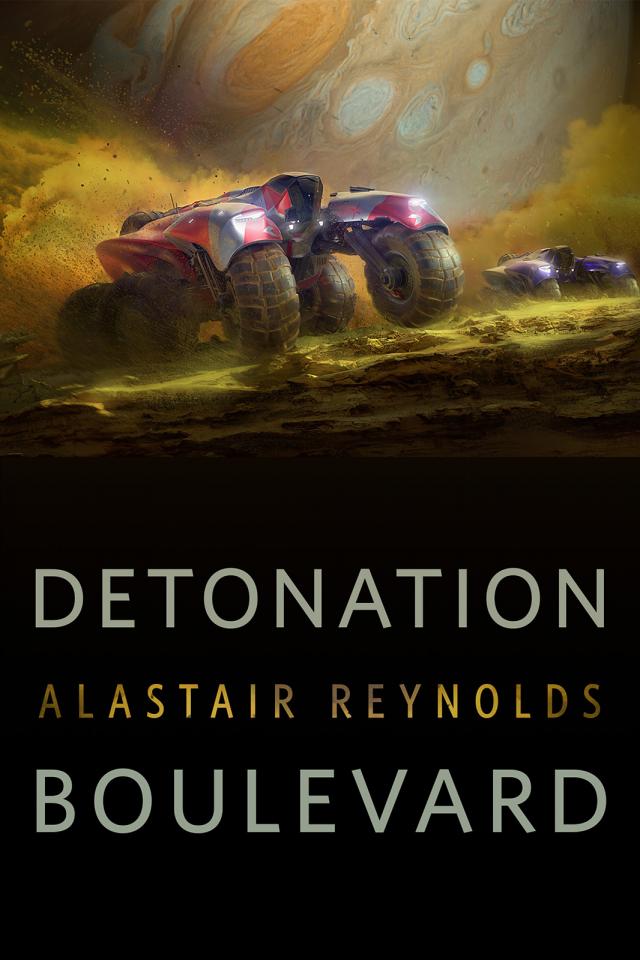
Begin Reading
Table of Contents
About the Author
Copyright Page
Thank you for buying this
Tom Doherty Associates ebook.
To receive special offers, bonus content,
and info on new releases and other great reads,
sign up for our newsletters.
Or visit us online at
us.macmillan.com/newslettersignup
For email updates on the author, click here.
The author and publisher have provided this e-book to you without Digital Rights Management software (DRM) applied so that you can enjoy reading it on your personal devices. This e-book is for your personal use only. You may not print or post this e-book, or make this e-book publicly available in any way. You may not copy, reproduce, or upload this e-book, other than to read it on one of your personal devices.
Copyright infringement is against the law. If you believe the copy of this e-book you are reading infringes on the author’s copyright, please notify the publisher at: us.macmillanusa.com/piracy.
I raised a fist and strode out into the full glare of the floods.
Crowds roared in my earpiece as I stopped to take it all in, recalling the words of my old mentor. Before he flamed out across Utopia, Joff had told me to savour moments like this one while I still had the chance.
‘Never forget the hard work and sacrifice that put you on that grid, Cat,’ he’d said slowly, his voice like a gearbox full of gravel. ‘You’ve earned that ride, and you’ve earned the adulation. But always remember it might be the last time.’
‘I’ll know when it’s the last time,’ I’d countered, with all the arrogance and certainty of youth.
‘That’s what everyone thinks,’ he’d said, turning from me with a rag in his hand.
It had taken me a while to realise how right he was. About ten years, one pair of legs, and all the lessons I’d ever need in winning and losing. By which point it was far too late to admit it to the gruff old bastard.
* * *
The start of a race – any race, anywhere in the system – was a beautiful spectacle. The tiered, pressurised grandstands leaned in above the grid, twenty stories high. The cars waited on their launch positions, huge as houses, bodies perched high on six balloon wheels. Technicians and race scrutineers fussed around them, adjusting parameters and checking for the tiniest rules infraction. A circus of journalists, sponsors, and celebs pressed in close to the pampered machines. Some drivers were already aboard, hunched and tiny in their blister cockpits, set high up and forward on the enormous vehicles. Others were scrambling up the access ladders between the monstrous wheels. On the cars’ bodies, a changing flicker of logos and slogans betrayed the twitchiness of advertisers, responding to the tiniest rumour or hint of nervy body language.
Rufus nagged me through the earpiece.
‘We’ve got a car to be getting to, girl.’
‘And I’m just taking things in. Joff told me—’
He cut across my reminiscence. ‘Piping the commentary through to you now. Try and smile for the feeds.’
‘I am smiling!’
‘Then smile more. Looks like a grimace from here.’
I walked onto the grid, a spotlight tracking me. The crowd roared some more. I did a dance with my new prosthetics. They were fresh-in from Gladius Exomedical, expensive and sleek. Too bad they didn’t fit quite as snugly as my old pair. We had to keep Gladius sweet all the same, since they were paying for about a third of the car.
‘And Cat Catling emerges to take her place in the second car on the grid! Catling, the relentless underdog in the metallic blue Bellatrix Beta, never a victor at the TransIonian, but racking up an impressive set of wins this season, from Venus to Titan. Can she extend her run of good fortune under the baleful face of Jupiter, or will Zimmer retain his crown for the eighth year running? And speaking of Zimmer, he’s in no hurry to take his seat on pole position in the bright red Imperator Six! He looks like a man without a care in the world, happy to chat to all comers!’
‘Oh, balls,’ I murmured.
‘You weren’t on mute,’ Rufus complained.
‘In which case … oh, balls again.’
‘You realise each little outburst like that costs us three percent in sponsorship, don’t you?’
‘It’s Zimmer. Why didn’t you tell me he was grandstanding?’
‘It’s what he does. Which doesn’t mean you have to answer questions, speak to him, or even make eye contact.’
‘This is deliberate. He wants an exchange.’
I heard the weary resignation in his voice. ‘Catlin…’
‘Unmute me. This is for keeps.’
Zimmer had decided to stage his little performance piece right next to the flame-orange Firebird belonging to Shogi. He was addressing a journalist, flanked by two nervous, fidgety members of his PR team.
I could avoid him – but only by taking the long way around to my car.
Not a chance of that.
Zimmer turned to meet me, spreading his arms in a gesture of innocent apology. His voice boomed over the general race channel.
‘Sorry, Catling! I didn’t think I was in the way! I assumed you were already in your car!’ His visor dipped down. ‘New legs, aren’t they? Neon pink flamework, too. Old-school. Brave choice.’
‘Thanks,’ I said acidly. ‘And how’s that new eye of yours working out? Hear it started glitching on you last time out.’
‘Cosmic ray strike: took out a whole array buffer.’ He shrugged effortlessly. ‘I still won.’
I put my hands on my hips and appraised him like a slightly wonky art installation, the kind you glance at before moving on.
‘What is it now, Zimmer? Forty-three percent of you replaced or augmented?’
He smiled behind the semi-mirrored visor. Zimmer’s face was gameshow-host handsome, with a stiff, synthetic sheen to it. ‘I’m within the racing code. This year we’re allowed forty-five percent augmentation.’
‘And next year it’ll be even more, just to keep you legal. Lucky your team has the influence it does, or they might have to start stuffing meat back into you.’
He kept his voice level, his perma-smile unwavering. ‘You’re not as far behind me as you’d like to make out. Those legs, and those new neural mods your team have been keeping very quiet about?’
‘All legal,’ I asserted. ‘The scrutineers have been over me just as thoroughly as the car.’
‘In which case … all’s fair between us, isn’t it? Two drivers, two cars, a racetrack ahead of us. What could be more … sporting?’ He reached out a hand for me to shake. ‘Shall we?’
I bristled, aware that all eyes were on me. A show of ungracious conduct right now could knock whole percentage points off our sponsorship. Rufus wouldn’t like that.
Besides, Joff had always told me to keep it gentlemanly.
I gritted my teeth and shook his hand.
‘May the better driver win.’
* * *
The start lights came on in sequence. I pressed down on the throttle, the force-feedback from my new legs just a fraction off, but not so much that it was going to throw my race. Traction power flowed from the car’s nuclear reactor to my wheels. They strained against supercooled ceramic brakes, the entire vehicle rocking like a theme-park pirate ship. Temperature dials needled into the red on my console.
The car was a beast. It hated standing still.
‘Race watchers!’ bellowed the commentator. ‘The course is open! The down-ramp is lowered! The drivers are set, their cars at launch power! Who will cross the finish line first after circumnavigating Io, some sixty hours from now? Zimmer and Catling lead the grid, and all eyes will surely be on their races, but we must still talk about Shogi, looking to go wheel-to-wheel against Mossmann in the Black Shadow. Denied the cup at Callisto after a cooling circuit blowout, the redoubtable Shogi…’
I tuned out the babble and concentrated on my launch. The interval between the fourth and fifth lights always seemed an eternity … and yet there was only room in it for one or two heartbeats.
Five lights.
No lights. And … everything flowed, slow and fast in the same impossible instant. Cars were moving. I saw them all, picked up in mirrors and direct video feeds. A line of huge colourful machines gathering speed like boulders sliding down a mountainside. I studied Zimmer’s wheels, looking for a trace of slip against the greasy surface of the grid. Nothing. The bastard had a perfect launch, clean on the throttle. I resisted the urge to gun it, applying smoothly rising power, letting the car find its own grip.
There was no overtaking down the long start straight, and no one stupid enough to attempt it. Speed mounted: one hundred kilometres per hour, two hundred, three hundred. The grandstands became a silent blur of light and tiny faces. The cars were barrelling down a long enclosed tunnel, metal grid below and floods above, premium advertising banners chasing hard on their tails.
All very sterile, all very corporate and controlled. But things would be getting real and dirty very quickly.
Ahead, coming up fast – the Bellatrix Beta was nudging three hundred and fifty kilometres per hour – was a steep down-ramp. Zimmer hit it first, momentum carrying him over the lip, his car following a shallow parabola until it re-engaged with the sloping road.
I eased off just before the transition, keeping all wheels in contact and maintaining my slow but steady acceleration. I fell behind Zimmer, then caught up again as his car bogged down and struggled with traction.
‘Rookie error, Zim.’
His answer crackled back, his voice juddery with vibration. ‘You’ve made enough to know one.’
‘Oh, the burn!’ I shot back.
Joff would be shaking his head about now, telling me to focus on the race, not mind-games.
Zimmer was first down, but only just. I was at his side, less than a third of a car’s length from the bulbous nose of the Imperator Six. Now those monster wheels really came into their own, biting into the Ionian crust. I put all power down, red-lining the motors. The huge structure of the grandstand and starting grid fell behind, blurred in the plumes of dust and gas rising behind our cars. The opening leg was relatively flat and level: I could go all-out without risking damage to the tyres, wheels, or suspension.
So could Zimmer, though. His car was no faster than mine, but because he was slightly ahead he could choose the racing line. He knew this moon like it was his private racetrack. He could pick and choose his course, gunning for the areas of crust where his instincts promised a tiny but crucial advantage.
The only winning condition was this: end up back at Ruwa Patera, after a complete circumnavigation. Twelve thousand kilometres, give or take. Sixty hours, at the average winning speed. Fifty-seven was the course record, set by Chertoff. No one had got close to that since.
Chertoff wouldn’t be trying. Hard to race in a lead-lined coffin.
* * *
The first hour was critical. Cars could get badly out of position, picking a bad strategy, pushing too hard, or just hitting an early streak of bad luck. A lot could be decided in those first couple of hundred kilometres. The next nine or ten hours, once the drivers had settled into things, was more a question of endurance and perseverance. Things got juicy again around the first waypoint, as cars converged from different routes and scrapped for a limited strip of terrain.
I was too much of a veteran to make any silly mistakes in the first leg. I kept an eye on Zimmer, never letting him pull more than half a kilometre ahead of me, but I kept telling myself to drive my own race and not get drawn into wheel-to-wheel action too early on. There’d be time for that later on.
Mossmann was the first to blow out. He hit a big boulder eighty klicks into the race, trying to squeeze through a gap that was too narrow for his car. He flipped and rolled. He was a long way behind me (Mossmann had picked a completely different route to mine, going much further south) but I watched it all on the live feeds. I was glad when his car righted itself and his cockpit pod ejected safely, rockets lifting him away from the surface. The car was a radioactive wreck but Mossmann would live to drive again, provided his team stayed afloat.
Joff had been racing before ejection cockpits became a mandatory feature. I still remembered some of the horror stories. Whether he told me them to make me a safer driver, or just to emphasize how easy we had it now, I couldn’t say.
There’d been a lot of changes, for sure. In Joff’s day drivers had to stay awake by means of willpower, grit, and maybe the odd illegal substance. Now we had consciousness-management neural mods, staving off sleep for up to sixty hours by selectively de-emphasizing certain areas of brain function. We had tweaks for enhanced reaction time, low-light perception, and superior spatial awareness. Mossmann must have skimped on the last one, because I’d never have made the same error. I knew my car’s limits like I knew my own elbows.
None of these tweaks and prosthetics and in-car protection measures exactly made racing on Io safe, though. They just reduced the probability of death to something acceptable to the advertisers and networks.
Every racing location in the system had its own parcel of risks. Io didn’t have the crushing pressure and acidic environment of Venus, nor the alloy-freezing chill of Titan. It lacked the dust-storms of Mars or the cracked, treacherous icescapes of Europa.
What it did have was savage, unpredictable geology. As Io moved around Jupiter, gravity toyed with it like an executive’s stress ball. All that energy being pumped into its core had to go somewhere. It ended up percolating out into a sea of sub-surface lava, keeping it nicely molten and prone to sudden explosive eruptions. Io’s geysers were lethal, random timebombs. Hit one as it went off, and your race was over. You could play safe by keeping clear of the main eruption zones, but not if you wanted a shot at a podium finish. The trick was to plot a course that hopscotched close to the geysers. Close, but not too close. Up to each driver how close they pushed that margin. How much they wanted to win. How far they had come, and how much of their career they had ahead of them.
You could roll the dice. Geyser activity was loosely correlated with Io’s position in its orbit, with the Sun either hidden behind Jupiter or bearing down hard and cruel overhead. Drivers could make a mad dash across a danger zone when the activity was expected to be at its lowest … but nothing on Io ran like clockwork. Plenty had been burned that way. And since no two TransIonians ever started at the same orbital phase, lessons learned from one race were all but useless the next time around.
Which was why winning on Io mattered more than anywhere else in the system. It might not be the race that decided a tournament, but it was the one that forged legends.
* * *
At the first waypoint, ten hours and forty minutes in, Zimmer and I were comfortably clear of the competition. He was ahead of me, but not so far that anything was decided. Now cars were bouncing in from north and south, averaging between one hundred and fifty and two hundred kilometers per hour, but looking slow and ponderous, raised up high on those enormous wheels.
We’d started with Jupiter’s dark face sitting above us, blocking the Sun: none more black over a sullen, barely visible landscape. By the time the cars started arriving at the first waypoint, though, Io had moved a quarter of the way around Jupiter. The Sun was no longer in eclipse and Jupiter was demi-lit and on its way to the horizon. The sky had picked up a shimmering, sickly sodium glow. It projected confusing shadows, making everything look unfamiliar, even to drivers who had followed the same course a dozen times.
Other than Mossmann, all the drivers made it through the first waypoint without drama. The toll was beginning to show on Scurlock, in her lime-green Draco, with a motor seizure on one of her axles. She’d been over-gunning it early on, risking cooling failure. I could tell from the plume her car was pushing up, crabbing lopsidedly as it dragged a dead wheel along for the ride. No way she was making the next waypoint, or even close to it. Mittendorfer was the next casualty, five hours into the second stint: he followed Shogi’s line right through a geyser field that was just waiting to be poked and prodded. Shogi made it through, but his car had weakened the crust just enough to spring an eruption right under Mittendorfer. The blast caught his belly, flipped the car, rolled it. The car righted itself, but by then its leading axles were buckled and useless. Mittendorfer punched out, leaving his smouldering wreck behind. A rescue drone caught his cockpit before it fell back to Io, and thirty minutes later he was pontificating from the commentary box, shaken to the core but glad to be alive.
The Sun got higher and higher in the sky through that second stint, as Io positioned itself between Jupiter and the Sun. It would have been a glorious sight from the moon’s Jupiter-facing side … but by then our cars had driven more than a quarter of the way around, edging into the face of Io which was permanently averted.
Twenty-one hours in, the remaining cars converged for the second waypoint. By now there was a big spread in their positions and chances of victory. Zimmer was ahead of me still, the only one I had a direct visual on. The others were too far away, lost behind ridges or hidden completely from view by Io’s nearby horizon. I had to rely on the video feed and race commentary to get a sense of how the larger race was playing out. Not that the others really concerned me. It was between me and Zimmer right now.
The fatigue was just being kept at bay by my mods. The race was only a third done, too. This was the psychological pinch-point for a lot of drivers, as they pressed on into the third stint. They were mentally and physically drained, even with the augmentations. The trick, Joff had told me, was to forget how many hours of driving were still ahead. It was only ever the next hour that counted. The next minute, in fact. The future only existed as far as the next corner, the next breaking zone.


