Deck Boy, page 15
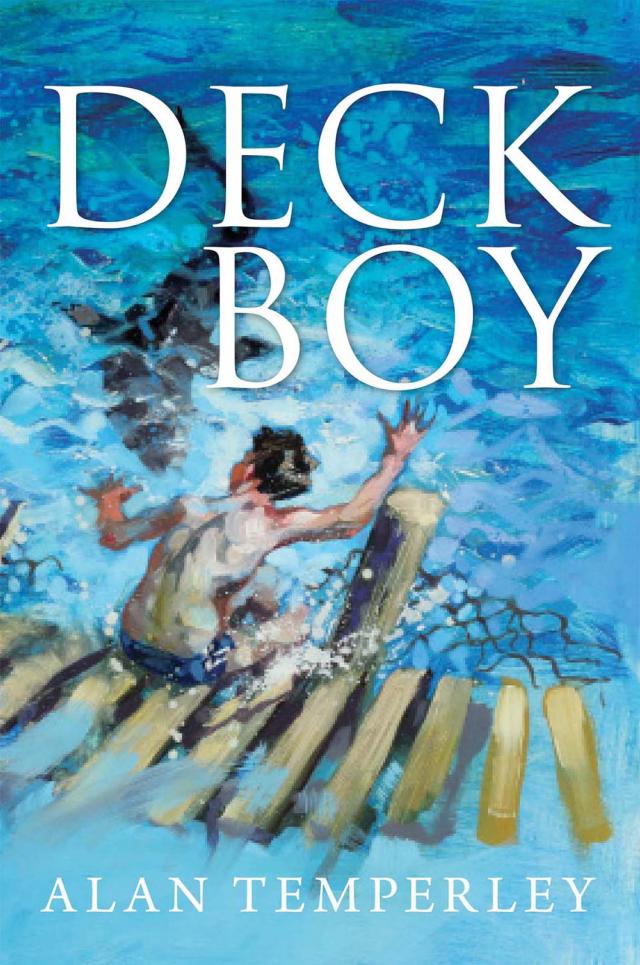


The shark circled away but before I could continue it lunged again. The weakened post threw me back into the sea. The gap was almost wide enough for the shark to squeeze through. I looked into its face with no mesh between us. The massive body, thick as two men, struggled to reach me.
In a panic I swam to the next post and pulled myself from the water. I was just in time for at my back the shark had reached the open sea. It was injured. Cuts and scratches bled into the water. Apparently feeling no pain, it turned towards me and in an instant could have snatched me by a leg. I flung myself back over the net into the pool and started swimming in a clumsy frenzy towards the shore. For several metres the shark kept pace alongside, batting the mesh with its terrible head, watching me with those dead eyes.
Then the fence came to an end. An outcrop of rocks protected the pool from the open sea. The shark glided to a halt. I stood up, the water to my shorts, and began wading. Charlie and Philip splashed to meet me.
“Are you hurt?” Charlie’s arm went round my waist.
“Why should I be hurt?” I tried to smile. “It was just an old … Happens all the …”
I began shaking. From head to foot, though I stood in the blazing sun, it was as if my bones had turned to ice.
Beyond the fence, the shark turned as if it had all the time in the world and swam off into deep water.
“I feel so c-c-cold!” I hugged arms about my chest and sat on a rock a few metres up the beach. It was so hot it almost seared my skin but the heat was comforting and after a while my shivering died down.
“Striped,” Charlie said. “That’s a tiger shark. They’re dangerous!”
“No, really?”
“Yeah, they – Oh!” He grinned.
“I thought you said you weren’t hurt,” Philip said. “What’s that?”
I looked down. There was red on the rock. The sand on my left foot was caked with blood.
“Oh, yes.” Now I saw it I felt the pain. I pulled my foot up. A ragged scratch, quite deep, ran across the sole. “I cut it on the wire.”
“That’s why it attacked you and not me,” Philip said. “They can smell blood through the water. Switches on their feeding mechanism or something. They go into attack mode.”
“Like Ben with sausages,” Charlie said. “Will you be OK for walking back?”
Limping on my heel, I returned to the shallows and rinsed out the sand. The water stung and it started to bleed again. Charlie gave me a piggyback to the rocks to keep it clean. My hand was cut too, a gash across the fingers. While I waited for the bleeding to stop, the others explored the shore.
How, I wondered, had the shark got into the pool in the first place?
Charlie provided the answer. “Hey, look at this.”
Philip was examining a desiccated seabird. He dropped it and went to see.
Charlie had found a large white board and was picking off strands of seaweed. He showed it to Philip.
“What is it?” I called.
He brought it across, a notice board with a warning painted red and black in four languages: Dutch, German, Spanish and English.
DANGER
SHARKS
DO NOT SWIM IN PROTECTED AREA.
VISITORS ARE ADVISED THAT THE NET IS
HOLED BENEATH THE SURFACE. THERE IS A
HIGH INCIDENCE OF SHARKS IN THIS AREA.
“I didn’t see that,” I said.
“Well you wouldn’t, would you.”
“Blown down?”
“No, it was hidden.”
“Hidden?”
“You know what hidden means. Pulled off the post and covered by some weed an’ dead branches an’ stuff.”
I stared at him.
“Look.” He showed me the freshly-broken wood. “I saw a corner sticking out.”
“You mean somebody – ?” I looked back at the spot where he had found the notice. There stood the white post. Jagged splinters projected from the top.
A similar post stood further away. Philip ran to look. An identical board lay near it. Fresh sand had been kicked over the top. He held it up for us to see.
“Well,” Charlie said ironically. “Both of them, there’s a coincidence. I wonder how that happened?”
An Ear at the Curtain
FOR A day we were famous. Everybody wanted to hear the story of the boys who were attacked by a tiger shark. It was even, we were told, reported in the Caribbean newspapers and back in the UK, although by that time we were far out in the Pacific Ocean.
Captain Bell interviewed us in his cabin. He was a kindly man close to retirement who wanted to enjoy his last year or two at sea. Running the ship was left in the hands of Mr Rose, the first officer.
“By God, boys, that was a close shave. And there were no warning signs or anything, you’re sure about that?”
“Yes, sir,” Philip said. “We looked before we came away. Two posts but no notices.”
We’d agreed to keep quiet about it. If Ryland, Tony and Steve knew we’d found the boards torn down with splinters of fresh wood, they were bound to realise we’d be suspicious. We had no proof they’d done it, and there was no point making a bad situation worse. Perhaps they’d realise we’d had a fright and would leave us alone for a while.
“Well it won’t do, won’t do at all. Can’t have half my crew vanishing down the throat of some bloody great shark.” He took a turn around the cabin. “Who’s going to run the ship apart from anything else?”
I laughed.
“And who’s going to tell your mothers about it? Harbour master had better pull his bloody socks up. I’m going to give him a rocket up his backside, I can tell you.” He remembered something. “You’re the laddie got his coat cut by that broken wire aren’t you?”
“Yes, sir.”
“Got a black eye too.”
“Yes, sir.”
“Want to tell me about it?”
“I’d rather not.”
“Mm. Thrive on danger do you?”
“Not really. I just want to get on and do my job, enjoy the trip.”
He eyed me keenly. “You express yourself very well for a deck boy.”
I’d done it again. “Thank you, sir.”
He thought about it. “Well said, anyway. That’s the attitude we want. I can see your hand’s scabbing over. How’s the foot?”
“A bit sore. It’ll be all right.”
“Good, good. I like a chap who doesn’t make a fuss. Gives you something to write home about anyway.”
It occurred to me that Philip and I were lucky to have hands to write home with.
“Carry on then.”
“Thank you, sir.”
As we filed from the cabin Mrs Bell, who had been sitting all this while with a piece of embroidery, offered us a chocolate.
We left Curaçao on Sunday, the bitts hot enough to fry eggs. Our next port of call was Colón, seven hundred miles away at the Caribbean end of the Panama Canal. We were scheduled to arrive late afternoon on Tuesday, allowing plenty of time to take on fresh water and give the crew a night ashore before making the nine-hour passage through the canal the following day.
Our route lay round the north coast of Colombia. The sea was calm, the sky was clear. That Sunday evening I leaned on the rail watching a school of twenty or more dolphins leaping in the bow wave and diving beneath the ship as the sun, a molten orb, slipped into the sea. Darkness came quickly. Fat stars appeared in the tropical sky. Around midnight, while I slept, we rounded Punta Gallinas and turned south-west on the long run down to Panama.
When I went on deck next morning, the snow-covered peaks of the Sierra Nevada, fifty or a hundred miles away on the port beam, floated like a mirage above the horizon.
In the mid afternoon Philip, who had been sent to the crow’s nest to keep a lookout, shouted down to the bridge. A short distance ahead, sharp-cut as a brushful of paint, the sparkling sea turned brown. The great Rio Magdalena, running north between two arms of the Andes, reaches the sea at Barranquilla and keeps on flowing. Forty miles out we sailed into fresh water. At once Charlie, Aaron and I, who had rigged a deck hose and shut the portholes in readiness, were sent to spray the ship from top to bottom to wash away the salt. We had to work quickly and were just finished, happily wet from head to toe, when the sea turned crystal blue again.
That evening, after dinner, I played deck golf with three others. A course had been painted on the crew deck. It is a game a bit like croquet with wooden mallets, hardwood pucks and numbered circles. Halfway through, Aaron’s puck cannoned into a ringbolt and flipped over the side. Since we had no spare, the game had to stop. The rest went to their cabins or the bar but I wandered up to the boat deck and leaned on a rail again to watch the sunset.
As the light faded I heard footsteps and saw Tony Fanshott-Williams disappear through a door and start down a stairway that led to the petty officers’ accommodation. He was carrying a bottle. It was, I guessed, whisky he had stolen from the hold, either when I saw him or when he returned later, as he must have done, to get the snorkelling gear for Steve. I wondered if he was visiting the bosun. Curious, I went below decks and approached the bosun’s cabin from the opposite direction.
Ryland’s and the other petty officers’ cabins stood apart from the crew accommodation. I knew them well for it was my job, as peggy, to keep them clean. I looked round a corner. The door curtains swung gently in and out but no one was to be seen. Faint voices reached me, a chink of glass, a sudden guffaw. They came, I was sure, from the bosun’s cabin. Who was in there? What were they talking about? I longed to know. It would be so easy to tiptoe to the entrance and listen. But what if I were caught? A ready-made answer sprang to mind: I could say I was looking for Lampie to get a new puck. Softly I crept along the passage.
The curtain almost touched my knee. There were three in the cabin, at least it sounded like three: the bosun, Rat’bone and Tony. Their voices were muffled by the throb of the engines, but I could make out enough to follow the conversation.
“ ’Ow much?” This was Rat’bone.
“Twenty pallets,” Tony said. “That’s … cargo plan.”
“Lovely stuff an’ all, slips down a treat. Here …”
Another clink of glass.
“… get the key?”
“Any time, just … chartroom.”
“… kids in a sweet shop.”
“… bottles you want?”
“Not … bottles. Cases, son.”
“Cases!”
“What you reckon, Lenny – thirty?”
“Whatever you … Jumbo.”
“Who dares wins, eh?”
“… store them?”
“Loads of places. Just for a few … guy I know in Fiji.”
“Pretty risky …”
“Nah … mid Pacific, everyone in their pits … dopy Steve to keep a lookout.”
“… reckon you’ll get – a case like?”
“Stuff like this, single malt? Fifty anyway. Maybe …”
“… dollars?”
“Quid I should hope. What’s that add up …?”
Something brushed my ankle. I bit back a yell of fright. It was Attila, prowling the alleyway.
“Sshh!” I stroked his ginger head. He gave a little front-paw jump to greet me, and stalked through the curtain into the bosun’s cabin.
I froze.
“Allo, a visitor.”
“Puss-puss.”
“… that mad messman.”
“Come on then.” Someone made a kissing sound. “Let’s be ’aving you. Cor, he’s a heavy brute.”
“No wonder, the Maggot prob’ly gives ’im … an’ we get the stringy bits.”
“… sling him out the porthole.”
“… kind o’ person are you? That’s cruel.”
“ ’Ere, cats like whisky?”
“… be a prat, course they don’t.”
“… a try. Come on, Moggie, what’s this? Now, now!”
Attila gave a dangerous growl.
“… bloody thing tried to scratch me.”
“I told you, they don’t …”
“Come on, Jumbo … for a laugh. You ’old ’is ’ead an’ I’ll …”
A chair scraped.
“Should be rum, o’ course … ship’s cat.”
“… like this?”
“Cor, look at the teeth on ’im.”
“Hurry up.”
“ ’Old ’im steady now. Come on, puss, open wide. You try a drop o’ – ”
There was a wild squall and a commotion. Glass smashed, something fell. A babble of voices: “Bloody arm! My face! Aah!” Another screech from Attila as somebody kicked him. “Go on, you brute!” The curtain convulsed. Attila, not hurt too badly, shot from the cabin, skittered past my feet and vanished round the corner.
I fled after him.
Halfway down the alleyway, Philip stood outside Samuel’s cabin. The mate had given permission for these two committed Christians to read the Bible together. “Hi!” He raised his hand as I came close, then Samuel appeared through the curtain and welcomed him inside. A choir was singing ‘Jesus Loves Me’ on the tape player: I knew most of the hymns through going to church with gran all my life. I hesitated then continued to my own cabin at the end.
Aaron and Michael were paying us a visit, Aaron fresh from the shower with a towel round his waist and Michael with a gin and lemon. He was talking about Ossie: “And now he’s messing about with the occult – tarot cards and that ouija board. It’s the Star of Bengal all over again. I’m frightened to think how it’s all going to end.”
They looked up as I came in.
“Ben, darling!” Michael changed mood like a chameleon. “Where have you been? We’ve missed you.” His eyes widened. “Something’s happened, I can tell. Are you all right? Come on, sit down here beside Aaron and tell us about it.”
Night in Colón
AT HALF past three on Tuesday afternoon we sailed between the tremendous breakwaters at the north-west end of the Panama Canal and entered Limon Bay. By five we were moored alongside in Colón, ready for an early start the next morning.
Strong scents blew from the land: steamy vegetation, spice, hot streets, fruit stalls, bars, drains, tropical flowers, fish. It was a heady, alluring mix that made everyone eager to go ashore.
The washroom was crowded: sailors shaving, showering, scrubbing paint from their hands, scrutinising themselves in mirrors, getting ready for a night out. To and fro they trotted along the alleyways, some half naked and still dripping, others in fresh shirts with rings on their fingers and money in their back pockets. The scents of the isthmus were obliterated by aftershave, hair gel and anti-perspirant. From a dozen cabins came the fumes of beer and whisky to set the nerves a-tingle and get the night started.
Not everyone waited for dinner. Eating wasted time, and food at that moment was not a priority. Beyond Panama lay the whole Pacific, a fortnight with not a glimpse of land. They planned to make the most of the hours ashore.
I was a sailor who did want his dinner. After a hard day’s work I was starving. Also I was on my own. Charlie, in a flame-red shirt and his striped jeans, was planning to visit a barber and get his hairstyle sharpened up, then join a crowd in the waterfront bars. The last thing I wanted was to go drinking with men old enough to be my father, though we did make a sort of arrangement to meet at a place called Matteo’s if I changed my mind. Aaron, who spent many hours writing to pretty pen pals in ports he was likely to be visiting, was off to meet Sophia, a dark-haired beauty of sixteen. Samuel was going to a church meeting. Philip was on duty. Michael had to serve dinner to the officers. Afterwards he, Barbara and Luigi were heading for a club called Tamara’s, several miles out of town.
He had described it to me: “It’s fabulous! Right out in the jungle. Madame Tamara walking round with this leopard on a leash. Actually,” he confided, “she used to be a stoker in the Royal Navy but you’d never know.”
I met them on deck, a colourful trio in a haze of lotions. “Wish us luck,” Michael called gaily. “If we don’t come back you’ll know the little brown men got us.”
“What little brown men?”
“You know, poisoned darts and pointed teeth.” He was high on excitement.
“Or the mosquitoes, or the rabid monkeys,” Barbara said gloomily. “Or the snakes, or the piranhas, or the vampire bats, or the – ”
“Oh, shut up!” said Michael. “You’re such a drama queen! I’ve told you, you’ll love it.”
“Or’a the jungle juice,” said Luigi who rarely spoke. He gave his fruit-bat smile.
“Or the taxi driver.” Barbara was looking down.
A dilapidated vehicle with a wing hanging loose and what looked like bullet holes in the windscreen stood by the gangway. The driver, a murderous-looking man with dreadlocks, leaned on the bonnet.
“Oh, my God!” Michael said. “Still, come on, my jolly sailor lads. We can only die once.” He ushered Barbara ahead of him.
Luigi, to my astonishment, gave me a big Italian hug. “Good’a bye, Ben. I love you like’a my brother. You enjoy’a yourself.”
I watched them descend the gangway. The taxi, with a bang and enveloping cloud of smoke, shuddered into life. I heard Michael’s scream of laughter. Pale hands fluttered from the window as it drew away.
I returned to my cabin. The alleyway was deserted. I had changed into my only decent shirt – my blue school shirt – and clean jeans. Now I pushed a few notes into my pocket, ran a wet comb through my hair and left the ship.
The city of Panama lies at the southern, Pacific end of the canal. The docks at the Caribbean end adjoin the twin towns of Colón and Cristóbal. Daylight was fading as I limped along the quays, for my foot was not completely healed yet, and down the dusty road that led to town. Squashed fruit and withered palm fronds lay in the gutters. With the onset of dusk, cockroaches and crabs had emerged from the drains. On every side cicadas were chirruping. Tree frogs bubbled and croaked in the undergrowth. A big rat scuttled in front of me and vanished through a wall.