Mister Timeless Blyth, page 15
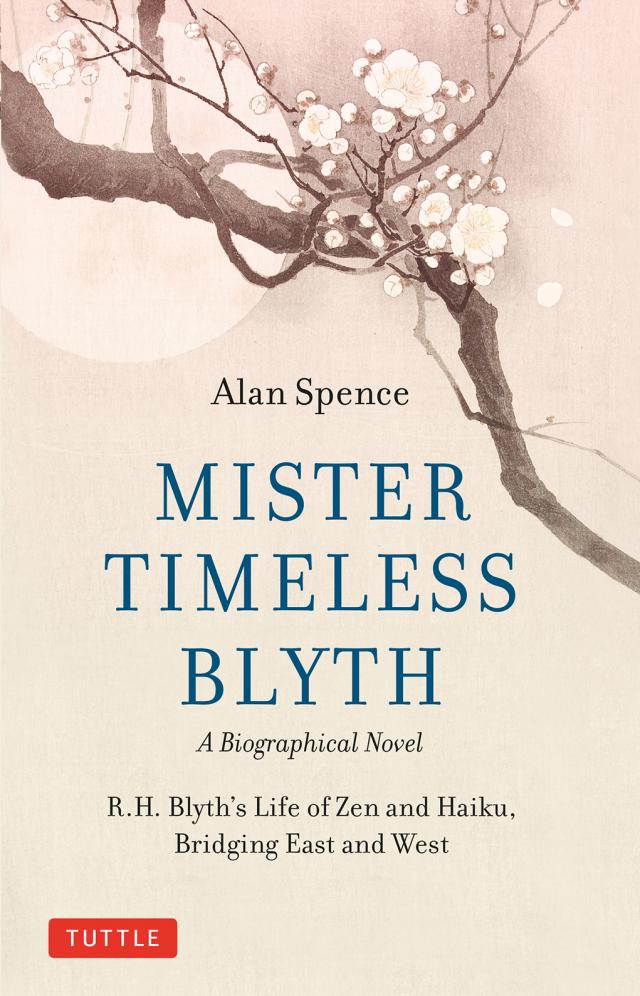


It was exquisite, the juxtaposition just perfect.
I flicked through the pages, smelled the paper. I laughed.
I could eat it! I shouted.
Tomiko didn’t quite understand but I mimed taking a bite out of the book, rubbed my stomach. Then she laughed too, at her husband the crazy gaijin, and she patted her own stomach.
A good time for us, she said.
Yes, I said. Yes!
When Tomiko’s contractions began I was useless – headless chicken, dog chasing its own tail – all the cartoon cliches of bumbling male ineptitude. What price my years of Zen practice? But I ran next door and summoned our neighbour Mrs Tanaka who had three children of her own. She immediately took charge, brisk and efficient, dispatched me to the public telephone across the road to call the hospital. We had decided in advance Tomiko would go there and she had already packed a bag with a few things she might need. The ambulance arrived and I watched, in a daze, as she was helped into the back and the doors were closed. I silently chanted the Nembutsu as the vehicle eased off down the street. Mrs Tanaka made me tea, told me Tomiko was strong and everything would be fine.
Not worry, she said, in English.
I sat up half the night, tried to read, to pray, to meditate, to not-worry.
At first light I got on my bike and went to the hospital. Tomiko had just given birth to a baby girl. There was no way on earth that I, a mere man, could begin to understand what she had gone through. The doctors said everything had been straightforward, insofar as such a thing is possible.
Later they allowed me to visit the ward. I could see Tomiko was exhausted, but her eyes shone. I stood at the end of the bed and she held up the baby for me to see. I went closer and she let me hold the little bundle. I looked in awe at the lovely puckered face, the tiny, perfect hands.
Our daughter.
I was overwhelmed, felt a joy I had never known.
We called her Harumi, the two kanji meaning Spring and Beauty. Harumi, our little Spring Beauty. Or, even more poetically, they might mean Spring Sea, as in the name of a piece of music by Michio Miyagi – Haru No Umi. Then there was a haiku by Buson, one of my favourites. Haruno umi Hinemosu Notari Notarikana.
I had made my own translation.
The sea of spring
Rising and falling
All the day long.
Harumi. Harumi.
Suzuki-sensei and Yamanashi-san both suggested I apply for Japanese citizenship. They would give their backing, and they thought Harumi’s birth and the publication of my book would both weigh heavily in my favour.
The war in Europe was running its bloody course and I entertained no more thought of returning home to England. My responsibility, my duty, was here in Japan, with Tomiko and now Harumi. The fear was that the collective madness of nations, this insatiable bloodlust held in check these twenty years, would spread, a conflagration, over the whole world. I knew Japan had its own dream of a pan-Asian empire and was in conflict with the US and the UK (itself no stranger to colonising the continent).
I renewed my application for citizenship, citing my new circumstances. I cycled to work every day, continued to teach the children in my charge. I wrote. I prayed. I meditated. I was at peace. I lived in hope.
However much we had anticipated the escalation, it was the suddenness of it that was such a shock.
The newspaper report, under the headline VICTORY, stated that Japan’s Imperial Forces had made one splendid strike after another in historic surprise attacks on Pearl Harbour, where the bravado of the US Asia fleet met with sudden defeat, and off the Malaya Coast, where the main forces of the British Asia fleet were utterly annihilated. In a third strike, Hong Kong Island, England’s strategic base for its 100-year exploitation of East Asia, fell in a matter of days.
Suzuki told me when Yamanashi heard the news, he wept.
Japan was now officially at war with the US and the UK.
Three days later I was arrested. Two policemen came to the house and I was taken to Naka police station.
The chief officer spoke English.
You will be taken to Kobe, he said, and institutionalised as persons in a belligerent nation.
Oh well, I said. If you put it like that.
Tomiko had left Harumi with our neighbour and followed me to the station. She was distraught but composed herself, tried to explain. I was a respected teacher and author, I had important friends, I would soon be a Japanese citizen, we had a young child. But the man was unmoved. The regulation was clear. There was nothing to be done.
Don’t worry, I said to Tomiko, with an assurance I didn’t feel. It will be all right.
Yea though I walk in the valley of the shadow.
They led me to a cell.
Persons in a belligerent nation.
Among my papers I have an old typed copy of the letter Churchill sent to the Japanese Ambassador in London, confirming the declaration of war.
Sir,
On the evening of December 7th His Majesty’s Government in the United Kingdom learned that Japanese forces without previous warning either in the form of a declaration of war or of an ultimatum with a conditional declaration of war had attempted a landing on the coast of Malaya and bombed Singapore and Hong Kong.
In view of these wanton acts of unprovoked aggression committed in flagrant violation of International Law and particularly of Article I of the Third Hague Convention relative to the opening of hostilities, to which both Japan and the United Kingdom are parties, His Majesty’s Ambassador at Tokyo has been instructed to inform the Imperial Japanese Government in the name of His Majesty’s Government in the United Kingdom that a state of war exists between our two countries.
I have the honour to be, with high consideration,
Sir,
Your obedient servant,
Winston S. Churchill
Churchill later wrote that some people did not like the ceremonial style of the letter. But after all, he said, when you have to kill a man it costs nothing to be polite.
I once told Yamanashi there was much Zen in that statement.
Samurai spirit, he said.
Yes, I said, but with a kind of droll bleakness, a sense of irony and paradox. Like something by Stevenson. Churchill holding his lit cigar to the fuse of a loaded cannon.
Perhaps, he said.
Now it brings to mind the passage from the Gita where Krishna tells Arjuna to fight and slay his enemies who are also his kinsfolk. Krishna tells him to have no fear because they are already dead. Krishna, as Time and Death, has already destroyed them.
Time and Death. Time and Death.
Thou shalt not kill. Or if thou must, then thou shouldst be polite about it.
They kept me at the police station for two days. Tomiko came to visit. She was tearful but resolute, determined. She had not given up hope that it was all a mistake and I would be released. But if I was indeed to be sent to Kobe for the duration, for God-knows-how-long, she would get her father’s help. She would move to Kobe, find somewhere that she and Harumi could live, near where I was to be interned.
Poor Tomiko. What she went through for my sake.
She brought me a change of clothes, a heavy coat against the coming cold. (If it came to it, the coat could serve as a blanket). She also brought a case containing some of my books and papers, the ones I had told her were most important (and including a copy of my Zen in English Literature).
The chief officer looked through the contents, checking the papers, picking up individual books, putting them back with a noncommittal grunt. I half expected he might refuse to let me take the books. But perhaps he was indeed swayed by my status as respected-man-with- important-friends. Perhaps he was impressed at seeing my own book, and by the fact that some of the volumes – the Manyoshu, the Mumonkan – were in Japanese. For whatever reason, he grunted again, closed the lid of the case, said OK, you take.
Tomiko cried, with relief I guessed, and maybe a glimmer of reassurance. We embraced and I was led away, carrying the case and my bag of clothes, back to my cell.
Next morning I was taken in the back of a van, to Kobe where I had first made landfall in Japan, so many years ago, in another life.
The Daruma doll was brightly coloured, a child’s toy I had bought in the market in Kanazawa, the robes rendered in deep red, the features crudely drawn like a caricature, a cartoon version of the fierce Zen patriarch Daruma, Bodhidharma.
The eyes were staring, lidless, for according to legend, Bodhidharma had cut off his own eyelids so he wouldn’t fall asleep in meditation. Where he threw them a tea-plant grew up, so the monks could drink tea to keep awake. A less drastic solution, and a good story.
Another legend was that he sat so long in zazen that his legs atrophied and fell off, hence this depiction as a doll rounded at the bottom. If you knock it over it rolls back up.
Get knocked down, bounce back up.
Before I was taken away I had showed it to Harumi. Down…up.
There was a little chant that went with it.
Nana korobi ya oki… Seven times down, eight times up.
I sang it to her, made her laugh. She knocked the doll over, watched it bounce back, clapped her hands.
The clothes and blankets Tomiko had packed for me were in an old kit bag – Pack up your troubles! (What’s the use of worrying? It never was worthwhile…) At the bottom of the bag, wrapped in a towel, she had placed the Daruma doll. To remind me.
Nana korobi ya oki…
6
EIGHT TIMES UP
The authorities had taken over a ramshackle old mansion known locally as Mark’s House after its original owner, an American businessman who had gone back home when he saw the way the wind was blowing. The house was set back from the road with a courtyard and high surrounding walls. There I was to be interned along with other persons in belligerent nations, mostly Americans
Shades of the prison house. Again.
The camp commander, Mister Higasa, seemed like a decent man, serious and conscientious, making the best of a difficult job. He assembled us one morning in the courtyard in front of the house.
It was the kind of scene that would later be replayed in numberless British or American war films. But here there was no brutality, no overt threat. Higasa did not rant or try to intimidate us. He explained that our situation was unfortunate and that he hoped our internment would not last long. He also said we would be treated well and that our co-operation was essential. Restrictions on our freedom were regrettable but necessary and if we accepted this there would be no problems. He then bowed to the rising sun flag above the building, and we were dismissed.
His office was on the ground floor, next to the main entrance. He must have had a gramophone in there and from time to time, when the window was left open, we could hear his music blaring out. Most of it was martial – patriotic marching songs, with now and again some popular piece of sentimental trash. Occasionally he would play something western, a sombre passage from Beethoven, or a march by Sousa. But one recording he played every day was an unsettling piece called Roei no Uta, the Bivouac Song.
It was a paean to glorious death, bloody sacrifice on the battlefield, and I grew to loathe every note of it, its tinny jingoism jangling my nerves.
It began, Katte kuru zo to isamachiku… To prevail with utmost courage.
Then came Asita no inochi o dare ka shiru… Who knows what tomorrow shall bring?
Next was something about being soaked in blood, saluting the rising sun. And finally the triumphant Tennoheika banzai to! Long live His Majesty the Emperor!
Ten thousand years. The rising sun flag. Banzai!
I was allocated a corner of what had been an office. In an alcove there was room for a simple wooden palette bed, covered with a thin mattress and an old quilt. I could draw a curtain across the space to close it off, transform it into a monk’s cell.
Did ye hear about the lonely prisoner?
Next to the bed was a makeshift desk knocked together from two old packing cases. It was definitely more comfortable than my cell in the Scrubs. I would make the best of it.
We arranged for Tomiko to move to Kobe for the duration. We could afford to rent a small house not far from where I was imprisoned and where she and Harumi could be comfortable enough. With the help of her father and some of my colleagues from Kanazawa, we even managed to transport my entire library, packed in crates and loaded into a borrowed truck. Tomiko was allowed to visit me one day a week (sometimes with little Harumi in a harness on her back). Every time she would bring a few books, my papers and notes, pens and a stack of lined notebooks for writing.
Translations of haiku in English had begun to appear – Asataro Miyamori’s Anthology of Haiku, Ancient and Modern and a little volume by HG Henderson, The Bamboo Broom. I found much to admire in both books. I could even (almost) forgive Henderson his talk of ‘Basho’s eternal concentration on the beauties of the Absolute.’
(I had no idea how much Henderson would come to figure in my life, or the nature of the task we would undertake together. That would be years ahead, in a yet uncertain future).
I resolved to keep working on my own translations and commentaries, towards another book. By effort of will, or by simple acceptance, letting go of expectation, I would lose myself in writing or in the focus of zazen. War was raging over half the world and I was locked away here, not free, but otherwise unharmed. And in that very constraint, the limitation placed on my outer life, my inner life came powerfully to the fore. I recalled Suzuki’s quote from Eckhart – What a man takes in by contemplation he must pour out in love – and Suzuki’s gloss, that in Zen he must pour it out in work.
Well then, this was my work, and I would go to it with love.
I settled to a routine, zazen every morning, early before anyone else was awake, a little exercise walking round the yard, some physical work sweeping and cleaning the floors. I washed dishes, I even took my turn scrubbing the latrines, holding my breath against the stink. (In fact I rather took a pride in that as a kind of monastic duty!) But for hours every day I had time to read and to write. This would be my life, my discipline, as long as the war might last.
Two years passed.
I endured.
I was seated one day, cross-legged on my bed, absorbed in my work. As I recall, I was translating a passage on senryu, and a particular poem had made me laugh.
When the Buddha was born,
the first thing he did
was blow his own trumpet.
I looked up and saw a young man who had just come into the room. He was clearly American, a new arrival.
He looked at once eager and apprehensive.
Mr Blyth? he asked.
The very same.
My God!
I sincerely hope not, I said, otherwise you’re in trouble!
I looked at him more closely, saw he was frail and thin. His breathing was wheezy and laboured, asthmatic.
He said his name was Robert Aitken and he’d just been transferred from another holding centre.
I said I hoped he had not been too harshly treated.
No, he said. Not at all. Apart from the loss of my liberty. And the inadequate rations. My health has suffered somewhat.
I nodded in sympathy, cleared a space beside me on the bed and motioned him to sit down.
Thank you, he said, and he caught his breath before continuing. But I know we’ve been lucky, and things could have been much worse.
Indeed.
In fact, he said, one of my guards showed me a great kindness, and that’s why I was hoping to find you.
I’m intrigued.
This particular guard was a young man who actually spoke some English. One evening he came into my room, quite drunk, waving a book in the air. This book! he shouted. My English teacher…
As he spoke, Mr Aitken opened a little canvas bag he was carrying, and brought out a book to show me – a battered and much-read copy of my Zen in English Literature.
My book! I said. How extraordinary!
It was! You’d taught this young fellow in Kanazawa, and he actually loaned me the book. I think he wanted corroboration that his English teacher was in fact a man of some importance.
Hardly.
You sell yourself short, said Aitken, his eyes shining with what I feared might be the zeal of the acolyte. I must have read the book straight through ten or eleven times, he said. I memorised my favourite passages and could turn right to them. The guard gave up on even trying to get it back from me, and bought himself another copy.
Aitken flicked through the book again, laughed, amazed at his luck in finding me. He had heard a rumour I was here but he didn’t dare believe it.
Every time I finished reading the book, he said, I just started again at the beginning. I suppose it was my First Book, if you know what I mean. The way Walden was for some of my friends.
You put me in exalted company, I said.
Would you have had a First Book? he asked.
I’ve never thought about it, I said. But perhaps Arnold. I read him when I was still at school. Dover Beach. Culture and Anarchy. I still find myself revisiting him from time to time. Life is not a having and a getting, but a being and a becoming.
Yes! said Aitken, clenching his fist in a little gesture of affirmation. I think there’s a great deal of Zen in that.
And even more in this. We are here on earth to do good to others. What the others are here for, I do not know.
For a dreadful moment I thought he was about to start taking notes, but he just laughed again, shook his head, still coming to terms with the fact that we were actually sitting here talking.