

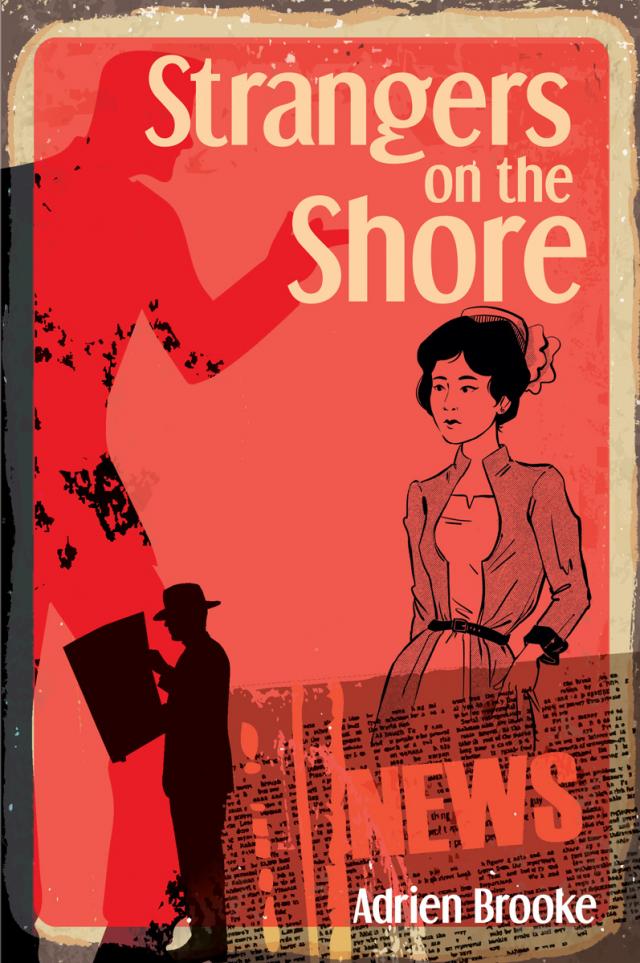
Strangers on the Shore, page 1


Published by
Hybrid Global Publishing
333 E 14th Street
#3C
New York, NY 10003
Copyright © 2024 by Adrien Brooke
All rights reserved. No part of this book may be reproduced or transmitted in any form or by any means, electronic or mechanical, including photocopying, recording, or by any information storage and retrieval system, without the written permission of the Publisher, except where permitted by law.
Manufactured in the United States of America, or in the United Kingdom when distributed elsewhere.
Brooke, Adrien
ISBN: 978-1-961757-89-9
eBook: 978-1-961757-53-0
LCCN: requested
Cover design by: Julia Kuris
Copyediting by: Claudia Volkman
Interior design by: Amit Dey
Author photo by: Jeff Sweet
Illustrator: Daniela Ruggeri
adrienbrooke.com
EPIGRAPH
To the west, America, he said, full of greedy fools fouling up their inheritance. To the east, China-Russia; he drew no distinction: boiler suits, prison camps, and a damn long march to nowhere. In the middle . . .” —John le Carré, Tinker Tailor Soldier Spy
活着就要斗争,
在斗争中前进,
即使死亡,
能量也要发挥干净.
To live is to struggle; we advance in the struggle so that we may use all our potential, even in death.
艾青 Aì Qīng, 鱼化石 “Fish Fossil”
WU FAMILY
胡玉英 - Wu Yukying, the oldest of the Wu siblings. Married to Laurence Li, she sometimes introduces herself as Li Yukying
胡天圣 - Wu Tinseng, the middle child, adopted by the family at age six, physics tutor turned spy
胡卓群 - Wu Cheuk-Kwan, the youngest, a doctor in Hong Kong
MEI FAMILY
梅涵空 - Mei Hankong, a cultural attaché for the People’s Republic of China, living in Switzerland for the past fifteen years
李熙鳳 - Li Xifeng, his wife, a poet, and an accomplished translator
梅今朝 - Mei Jinzhao, youngest of their two sons
PASSENGERS
Laurence Li, born 李英东 - Li Yingtung, Wu Yukying’s husband, a Hong Kong government undersecretary
林子文 - Lim Chiboon – aka Hugh Nash, a Singaporean and New York-based gossip columnist
单瓙 - Shan Dao, Wu Tinseng’s friend from France
Lucas Grodescu – a blackmailer
Marissa Grodescu – his wife
Mrs. Richard Lanzette – a widow from Chicago
Mrs. Duncan – an American tourist
Miss Duncan – her daughter
Rebecca Arden – an American feminist
Mrs. Biddle – an elderly Londoner
N.B. for English-only readers – While phonetically both Mandarin and Cantonese names are pronounced separately, they can be written together (Yukying) or separately (Yuk Ying, Yuk-Ying). The Chinese characters remain the same regardless of Romanization. In this story, the Mei family’s names are Romanized in Mandarin, while the Wu family is Romanized in Cantonese; this reflects their journeys and where they live.
Terms of Endearment
Jiejie/jie – older sister or older female friend
Didi – little brother or younger male friend
Gege/ge – older brother or older male friend
Da ge – eldest brother
A-Seng, A-Kwan – a common diminutive nickname style
A-die – father
CONTENTS
Part One—The Night Has a Thousand Eyes
Part Two—Do You Want to Know a Secret?
Part Three—He’s a Rebel
Part Four—Mama Said
Part Five—A Town without Pity
Acknowledgments
About the Author
PART ONE
THE NIGHT HAS A THOUSAND EYES
PROLOGUE
June 25, 1963. Épernay, France.
The room was cold, and Wu Yukying was beginning to worry. When she’d first arrived, they’d led her to a room with no windows, directing her to sit in the chair directly below the vent. Afraid to contradict them, she sat with air like cold fingers tickling the back of her neck. A shudder shook the pen in her hand. The shivering was becoming impossible to suppress. She set down the pen and, though she knew it would not make much difference, slid her hands under her legs to try to keep them warm.
When she’d asked, the man in the wrinkled suit hadn’t been sure of the timeline. It was busier than normal, and many people were in line to be questioned; she was just one of many. She could knock on the door if she needed anything. His smile suggested knocking would be noted in the file. She glanced across the desk to the waiting chair and wondered how much they knew.
They’d kept her waiting for over an hour now.
It had occurred to her, of course, to move to the other side, away from the vent. She was well within her rights to seek a little comfort. But who knew what might tip the scales against her? Besides, what was a few more minutes? She had her shawl, after all, well-made Irish wool, dyed blue flecked with white and gray—a gift she almost hadn’t accepted and now was glad she had. She wrapped it tighter around her shoulders and imagined it a shield. The clock ticked slowly. One minute. Another. Yukying rubbed one hand with the other, trying to encourage circulation. Her fingers felt bony and fragile; she thought about small things in cages.
The detective noticed the wringing of her hands as he walked in, and grimaced.
“Ah, yes. Sorry.” A gentle French accent curled the corners of his English. “The building is old. Survived the wars, so now the city thinks it should be preserved. I’d rather get decent heating, but what can you do? Can we get you some tea? A warm cup always helps me.”
“No thank you,” she said, and moved her hands to her lap.
“Are you sure? We have a good selection.”
“That’s a kind offer, but I would rather get back to my husband.”
“I understand,” the detective said, in the tone of unmarried men everywhere. “So, Mrs. Li.” He tapped the file in front of him. “Do you want to tell me how you got involved in all this?”
CHAPTER ONE
Ten Days Ago. June 15, 1963. Southampton, England.
“Yukying-jie!”
Amid the train hisses and tinny announcements, she heard her name—but no matter where she looked, she couldn’t find the source.
“Yukying-jie!”
“How is it he manages to be heard over all this?” Wu Cheuk-Kwan grumbled happily, searching the crowded platform beside her. “He’s worse than an air-raid siren.”
Yukying patted her brother’s arm and used his shoulder to rise on tiptoes, scanning the crowd. Wu Tinseng had clearly spotted her, but everyone in Southampton was so tall, she couldn’t . . .
“Jie!” She heard right next to her ear, then a blur of gray swept her into a hug. Joy blossomed through her whole body, and then she was smiling, smiling, smiling as the stone she’d carried for three years finally dissolved, leaving her weightless as Tinseng swung her around.
“Put her down,” Cheuk-Kwan said behind them. “Is she your doll? Where’s my greeting? And why are you—”
Yukying was set down gently as Cheuk-Kwan got pulled in a hug of his own. A smile lurked behind Cheuk-Kwan’s usual scowl as Tinseng slapped his back enthusiastically. Cheuk-Kwan tried to look annoyed when they parted. It convinced exactly no one.
“Did you miss me?” Tinseng asked, looking between them with an unchanged smirk, and it was as though he’d never left.
“Of course we did,” Yukying said at the same time Cheuk-Kwan said, “Miss who? You?”
Tinseng shoved Cheuk-Kwan, then wrapped Yukying in his arms again, drinking her in with a rapt expression.
“Hi,” he said as they peered into each other’s faces, cataloging all the minute shifts, the new moles and wrinkles they’d collected during their time apart. Tinseng had always looked naturally mischievous, with a constant smile of some sort dominating his face. His dark amber eyes still sparkled, though crow’s feet were beginning to grow around them. His black hair was overgrown as usual, cut poorly and tied back in a mess of a low ponytail; she’d have to make him see the barber on the ship.
And what did he see in return? She thought she hadn’t changed at all: Same dull brown eyes, same round nose. Peasant features, her mother had called them. In three years, her black hair had started showing gray, but she stubbornly refused to dye it. She had gained weight through great effort, and it showed in her cheeks, which might be why he was smiling so softly now; her health had always been one of his biggest worries.
“I missed you so much,” he said. “You have no idea.”
“Some idea,” she teased gently.
“Yeah? You missed me too?”
“Of course I did, you silly boy.” She pulled his ear as he beamed. “Now, where’s this friend you brought?”
Tinseng’s friend hovered a few paces away with two suitcases waiting by his side. He would be imposingly tall if Yukying wasn’t so used to tall men. His expression was flat, eyebrows drawn together, mouth turned down in a frown; such a stony countenance changed his full lips and striking brown eyes from beautiful to imposing. His beauty reminded Yukying of a painting. Even the black hair tucked behind his ears lay perfectly on his shoulders; flyaways wouldn’t have dared. And yet, even that rebelliously long hair seemed st
“Shan Dao!” Tinseng called, waving his hand high above his head. She almost laughed; at least one person didn’t find him unapproachable, anyway.
“Stop it,” Cheuk-Kwan hissed, pulling Tinseng’s hand down. “Are you a child?”
“Living without me has made you even more of a stick-in-the-mud—how is that possible?” Tinseng reclaimed his hand and bounded over to his friend. Yukying caught the other man tracking Tinseng’s movement, hawkish in his intent.
“I still can’t believe he invited a complete stranger,” Cheuk-Kwan muttered as they watched Tinseng gesture back toward them.
“Lim Chiboon and Laurence are here too,” she said, trying to placate him.
“That’s different. Yingtung’s your husband, and Chiboon’s practically family.”
“Well, I think it’s nice. The more the merrier.”
Cheuk-Kwan drew a breath to say something else, but by then Tinseng had returned.
“Cheuk-Kwan, Yukying, this is Shan Dao.”
Shan Dao bowed, though it earned him stares from passersby.
“Shan Dao, this is my brother, Wu Cheuk-Kwan, and my sister, Wu Yukying.”
“Tinseng, please,” she said with a sigh. “It’s Li Yukying.”
“You . . .” Shan Dao tilted his head in confusion.
“Took my husband’s last name, yes.”
“Why?” Shan Dao looked genuinely shocked. Yukying tried not to blush; she should be used to the reaction by now.
“Excellent question,” Cheuk-Kwan said approvingly. “It’s because her husband, Li Yingtung, is a bootlicking dog’s hips for the English—”
“Wu Cheuk-Kwan,” Yukying cautioned, but Tinseng was talking too: “It’s because our sister is far too accommodating and also has the absolute worst taste in men. You’ll see when you meet him.”
“You will,” Cheuk-Kwan said, nodding, “and you’ll regret agreeing to come. He’s that bad.”
“My husband, Laurence—”
“Laurence!” Tinseng emphasized. “He named himself after a—”
And Cheuk-Kwan added, “Li Yingtung had the name changed by deed poll, by the way, that’s how much of a—”
Yukying put a hand on both her brothers’ arms. “Laurence is on the ship already, with Lim Chiboon. So we should probably get going.”
“Yes, let’s get out of here before you attract more attention,” Cheuk-Kwan muttered, picking up the luggage at Tinseng’s feet. “For fuck’s sake, how many suitcases did you bring, Wu Tinseng?”
“Yukying told me to! It was cheaper this way, instead of mailing my things back. Shan Dao packed them, so it’s all extremely efficient. Somehow, when he folds things, they don’t wrinkle. He could be a minor god of laundry. I should pray to you, Shan Dao.”
Tinseng’s patter accompanied them through the queue into their taxi. In the quiet of the backseat, Yukying finally felt comfortable enough to ask, “Tell us a little about yourself, Shan Dao. How did you meet Tinseng?”
“It’s a funny story, actually—” Tinseng started, only to be cut off by Cheuk-Kwan.
“She didn’t ask you.”
“I tell it better!”
“A mutual acquaintance,” Shan Dao explained to Yukying, having clearly picked up on the need to ignore the brotherly sniping. “She was hosting a salon on Chinese poetry and invited us both.”
“You don’t write poetry,” Cheuk-Kwan accused Tinseng.
“But I have plenty of opinions about it,” Tinseng chirped.
“Are you a poet, Shan Dao?” Yukying asked before Cheuk-Kwan took that bait.
“No. I translate professionally. I was asked to translate Mao’s Ode to the Plum Blossom into French. Tinseng . . .” With the slightest pause, during which his gaze shifted toward Tinseng, he continued, “did not agree with my choices.”
“You’d lost the intent,” Tinseng said.
“The intent was there. So was the form.”
“Why bother trying to keep it within the confines of a 词牌名 when it’s a translation?1 The syllabic parallelism is totally lost. And your audience was French. You had the opportunity to sway them away from pessimism and say something about endurance, the way Mao intended, but instead you had them arguing about metre.”
“Metre is the vehicle by which the poet sways,” Shan Dao rejoined haughtily. “Otherwise, it would have been a speech.”
Yukying and Cheuk-Kwan exchanged a look; they could imagine, suddenly, exactly how this first meeting went.
“Who won the argument?” Cheuk-Kwan asked.
“Neither,” Shan Dao said at the same time Tinseng crowed, “I did.”
Shan Dao turned fully in his seat to glare, which delighted Tinseng. Yukying watched with interest; before he’d left, Tinseng had been muted, withdrawn in a way that had worried her. But here he was, the Tinseng from her earliest memories, the full brightness of the sun in his smile.
“It seems like Paris treated you well,” she observed.
“It did,” Tinseng nodded thoughtfully, “but I’m glad I’m leaving. I missed you too much. Not you though.” He knocked his knee against Cheuk-Kwan’s, who immediately retaliated with a smack to the head. Shan Dao watched coolly as Tinseng tried to flick Cheuk-Kwan’s ear; Cheuk-Kwan blocked, hitting his brother’s arm away.
“They missed each other,” Yukying explained apologetically. “A-Kwan, A-Seng, you’re being very rude to our guest.”
“How can I be rude when he’s not my guest? He’s my very close friend.” Tinseng’s sly grin foreshadowed trouble. “He’ll be invited to all my lectures.”
“Wait, what? Lectures?” Cheuk-Kwan’s indignation filled the car. “Since when? I thought you were coming home because you’d quit your job.”
“I did quit my job, but I know how much you’d complain about me not earning my keep, so I called in a favor and got a position at that new university opening up. Turns out, they needed to fill some adjunct positions last minute. Now you don’t have to worry about me. In fact, I’ll probably be able to move out of Yukying-jie’s after just a few months. Aren’t I amazing? You’re welcome.”
So that hadn’t changed, she noticed sadly, but it had probably been too hopeful to think Tinseng would come back understanding how valued he was. He’d always struggled with his place in his adopted family, though some of the pressure had let up after their mother had been killed in ’49. Wu-furen had refused to acknowledge that she couldn’t fight the nation’s tide, and sometimes Yukying quietly thought it had been a little too easy for her mother to die with the old China rather than adapt to the new one. Tinseng was the opposite: he was ever adaptable, a survivor no matter how he had to change. Even at twelve, Tinseng had been the one to keep them all alive and safe until their father could arrange to have them secreted out of China and established in Hong Kong. But they’d lost everything, and between the loss of his wife, his familial land, and his fortune, their father had never recovered; it had been up to the three children to learn how to survive.
Now Tinseng and Cheuk-Kwan were twenty-six, and she was an ancient thirty. She wondered if they’d learned any other lessons since those days, or if they were still just surviving.
The line for the check-in process stretched down the ramp at the dock. Passports had to be checked, rules explained, welcomes extended. Tinseng stood ahead with his friend, having walked briskly with his luggage from the taxi. Yukying moved a little slower, a bout of pneumonia during childhood having permanently damaged her lungs. Her younger brother lingered with her, eager for an opportunity to complain out of Tinseng’s earshot.
“You know what’s going to happen now. We’re not going to see him the whole trip. And what about this Shan Dao? Did you hear his accent?”
“A-Kwan,” she scolded sharply, and lowered her voice to only reach his ear. “It’s good that A-Seng brought him along. It’s good that he trusts us to introduce . . . important people in his life. He needs us,” she reminded him, “to see things he might not see.”
The glance they exchanged was a promise between them. If Tinseng was a survivor in some ways, he was his own worst enemy in others. When Yukying had heard Tinseng was moving to Paris, she’d been relieved: she’d caught him only six months before with another man, and his indiscretion had terrified her. France was the only place she knew where sodomy wasn’t a criminal act. Of course, he would still be a Chinese man in a European country, but in one part of his life, at least, he could live a little freer. If she had to lose him, it would be worth the sacrifice if he gained that for himself.


