

The Midcoast, page 1


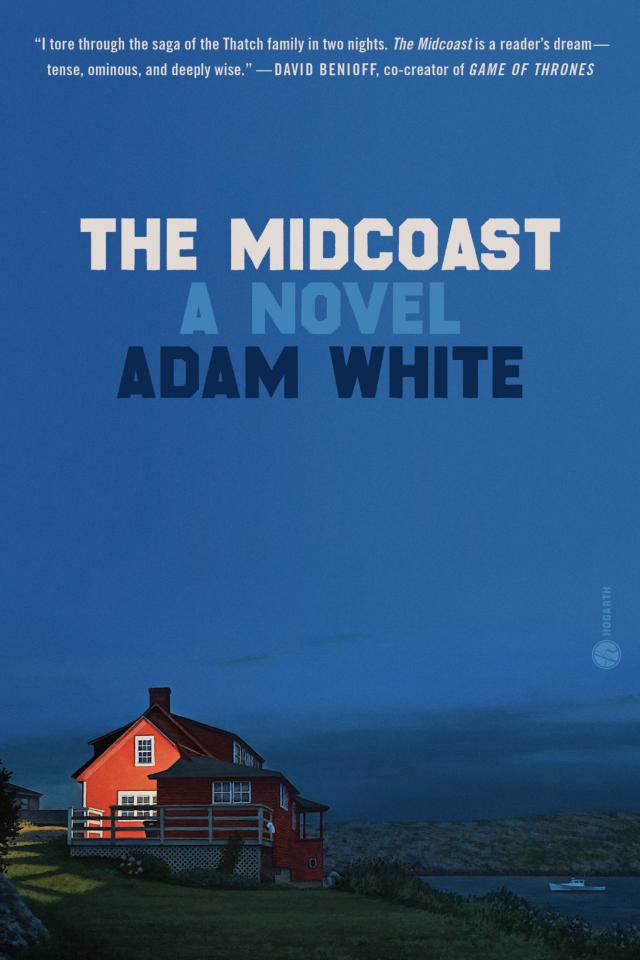
The Midcoast is a work of fiction. Names, characters, places, and incidents either are the product of the author’s imagination or are used fictitiously. Any resemblance to actual persons, living or dead, events, or locales is entirely coincidental.
Copyright © 2022 by Adam H. White
All rights reserved.
Published in the United States by Hogarth, an imprint of Random House, a division of Penguin Random House LLC, New York.
HOGARTH is a trademark of the Random House Group Limited, and the H colophon is a trademark of Penguin Random House LLC.
Hardback ISBN 9780593243152
Ebook ISBN 9780593243169
randomhousebooks.com
Book design by Susan Turner, adapted for ebook
Cover design: Anna Kochman
Cover images: David Vickery
ep_prh_6.0_140138097_c0_r0
Contents
Cover
Title Page
Copyright
Prologue
Chapter 1
Chapter 2
Chapter 3
Chapter 4
Chapter 5
Chapter 6
Chapter 7
Chapter 8
Chapter 9
Chapter 10
Chapter 11
Chapter 12
Chapter 13
Dedication
Acknowledgments
About the Author
PROLOGUE
Back when I lived out of state, people always used to get excited when they found out where I was from. They didn’t meet all that many Mainers—I was like a moose descended from a log cabin, wandering their backyard, eating their shrimp—and wondered if I was from anywhere near the town where they’d gone to summer camp or cruised in their custom sloop. Sometimes I was, sometimes I wasn’t, but Maine is a large state with more coastline than California, I liked to point out, plenty of old gray villages like the one I grew up in, plenty of places to get lost or hide, especially when socked in by a heavy fog. Maybe they’d heard of Damariscotta if they’d ever taken a vacation to the Midcoast, but they tended to pronounce the name wrong and then ask what it meant, and I would say either River of Little Fishes in Abenaki or something Scottish, we weren’t really sure. If they asked what the town was known for, I would have said brick-making, then ice-shipping, then oysters and this one little gallery that sells lobster buoys painted to look like political figures, but this was all before Maeve and I moved back home and bought our coastal charmer with a view!, a listing so pyritic that its author, our realtor, met us at the door mid-apology and with a referral to a rodent removal service.
Before my return I was still telling that old joke, whenever I needed to explain where I was from, about the local who has to give directions to a visiting urbanite. “You can’t get the-yah from he-yah,” says the Mainer, which tells you a little about the roads and highways on the Midcoast, a little more about the shotgun wariness that’ll greet you on so many overgrown front porches, and a lot about the granite breakwalls between those who’ve been here for generations and those who’ve landed more recently, within the past century or two. I am one of these newer arrivals, not a true Mainer—if your parents are from elsewhere, you don’t count, even if you moved to town at age three—but at least I’m not a tourist. We all scowl at the tourists. They ascend as one big traffic jam every summer and presume to know the place just because they’ve rented a cottage with bunk beds and weathered a gentle nor’easter. The other day I saw a couple in matching sunglasses lingering in front of the Sotheby’s, gazing at a flyer full of homes, one of which belonged to the Thatches, our town’s wealthiest family; when I overheard them indulging in the fantasy of moving here year-round, imagining Maine as the way life should be, I found myself wishing I had some other flyer with pictures of the peeling shack Ed Thatch lived in as a child, or the trailer he and his wife Steph moved into when they were only eighteen (or our own drafty ranch, for that matter), just to show these dreamers what they might find if they ever arrived in the off-season and ventured down the wrong dirt road.
To move on from any of these dirt roads was supposed to be impossible, but then the Thatches did just that, moved from there to here—well past here, actually. Steph loved to remind us of their early days, all the hard work and long hours that had put them on this different track, and it’s not that we didn’t believe her, just that we’d heard it all before, heard it plenty. But every small town has its own running dramas, its own local celebrities (there’s a set of twins that’s been calling our high school basketball games since the big playoff run in ’89, and there’s a mussel farmer who wears a bodybuilding getup in every parade—we think because mussel and muscle are homophones—and he’s been doing it since I was in college). So I guess I always assumed I’d return to the Midcoast, if I returned, to find things basically where I’d left them. And most things were. Just not the Thatches. Which was fine. They were off in the distance, nothing to do with us, their rise and fall like a rolling swell tumbling down the coast.
People do move here for the views. Ours is of the salt bay, partially, but also of our neighbor’s three-car garage and a pyramid of algae-covered lobster traps. “The real deal” is how our realtor described the neighborhood, meaning that what we’d see through our windows was mostly the slowly revving engine of Mainers going nowhere. Unless there’s a fog. Then there’s nothing to see, only what everyone else can see, only what’s right in front of us.
* * *
—
But it was a sunny day in May the last time I saw Ed, one year ago now, when I, Maeve, Jack, and Jane went to the Thatches’ house to attend “A Reception in Honor of Amherst Women’s Lacrosse.” That Ed and Steph had somehow given life to and sent into the world a freshman midfielder on the Amherst women’s lacrosse team had never stopped seeming completely implausible, and yet we all knew Allie’s story—this was the daughter—because Ed would give you the lowdown any chance he got. You’d be walking out of the post office or into the natural foods co-op when there’d be a loud honk and you’d look up to see Ed hanging out the driver’s side of his Silverado, banging a flat hand against the door. “Hey, Andy! Two goals against Tufts! She’s on some kinda roll!” And before you even had time to congratulate her, or really him, he’d be thundering down the low brick canyon of Main Street, past the art gallery and the butcher shop, both of which leased from him.
Our family was late getting to the reception so had to park on the shoulder of the gravel driveway, way up by the main road, behind a chartered bus and a steep line of out-of-state SUVs, their rear windows papered in Amherst Lacrosse stickers, Nantucket beach permits, and faux-European circle decals designed to make MV and OBX look like legitimate nation-states. Back when Ed and I had worked as teenage dockhands at the Pound, Ed would have called this visiting herd Your kind of people, Andy, but he’s the only one who ever called me Andy, and I always resented the characterization—perhaps because it fit. I had gone away to Exeter, then Dartmouth, played lacrosse at both stops, roomed with Virginia aristocrats who now arrived at reunions with full-time nannies and made a show of matching any and all donations to the scholarship fund.
I thought I understood, then, what we were getting ourselves into. The women’s lacrosse team would get feted and fed the day before its big game against Bowdoin College. There would be chicken parm and Gatorade. Dads would get sloshed and lean a little too close and deliver pointed musings about the way the team ought to be run, who should be getting more of a burn, who should be riding more pine. They’d be wearing shiny polos with their country clubs’ emblems on the breast, pastel belts embroidered with whales and three-woods. The moms would be overdressed in whatever summer attire had just arrived in the boutiques of Wellesley or Annapolis, and they would ask the players about their girlfriends, or in this case boyfriends, or maybe it didn’t matter anymore.
But as we steered our kids between the Thatches’ garage (formerly a farmhouse) and the house (formerly a barn) and made our way onto the backyard (really a long shimmering meadow that humped down to the river over a series of small hills like an off-season ski slope) it became clear that Ed had taken the concept of “pre-game reception” in a whole new direction. What we were stumbling into was more like a spectacular Midcoast-themed carnival. There was a train of folding tables dressed in purple gingham tablecloths, a trailer-length grill blowing smoke into the sky, and a massive white tent strung with yards and yards of hanging lightbulbs. There was even an inflatable lobster the size of an elephant (where had Ed procured it? I had no idea. I assumed he must have stolen it from some boarded-up state fair). Someone had wedged a lacrosse stick in the lobster’s left claw, and visitors were taking pictures of each other standing next to it as if they had slain the poor thing. The rest of the meadow was overtaken by players, parents, and coaches, all of them wearing purple.
“Can we play in the bouncy castle?” Jane asked, our daughter, seven years old at the time.
“What bouncy castle?”
She pointed in the direction of an overinflated lobster trap—another carnival prop I never could have conceived of—bursting with children, all flopping around and jamming each other’s heads between the pontoons.
“Yes,” Maeve said. “But bring your brother. And don’t touch anyone if they look sick. Like if they have a runny nos
“Stranger danger!” Jack said, age six.
“That’s something else, Jack,” Jane said.
“You’re something else, Jane.”
“Go,” Maeve said. “Have fun.”
The kids ran at the trap, and Maeve and I headed for the tent. We passed a table at the edge of the lawn, where I picked up a brochure proclaiming Damariscotta to be Maine’s “Vacation Haven” (Steph Thatch’s new marketing slogan, part of a rebranding effort, more on this later), and then we waded through the small clusters of guests, saying hello to anyone we knew—our accountant, our kids’ pediatrician, our sheepish realtor—all of whom looked a little confused by the surrounding festivities but willing to go with the flow in exchange for an open bar—until a man wearing a Hawaiian shirt over a turtleneck, the school superintendent I soon learned, corralled our marital unit and asked my permission to talk shop.
“About what?” I said.
“No, no,” he said, “with Maeve.”
Maeve runs a not-for-profit called EduVerse that empowers students to write poems about their own lives (here’s a stanza I found on the kitchen table recently: So many seagulls around the parking lot / It’s like a party for seagulls / If you have a bike you can bike right through em / But they’ll just fly away / They’ll be back to eat your trash someday), and once the superintendent had thanked Maeve for all the fine work she’d done in the county’s middle schools, he asked her how she might feel about expanding the program. Maeve would be very interested in expanding the program, she said, squeezing my hand in silent apology. This felt like my cue to slip away for a beer, so I waited until the superintendent wasn’t looking and mouthed Good luck to Maeve who mouthed Get me something, too, so I mouthed Okay, what? and she mouthed White wine, actually, no, I could go for a beer and by now the superintendent was looking again, so I said, out loud, “I’m on it,” and went hunting for the bar.
I found it in one corner of the tent, next to a raised platform where Maine’s most famous all-white reggae band was just starting to plug in its amps. The bartender handed me two Shipyards, both wrapped in purple cocktail napkins with the Amherst crest on one side, crossed lacrosse sticks on the other, and I thanked him and apologized because I didn’t have any cash for a tip, before following a trail of tiki torches down toward the river, where the fog was just beginning to snake along the shoreline, drafting north from the ocean. All of this land I had gazed upon many times, but always from the river, always from someone else’s boat. The house was high on a hill. Pines lined the northern flank of the meadow. Birches lined the southern flank. The grass was freshly mown. There was a new dock. I was hoping to take a look at Ed’s old lobster boat, recently converted into a pleasure cruiser with roaring twin engines, rumored to hit speeds northward of fifty knots, this overhaul, in total, rumored to cost northward of two-fifty—
But I never made it that far. Instead I ran into Steph Thatch. Ed’s wife. Our mayor. Town manager was her official title, but she called herself the mayor, and we all followed suit, feeling like the difference was trivial and she’d pretty much earned the right anyway. She was marching up from the dock, rising through the grass in black rain boots and tight blue jeans. She wore a gray flannel shirt and a down vest, the better part of a dead coyote serving as a hood. The garments were trimly cut, unzipped or unbuttoned to her freckled breastbone, her brown hair bedazzled with blond highlights. She said hello and asked if I had seen her husband, which I hadn’t.
“Well, either we launch this thing or we don’t,” Steph said.
“Which thing?”
She pointed to the steaming, barrel-shaped smoker where the Dodwells, a brother-sister catering duo, also operators of the town’s only taxi, were prodding at a mound of wet seaweed.
“You see any lobster?” Steph asked me.
“I can’t tell from here.”
“That’s because they’re still in the river,” she said. “Ed insisted on supplying them himself.”
“As he would,” I said.
Steph looked dubious.
“Since he’s a lobsterman,” I added.
“Of course he’s a lobsterman. Was a lobsterman. He wears a lot of hats, you know. He’s been busy. This reception means the world to him. It’s nice you’re here. Great turnout, actually. I just worry he takes too much crap.”
“Takes it, or takes it on?”
“Takes it on.”
I had no idea if this was true. Ed struck me as the kind of rural titan who’s come far enough in life to turn himself into a man of leisure, but perhaps that was only in my own dealings with him, which mostly concerned Allie’s lacrosse career.
“He and Chuck already filled three traps and put them in the river,” Steph said. We were standing in the steepest part of the meadow, so she had to brace a hand on her uphill knee to hoist herself to my level. “We’re supposed to go out on the boat, and the girls are supposed to help them haul the lobster. I should have stopped him. It’s just too much.”
I looked at a few of the young women, talking and laughing with their parents. “I bet they’ll enjoy going out on the water,” I said.
“Oh, they’ll love it,” Steph said. “But only if we go now. Otherwise, we’ve got issues.” She looked behind her at the sky, which was continuing its sweep toward gray, and then she waved at a woman in a periwinkle cashmere sweater, who waved back. “Who the hell are you,” Steph muttered through a smile, just loud enough for me to hear, before taking off in the woman’s direction, calling as she went, “We didn’t know if you’d make it!”
I sipped my beer. The challenge would be to drink just one. I wasn’t worried so much about getting drunk, although I probably would, more about putting on weight, which I already had. Right around then—as I turned my gaze upon the other men in the field—I realized there was a service I could provide, a way to contribute to the gathering. I would search the premises for Ed, let him know that his presence had been requested.
At first I couldn’t find him anywhere. He wasn’t in the meadow, wasn’t in the tent, wasn’t amongst any of the boosters. Perhaps he was in the house—the hulking former barn with deck appended to the river side, shingles new enough to hold only the slightest shade of ash, trim painted forest green. Steph had hired contractors from up the coast, blasted out all the old stable walls, pumped the roof full of skylights. I liked the look quite a lot.
The inside, too. This I saw as I cupped my hands to the glass doors on the deck. I was impressed by the openness and vastness of it all. From background to foreground: an industrial-strength kitchen, a high and wide stone fireplace, a living room carefully decorated in rustic antiques—black metal, raw wood, antler chandelier, vintage telescope, vintage map of the Midcoast. On the coffee table was a live—no, a stuffed—fox in an action pose, facing me and snarling. The voices of the party were beyond earshot now, so behind me I heard only a gull, the wind, and what sounded like a murmuring brook. I couldn’t detect any movement inside, but then I noticed a presence, an almost completely still presence, something—or someone—who didn’t quite fit. Ed. Wherever he went, the ocean went with him, and I could sense it, even through the glass: the salt in his beard, the mud beneath his nails. He was sitting in a chair in the middle of the room, in his socks, rubber boots upright next to his feet, leaning back, his hands on the squared-off leather arms. His head was cast downward, possibly at the table next to his chair, but with his hat blocking my view, I couldn’t tell for sure. I was about to knock on the glass when he shifted his gaze toward mine. For a moment we eyed each other through the door, and I felt caught.
“Hey, Ed,” I said, sliding the door open.
“How we doing, Andy.”
“Doing well. Thanks for having us.”
I was expecting him to say something more, but he didn’t, so I stood silently and he sat silently as the band launched into a cover of something familiar. They were down the hill and out of sight. “Enter Sandman” set to a reggae beat—that was it.


