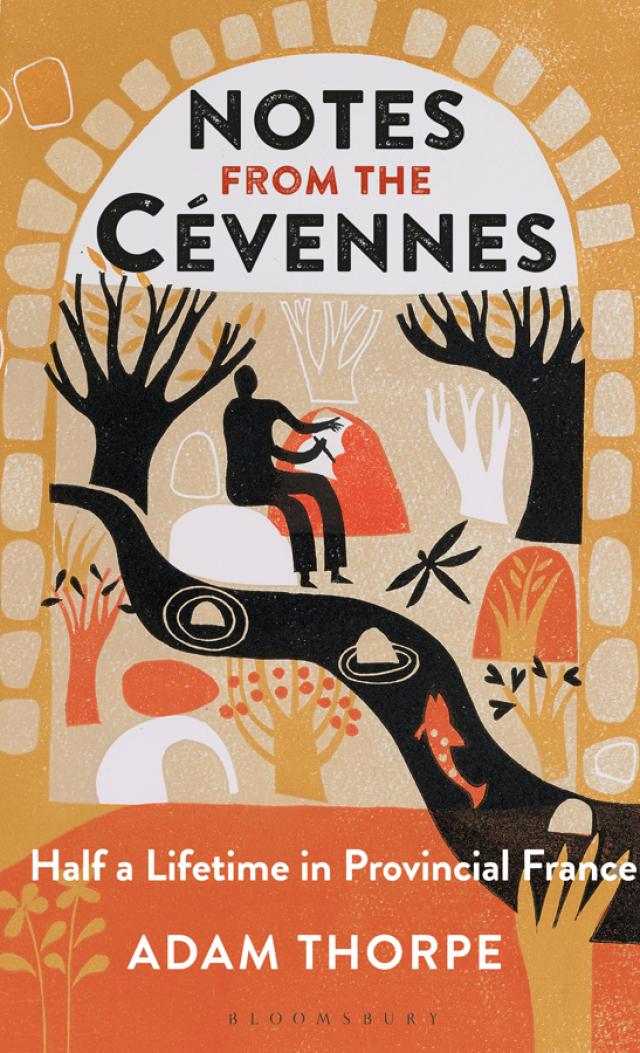
Notes from the Cévennes, page 6


One evening, after a year or so in France, my eldest son (aged four) asked, ‘Where is God, exactly?’ ‘In everything.’ ‘Even in trees?’ ‘Yup.’ ‘So if He’s in a tree, is He in the trunk, branches or the leaves?’ ‘Well, He’s sort of in the trunk and branches and leaves at the same time. And He – I mean, She – might be female. An Earth Mother.’ He pondered. ‘Every single leaf?’ ‘Er, yes.’
He reflected a moment. ‘OK, but then where would He be standing?’
I saw his point. ‘Our minds are too small to know how it all works,’ I faltered. Maybe Buddhism or paganism would have been easier. Life as a river with no beginning and no end, impossible to grasp. My son has been a confirmed sceptic through the two and a half decades since.
No doubt the ghost of the priest, said to linger by the back of the mill, might have helped me out.
1Louis XIV was an absolute ruler whose personal religion was also the nation’s. Under the influence of the Jesuits, he began to turn against the two million industrious Huguenots busy modernising the country’s economy. Eventually, with the revocation of the Edict of Nantes in 1685, he made Protestantism illegal, forced Huguenots to renounce their faith and embarked on a programme of outright persecution. Neighbouring countries received the resulting flood of refugees (including my own maternal ancestors, the Pinders, who ended up in Ireland) with mixed feelings, although this soon changed when they saw the outcome.
2No doubt as much a subsequent topic of conversation as poor Matt’s mule in Zora Neale Hurston’s masterpiece Their Eyes Were Watching God, whose description of life in an incorporated Black village in 1930s Florida feels so eerily familiar.
7
The Psychological Castle
Guillaume is standing on the little concrete bridge over the stream, a billhook in his right hand and a pair of handcuffs dangling from his left wrist. He is like the troll in a folk story, guarding access to the world beyond – in this case, the continuation of a favourite walk around the village, winding through holm oaks, vineyards and a stone-built farm whose dog is tiresomely incapable of recognising me as anything but an extreme threat.
Our troll is, in fact, one of the village’s few genuine soixante-huitards, leaving Paris for the Cévennes mountains at the age of 18 when the tear gas had barely cleared. In the summer of 1968, our valley was a favourite with the utopians thanks to a semi-derelict manoir, soon populated by every stripe of rebel. A few stayed on. When I first met Guillaume some 20 years back, he was a jobbing gardener. Our kindly then-neighbours, Georges and Michelle, had hired him for a few hours a week. Guillaume would arrive in his battered green van and mess about for an hour or two. He loved bonfires, clipping branches and creating thick, acrid smoke.
If you caught his eye through the pittosporum, he would buttonhole you with stories interspersed with epigrammatic wisecracks that recalled Cioran, the Romanian philosopher whose intense pessimism manages to be refreshing in the face-burning way of a Siberian wind. Guillaume didn’t know Cioran, but would have agreed with him that ‘Society is not a disease, it’s a disaster’, and that to believe and hope is ‘to lie to oneself’.
Seeing the world as a ship of fools can make you a recluse; although Guillaume had a wife and daughter, he seemed to illustrate Cioran’s observation that ‘you cannot protect your solitude if you cannot make yourself odious’. A passion for women erupted in sudden lubricious remarks, semi-camouflaged in a chuckling Parisian argot.
He was also perky back then, proud that he had stayed on in the hills while ‘most of the other kids went back up to their mums and dads the minute it got cold’. Beardless, with a mischievous smile and crooked beret, he didn’t look like the other babas, as the French call anyone vaguely hippie-like (from a combination of the Hindi for ‘papa’ and the French for ‘stupefied’). He did, however, imbibe, and often turned up with his outdoor flush deepened to carmine. His wife left him, and the house was sold. Before leaving it for the last time, he carefully painted a long Latin citation on the garage doors, which I meant to get round to asking him about. It felt like a curse. After a period of serious drinking and collateral oddity, he built a two-room bungalow on a plot of land he’d kept on the other side of the dirt track, overlooking the solar-panelled house now occupied by second-homers from Montpellier.
Both rusty billhook and plastic handcuffs are clues to Guillaume’s obsession, or what he has called ‘my illness’: he can’t stop collecting junk. His pickings and purchases have now overwhelmed the bungalow, sneaked along the approach path and started to accumulate in fusty heaps on his ribbon of land between an olive grove and a wooded slope. ‘I know where everything is,’ he once claimed, gazing into his now dismantled metal shed – bursting with his booty. He reassured me that he was not a miser, like the equally compulsive hoarder Plyushkin in Gogol’s Dead Souls. ‘It’s my cocooning urge. Lack of mother-love.’ Once, after proudly showing me a headlamp reflector found in a ditch, Guillaume suddenly said, ‘I’m old, on my own, and broke. I never bothered about my pension. Capitalist, I thought. I’m 63, merde. I smashed up a car a year, until the judge told me to stop drinking or it’s prison. I haven’t touched a drop in ages. It’s torture.’
‘You’re not old, Guillaume,’ I ventured, the dystopian rain dripping off the branches. ‘And you seem quite cheerful.’
‘Antidepressants.’ His eyes brightened suddenly. ‘I’m reading Céline. Genius. And a book about Mouna. Aguigui Mouna? My entire philosophy of life. A one-man demo on a bicycle. Flowers in his beard. A mixture of Don Quixote, Diogenes and Jesus. Ecology? He was there first!’
The bungalow, concealed beyond an olive grove belonging to an old lady in the village, seems an emanation of Guillaume himself; you can see what is now a hefty serpent of junk as a long and sinuous phrase, beginning with a First World War stretcher and ending on the large exclamation mark of a roadworks warning sign clambered over by small teddy bears. I have seen worse in exhibitions of contemporary art. I am jealous of the stretcher: I have a leather-bound trench flask and field binoculars that belonged to my grandfather, who survived the first day of the Somme and several weeks of Passchendaele in the 2nd Hampshires before being invalided home, but a stretcher is something else.
Despite present appearances, Guillaume is not a threat. He says he is clearing the stream, and I note a few inroads made into the bank’s thick growth of alder and buckthorn. ‘I’m worried,’ he says, waving his billhook close to my nose, ‘I am almost become a normaliste, when I am really a normalophobe.’ ‘I don’t think clearing a stream voluntarily is that normal, these days,’ I say, ‘but watching the telly might be.’ He snorts. ‘I don’t have a telly, mon cher, I have books.’
His ensuing patchwork of argot and polemic contains the real reason why he is getting his boots wet: long ago when he was a little boy, he would walk to his Paris school as the gutters were being sluiced. All he wanted to do was to dam them up like the older boys and sail paper boats, but his mother would drag him away. ‘We are always being dragged away from our desires,’ he sighs, shaking his handcuffs. ‘Now I am re-enacting it all.’
I tell him that my earliest memories of Paris are likewise of pavements and gutters, the sound of dry leaves on the cobbles, along with enormous chrome bumpers. ‘You’re so low down,’ I laugh, ‘it’s about all you notice.’ He nods vigorously. I add that I have an almost sexual obsession with the Citroën DS from the 1950s. He looks at me as if I am peculiar.
We more often cross paths at our local town’s vide-grenier, the equivalent of a British car boot sale and generally indistinguishable from the regular flea market, or puce. A snooty visitor from Paris once remarked that the town – grimly shabby in an atmospheric 1930s way – had the worst-dressed people he had ever seen. ‘I mean, really poor. C’est incroyable.’ ‘Well, there’s a lot of unemployment here,’ I said. When I took a friend from London around the stalls, she couldn’t believe it: ‘But this is not even junk,’ she cried. ‘It’s actual rubbish.’ For a moment I saw it all through different eyes; not as an intriguing cross section of the past hundred years of Languedoc life, nor as a way for impoverished locals to keep their budget down with des bonnes occases,1 but as clutter – the kind of stuff that no one could possibly want in their homes. You have to beware your presumptions, however: in the same town’s puce last year, an artist friend (an expert collector) spotted an unframed sepia shot of Notre Dame cathedral among mattresses, glass flagons and TV sets, and bought it for 10 euros. Having already spotted the signature of Gustav Le Gray, the greatest French photographer of the nineteenth century, he had it valued in Paris at 10,000 euros.
Three weeks before our bridge encounter, I found Guillaume standing in front of the spread jumble of a good friend who has become, to the despair of her husband, an obsessive flea-market trader. A full-time school secretary, Delphine gets up every Saturday and Sunday morning at three o’clock to be sure of a decent spot in one or other of the Cévenol markets. ‘We need the extra cash,’ she said. When they come round to supper these days, she has to leave early; I suggested that she must have an amour among the traders. This ribald remark did not go down well, although not because it might have been true: beyond any question of the modest gains she makes, she is simply addicted. As Guillaume is addicted to purchasing.
I greeted Delphine and turned to examine Guillaume’s latest foundling: a heavy iron contraption with a wooden handle and a pedal that he claimed was a wine bottle corker. It was broken, which was why he’d bought it. ‘It has to be useless or I’m not interested. I’ve worked through my savings, my pension, and now I’m eating into my life insurance.’ His unlicensed, clapped-out Renault 5 was full of more stuff, including the complete set of a mossy nineteenth-century encyclopaedia that I felt vaguely envious of, until he told me what he’d paid for it. ‘I offer more than they’re asking,’ he giggled, his crumpled hat falling over his eyes. ‘I love to see their shocked faces. It troubles them. They think they’re being cheated!’
Glued above the car’s rear bumper was a large handwritten REGISTER. This was what poor Marie Durand, the teenage Protestant imprisoned by the Catholics in the Tour de Constance in Aigues-Mortes from 1730 to 1768, carved into the cell’s stone floor. It is thought to mean ‘resister’ in her local patois, but Guillaume has another theory. ‘She made a mistake,’ he said, pushing his latest purchase into the boot, ‘even though she had plenty of time to correct it!’ The original version still holds: a lycée student told me recently that his mother was on the bus some years ago wearing her Huguenot cross, when a man opposite raised his fist and cried, ‘Register!’
Back home, I checked to see how much an unbroken antique French wine bottle corker might set one back: £480. Irrelevant to Guillaume, because he never sells.
I sometimes wonder whether I, too, have a touch of Plyushkin syndrome. During our early years here in the Cévennes I would scavenge in the illegal dump sprawled in trees outside the village, not out of grim necessity like a Third World waste picker but for discarded items of the old country ways. Clambering over the festering huddles of fridges, tyres, mangled chairs, mattresses and (for some reason) numerous toilet bowls, I eventually found, under warped sheets of plasterboard, a shallow reed-woven basket with a string for a handle, once used for gathering mushrooms or chestnuts. I was delighted. Stationed on our balcony, it started to swell and loosen. When Guillaume came round one day and saw it, his eyes lit up, but it disintegrated in his hands. ‘Alors ça, c’est comme la vie,’ he said. This felt like a found poem, and I promptly wrote it out when he had left. In some sense, poets are hoarders anyway, foraging through memory or life itself for multimodal scraps: a number of my poems feature such pickings as their literal subject. It was Guillaume who identified an ugly folding spade that I’d unearthed in one of our cellars as military, a US army entrenching tool from the last war. His nose flared as though at something delicious through his hunger. I still find it ugly, but won’t part with it.
There is a difference between ‘collecter’ and ‘collectionner’ lost in the usual translation: ‘to collect’. Guillaume’s thousands of objects are not a collection, or his sensitivity to their textures, the aesthetic and philosophical connections he makes between them, would bring him close to being an art brut artist: the enviable stretcher from the First World War, propped outside his door, is on the same level as a broken toy tractor. I once suggested, in teacher mode, that this could all edge towards artistic status, if he were to add a pinch of intention. ‘That would destroy the whole point,’ he scoffed. ‘It gives it all a meaning!’
Today, on the bridge, he is mourning the death of François Cavanna at 90. Writer, cartoonist, ecologist, founding editor of Charlie Hebdo’s predecessor, the satirically cruel and outrageously scatological magazine Hara-Kiri (Cavanna reckoning hara-kiri ‘the height of stupidity’), Guillaume’s working-class hero had the kind of tumultuous and tormented Parisian life which Guillaume deliberately escaped by fleeing to the Cévennes hills as a youth in 1968. When I profess ignorance of Cavanna, he splutters in disbelief. ‘But you’re a writer too! Yes, yes, I understand, d’accord, you’re much too busy scribbling your little books that almost no one opens anyway . . .’
The average bookshop holds 50,000 titles, and I’m relieved if one of them is mine, but I say nothing. Now and again Guillaume’s babbling words, like the proverbial troll’s, cut sharply.
A few months later, Charlie Hebdo was to become internationally known as the bloody target of Muslim fundamentalists, since when a succession of similar horrors has pitched us all into a different world, although not one unfamiliar to historians of religion.
As if following suit, the olive grove that glinted and glowed its silvery green and which provided Guillaume and his bungalow with a covert, has mostly gone. D. H. Lawrence recognised the difficulty of capturing, in words or paint, ‘the lovely glimmer of olive trees’. Van Gogh managed it, despite declaring, ‘It’s too beautiful for me to dare to paint it.’ He found that ‘the murmur of an olive grove has something very intimate, immensely old about it’. The old lady who owned the acreage thought similarly, and would come up especially to walk between the gnarled boles. She died last year, in her nineties. She had held out against her children’s demands to sell the patch. Within weeks, it seemed, they had parcelled it up in as tight a mosaic of terrains constructibles as they could legally manage, in an area with a severe shortage of new housing. I had envisaged two villas at most, but there are now five.
Perhaps in response, Guillaume’s serpent of junk has writhed and fattened, spreading into a kind of rampart. (‘It’s my psychological castle,’ he once explained.) Now it is spilling over the stone walls in a riot of barely distinguishable items, from broken cane chairs to old prams and tin buckets, topped by a cathode-ray TV (‘I never watch telly’). There is only just enough space for his rattling Renault, one wing-mirror tightly bound in red, white and yellow tape.
At first I imagined that the huge backhoe digger parked on the public track was his pièce de résistance, as it was festooned in teddy bears, rubber ducks and red ribbons, with a handwritten cardboard sign at its foot declaring MARCHE EN AVANT – perhaps a wry glance at soon-to-be-President Macron’s En Marche movement. Eventually I realised that this ungainly machine was there only for the new houses, and Guillaume was making a temporary feature eccentric and therefore palatable.
It has now gone, the last villa all but finished. Perhaps the digger did, after all, ‘walk forward’ on its caterpillar tracks. The mairie has promised the proud new house-owners that the unsightliness will be dealt with, but nothing has changed. Meanwhile, I am struck by a surprising addition to the swelling junk outside: a tall and pretty house-plant in its pot. Fresh and green in this hot summer, it must be getting regularly and even lovingly watered.
1From occasions, meaning ‘bargains’ or ‘second-hand goods’.
8
Taking the Postman Hostage
While their British counterparts are studying comparative religion from primary school onwards, French children learn about the political system, finishing with a year of philosophy. This perhaps explains a certain official tolerance of intelligent protest, with a historic fondness for the barricade. I was amazed some years ago to see an alpine ridge of chairs heaped up in front of a Nîmes lycée for a fortnight. Montpellier University was similarly blocked for an entire semester in response to what appeared to be a minor change in researchers’ conditions. While infuriating if you’re trying to follow a cursus – especially as militancy tends to attract the least assiduous – le blocage remains a sign of democratic health, a historic right extending to the remotest village in the mountains.
Take ours, for instance. When that chronic threat to shrink the school by a whole class was about to be enacted, the teachers, parents and pupils protested with sit-ins, huge home-made banners draped across the façade and railings, and a journey to Nîmes to confront the préfet. We were told to ‘bring things that make a noise’, which meant a timeless recourse to pots and pans. The class was retained, the school predictably expanding with its reputation for being dynamique, and now an environmentally friendly school has been built at huge cost (much of it EU-funded) in the field below, sporting a vegetal roof like a hanging garden, and with inner walls of healthy pale-brown clay on which it is impossible to pin anything up.
More drastic methods are sometimes used, which in Britain would probably risk a jail sentence. Fracking has been dropped by the government as a result of protests, and a beautiful local valley (where we often swim) was saved from being dammed and flooded when the first two earth-movers were set on fire. Holding the manager of a doomed factory in his office for days is one favourite.
A variant was shown in our village some years ago, in relation to its then-full-time post office. Tucked below the church, in a building housing a cellar that was once the local lock-up (a service no one fought to retain), its dwindling use led to rumours of imminent closure. Our hard-left mayor at the time called on the villagers to gather in front of La Poste half an hour before the postman was due to arrive to collect the mail. We did, with appropriate banners, although the political effectiveness of impressing a postman seemed doubtful.