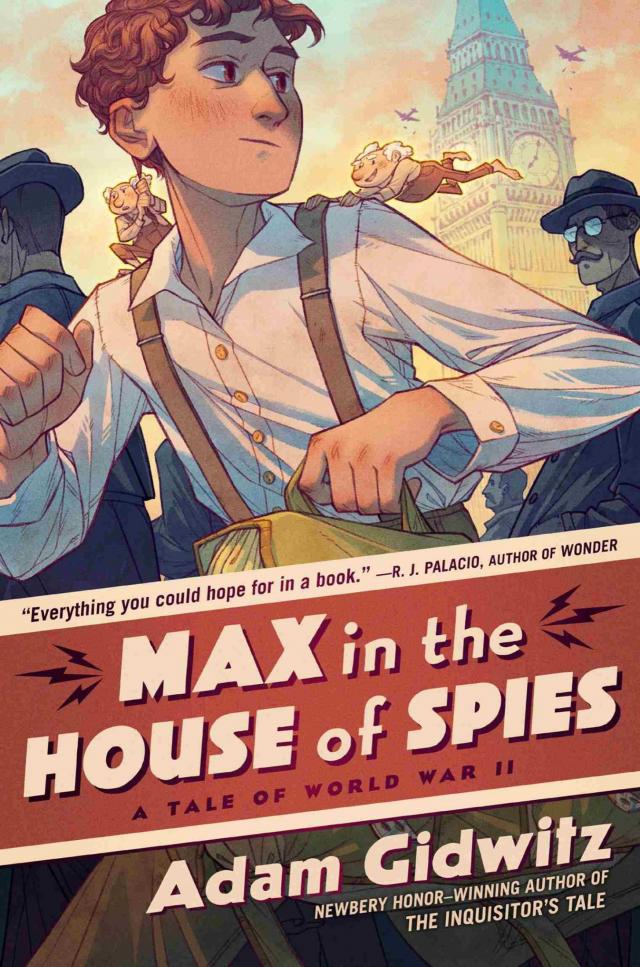
Max in the House of Spies, page 1


Also by
Adam Gidwitz:
A Tale Dark & Grimm
In a Glass Grimmly
The Grimm Conclusion
The Inquisitor’s Tale:
Or, The Three Magical Children and Their Holy Dog
The Unicorn Rescue Society series:
The Creature of the Pines
The Basque Dragon
with Jesse Casey
Sasquatch and the Muckleshoot
with Joseph Bruchac
The Chupacabras of the Río Grande
with David Bowles
The Madre de Aguas of Cuba
with Emma Otheguy
The Secret of the Himalayas
with Hena Khan
DUTTON CHILDREN’S BOOKS
An imprint of Penguin Random House LLC, New York
First published in the United States of America by Dutton Children’s Books,
an imprint of Penguin Random House LLC, 2024
Copyright © 2024 by Adam Gidwitz
Photograph on page 302 from the collection of Patricia Lewy
Photograph on page 302 from the collection of Michael Steinberg
Penguin supports copyright. Copyright fuels creativity, encourages diverse voices, promotes free speech, and creates a vibrant culture. Thank you for buying an authorized edition of this book and for complying with copyright laws by not reproducing, scanning, or distributing any part of it in any form without permission. You are supporting writers and allowing Penguin to continue to publish books for every reader.
Dutton is a registered trademark of Penguin Random House LLC.
The Penguin colophon is a registered trademark of Penguin Books Limited.
Visit us online at PenguinRandomHouse.com.
Library of Congress Cataloging-in-Publication Data is available.
Ebook ISBN 9780593112090
Edited by Julie Strauss-Gabel
Design by Anna Booth, adapted for ebook by Michelle Quintero
Cover art © 2024 by James Firnhaber
Cover design by Anna Booth
This is a work of historical fiction. Apart from the well-known actual people, events, and locales that figure in the narrative, all names, characters, places, and incidents are the products of the author’s imagination or are used fictitiously. Any resemblance to current events or locales, or to living persons, is entirely coincidental.
The publisher does not have any control over and does not assume any responsibility for author or third-party websites or their content.
pid_prh_6.3_146236080_c0_r0
Contents
Cover
Also by Adam Gidwitz
Title Page
Copyright
Dedication
Epigraph
Introduction
Chapter One
Chapter Two
Chapter Three
Chapter Four
Chapter Five
Chapter Six
Chapter Seven
Chapter Eight
Chapter Nine
Chapter Ten
Chapter Eleven
Chapter Twelve
Chapter Thirteen
Chapter Fourteen
Chapter Fifteen
Chapter Sixteen
Chapter Seventeen
Chapter Eighteen
Chapter Nineteen
Chapter Twenty
Chapter Twenty-One
Chapter Twenty-Two
Chapter Twenty-Three
Chapter Twenty-Four
Chapter Twenty-Five
Chapter Twenty-Six
Chapter Twenty-Seven
Chapter Twenty-Eight
Chapter Twenty-Nine
Chapter Thirty
Chapter Thirty-One
Chapter Thirty-Two
Chapter Thirty-Three
Chapter Thirty-Four
Chapter Thirty-Five
Chapter Thirty-Six
Chapter Thirty-Seven
Chapter Thirty-Eight
Chapter Thirty-Nine
Chapter Forty
Chapter Forty-One
Chapter Forty-Two
Chapter Forty-Three
Chapter Forty-Four
Chapter Forty-Five
Chapter Forty-Six
Chapter Forty-Seven
How Much of This Story is Real?
Annotated Bibliography
Acknowledgments
About the Author
_146236080_
To Mama and Papa
And in memory of their dear friends,
Jorja Fleezanis and Michael Steinberg
Between the truth and my mother, I choose my mother.
—Albert Camus (sort of)
To understand the story that follows, you have to remember a few things. Actually, you have to forget a few things. You have to forget everything that you know about World War II, about Nazi Germany, and about the Holocaust. This tale begins in the summer of 1939, and the characters in it—many of whom were real people—did not know that World War II was about to begin. And they certainly didn’t expect the Holocaust to occur, with its death camps and gas chambers. It’s hard to believe it now, but to average people in England and Germany in 1939, the mass murder of six million Jews, and millions of others, was quite literally unimaginable.
Even so, in 1939, life for Jews in Germany was brutal and frightening. Which is why many left, and why some of those who couldn’t leave resorted to sending their children far away from home . . .
CHAPTER
One
Once there was a boy who had two immortal creatures living on his shoulders.
This was the fourth most interesting thing about him.
The first most interesting thing about Max—that was his name—was that he was a genius. He could make a working radio from the junk at the bottom of a trash can, and he could usually predict what someone was going to say ten minutes before they said it.
The second most interesting thing about Max was that, when he was eleven years old, his parents sent him away from Germany, where he was born and grew up, to England. All by himself. Even though he’d never been there, didn’t know anyone there, and barely spoke any English.
The third most interesting thing about Max was that, when he got to England, he fell in with spies. Real, honest-to-goodness spies. A lot of them.
And the fourth most interesting thing about him was that he had two immortal creatures living on his shoulders.
But that’s probably what you have the most questions about, so let’s start there.
The two immortal creatures appeared the day his parents sent him to England.
His family had been arguing about it for weeks. Their small Berlin apartment shook as Max had stomped from the living room to his bedroom to the kitchen and back again, shouting things like:
“You can’t make me go!”
“Everything is fine! Who cares about the stupid Nazis?! They don’t matter!”
“What if you need me?!”
And, more quietly, alone in his room, “What if I need you?”
But no matter what Max said, his parents had refused to change their minds. His mother had held him at the train station against her soft stomach, while his small, thin father had stroked Max’s hair. They’d waved as the train pulled out, taking Max and the 198 other Jewish children to Holland and the ferry. Max hadn’t waved back. He’d just stared at them and thought, How could you do this?
The 198 children had left the train station in Holland and boarded a steam-powered ferry. With a blast of its foghorn, the ship had pushed out into the North Sea, bound for England.
Thirty-one minutes later, Max had fallen asleep.
This might be a little surprising. But after a trauma—something really awful that happens to you—your brain often makes you fall asleep right away. Maybe to help you process the trauma. Or maybe because your brain is scared of more traumas, and figures you won’t have to experience them if you’re asleep. Whatever the reason, it happens a lot. And it happened to Max.
So he fell asleep thirty-one minutes into the ferry ride.
Thirty-two minutes into the ferry ride, he heard a voice in his ear.
“Max. Max!”
Max jerked awake and looked around.
“Max, you are drooling.”
Max quickly wiped his mouth.
Wait. Who said that?
He looked to either side of him. He was sitting on a bench in the belly of the steamship. There were other kids on other benches. Some boys were sleeping, leaning against each other, not too far away. A girl had her face buried in a handkerchief, sitting across from Max. But the voice had been right next to his ear. And it had not sounded like a kid’s voice.
“What’d you wake him up for?” said another voice, very near his other ear.
“He was drooling. It was disgusting! I thought he would want to know!”
Max spun from side to side. Where were these voices coming from?
“You think he doesn’t have bigger problems than drooling in his sleep? The poor kid just lost his country, his home, his parents. You can’t let him drool a little?”
Now Max was staring at his left shoulder. His eyes came into focus.
Crouching there was a tiny man with a bulbous nose, thinning hair, twinkling eyes, and a sour smile.
“Hiya,” he said.
Max screamed and fell off the bench.
The sleeping boys woke up with a start and looked around to see what the commotion was. The girl across the way lowered her handkerchief and glared through wet eyelashes at Max.
“No need to scream.” This was coming from Max’s right shoulder. He turned . . . and saw another tiny man, who looked exactly like the first. This tiny man said, “We are not going to hurt you.”
“He’s not worried we’re going to hurt him,” said the little creature on Max’s left shoulder, who Max would later learn was called Stein. “He’s worried he’s going insane.”
“You are not going insane,” said the creature on Max’s right shoulder, who Max would later learn was called Berg. “We are really here! Sitting on your shoulders!”
Berg spoke with an antique German accent, like something out of a storybook.
Stein sounded more like a vaudeville comedian.
Max looked desperately to the children on the other benches. They were staring at him.
“Don’t worry,” said Berg. “They cannot see us. Or hear us.”
“Just like we can’t hear you! Say something!” Stein demanded.
Max said, “I’m dreaming.”
“Nope!” Stein said. “Not a dream!”
Max put his butt on his bench. He eyed both of these tiny men warily, his gaze flitting between them. Then he said, “I’m gonna go back to sleep. Since this is a dream, when I wake up for real, you’re going to be gone.”
“I wouldn’t count on it,” said Berg.
“Yeah, not gonna happen,” added Stein. “Sorry, kid.”
Max did not believe them. His eyelids were so heavy they closed themselves.
Max slept the remaining seven hours and fourteen minutes of the journey to England.
He dreamed of his parents sitting on the threadbare sofa in their living room, listening to the radio Max had built for them, the way they always did after Max’s father got home from work: Papa’s eyes closed behind his wire-rimmed spectacles, his head resting against the cushions; Mama twisting her long hazelnut hair up away from her neck and smiling proudly at Max, who was on the rug leaning against their knees. But in the dream, instead of the symphonic music the radio station usually played, the wireless set was illogically making announcements about the ferry ride. Still, the dream should have made Max happy. But instead it filled him with an emotion he did not have a word for. Maybe the word was longing. Or maybe it was guilt?
But why should Max feel guilty? He hadn’t chosen to leave.
Then the ferry’s foghorn blew three blasts to the boats in Harwich Port, and Max woke with a start.
He rubbed his eyes. The children around Max were peering out of portholes, gazing at the industrial coastline of shipyards and cargo docks. Wondering what the next days, weeks, and months would hold for them. Wondering how they would like their new foster families. And wondering when their parents would be joining them in England.
Not knowing that very few of their parents would be joining them in England.
At least, Max thought, that weird dream about the creatures on my shoulders is over—
“There’s our sleeping beauty!” shouted Stein, grinning at Max.
“You drooled again! It was gross!” added Berg.
Never mind.
CHAPTER
Two
Now, Max was smart enough to know that Stein and Berg couldn’t really be on his shoulders. They were figments of his imagination. Products of the terrible trauma of being separated from his parents and his homeland. They had to be.
Nonetheless he decided, for the moment, to play along.
“So where did you come from?” Max asked the creatures.
“I come from Germany!” said Berg. “Or, what people now call Germany. It’s had lots of different names since the beginning of time. ‘Ugg.’ ‘Flurp.’ ‘The Holy Roman Empire.’ But no matter what you call it, I am a spirit of that land! Some people refer to me as a kobold.”
Max had heard of kobolds in fairy tales. They were what we, in English, might call hobgoblins—little creatures that cause mischief, like hiding your keys under the couch or raising the toilet seat in the middle of the night so in the morning when you sit down you fall in.
“I, on the other hand,” said Stein, and then he added, “uh, other shoulder, I guess . . . am a spirit of the Jewish people. I also cause mischief. Usually by sticking myself to someone and making their life miserable. It’s my speciality. My kind have had lots of names since the beginning of time, but these days people tend to call me a dybbuk.”
Max had heard of dybbuks, too. They were supposed to be evil spirits, who possessed people and tormented them. He had always expected them to look scary.
Neither Stein nor Berg looked scary. They looked like little old men. Balding. With round noses and round bellies. Nearly identical.
“So, are you twins or something?” Max said, squinting at one and then the other.
“Yeah, you could say that,” said Stein.
“No! Of course not!” said Berg at exactly the same moment.
The dybbuk and the kobold frowned at each other.
“Look,” said Stein to Berg, “we were born at the same moment, one instant before the end of the Sixth Day of Creation. Made by the same Holy Hand. And we look identical. Doesn’t that make us twins?”
“Well, not really, since an infinity of other creatures like us were created at the same instant. Thousands of other kobolds and dybbuks. Not to mention all the goblins, hobgoblins, gnomes, leprechauns, duendes, jumbies, dokkaebi . . .” Berg got a faraway look on his face. “Is there a word for an infinite number of twins? Two is twins . . . Eight is octuplets . . . So infinity would be . . . ?”
“Infinets?” Stein suggested.
“Besides,” Berg went on, “Stein and I are not identical. He is ugly. I, on the other hand”—Berg paused dramatically—“am hideous.” He hid his face in the crook of his tiny arm.
Stein said, “You’re dramatic is what you are.”
“So . . .” Max asked, “why are you sitting on my shoulders?”
Stein replied, “I don’t know what he’s doing here”—he pointed a warty thumb at Berg, who was still hiding his face—“but I’m hitching a ride out of Germany. I don’t know if you read the news, but have you heard of these guys called the Nazis? Maniacs? Love a clean uniform? Hate pretty much everything and everyone else?”
Berg looked up. “I’m doing the same thing, obviously!” He turned to Stein. “But I didn’t expect to see you here!”
Of all the things that Max had trouble believing at this moment, one struck him as most unbelievable: “Wait, you both just happened to choose me to hitch a ride on? What about all these other kids?” He gestured around at the benches of the ferry. “Are all their shoulders crowded with spirits, too?”
Stein and Berg looked around. “Hey! There’s Frank!” Stein exclaimed. “Hey Frank! Good to see ya!” He turned back to Max. “Just Frank.”
Max was trying to see Frank. He couldn’t. “There’s a spirit over there named Frank?”
Berg said, “We call him Frank. His true name is unpronounceable. Even by us.”
“It’s a very small part of God’s true name, actually,” Stein declared.
“Very small,” agreed Berg. “More like the punctuation.”
Max said, “God’s true name has punctuation?”
Berg slapped his hand over his mouth. “We’ve said too much.”
“But,” Stein went on, “to answer your question, I don’t know how we both ended up on your shoulders. I guess you’re just lucky.”
Berg was staring off into the distance. “I felt . . . drawn to you, somehow. Like it was my destiny to find you . . .”
Stein shifted uncomfortably. “Yeah, actually . . . me too.”
Max look back and forth and back again between the two little creatures. Then he said, “So is this a haunting? I’m possessed by evil spirits now?”
“No!” Berg said. “I never think of it as a haunting!”
“It’s more . . . an annoying,” said Stein. “And heckling. Heckling is a speciality of mine. It’s what I was put on Earth to do.” Then he added, “I think.”