

Bride of the City Volume 1, page 1


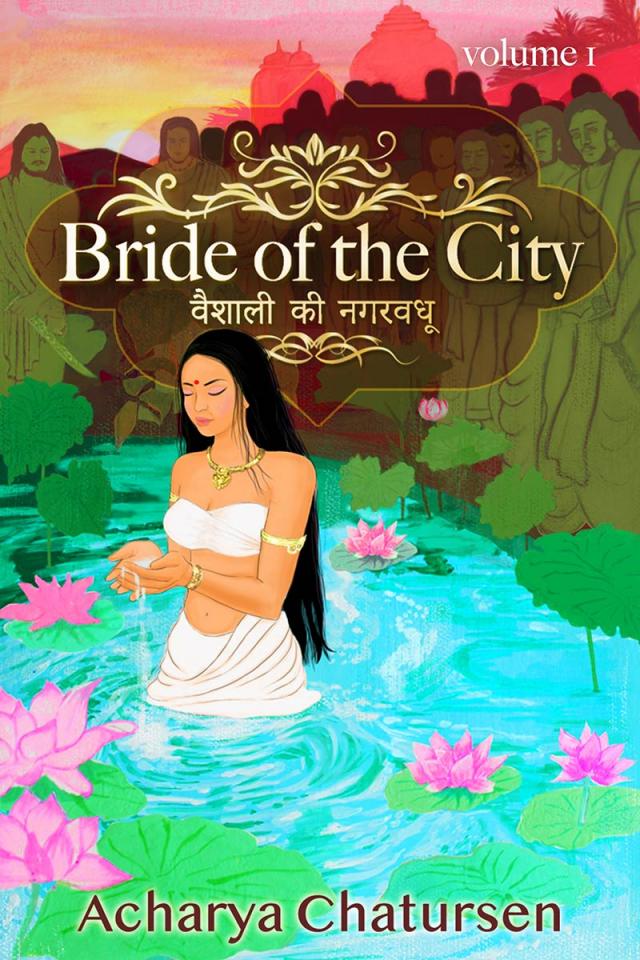
BRIDE OF THE CITY
Volume 1
‘Vaishali Ki Nagarvadhu’
वैशाली की नगरवधू
ACHARYA CHATURSEN
Translated by
Pratibha Vinod Kumar and
A.K. Kulshreshth
First published in Hindi in two volumes in 1948–1949
This translation © 2021 Ashish Kumar
Published by Cernunnos Books Pte. Ltd., Singapore, 2021
www.cernunnosbooks.com
Literary editors: Balwant Kaur (Hindi) and N. Henaff (English)
Hindi advisors: Archana Verma and Balwant Kaur
Interior design and composition: 52 Novels
Cover illustration and design by Zoya Chaudhury
ISBN: 978-981-14-9550-2 (paperback) | 978-981-14-9551-9
CONTENTS
About the Author and Translator
Dedication
Introductory Note
Cast of Principal Characters
Preface
Prologue
Chapter 1: The Cursed Law
Chapter 2: The assembly Deliberates
Chapter 3: The Blue Lotus Palace
Chapter 4: The Anointment
Chapter 5: The First Guest
Chapter 6: The Holy Town of Urubela
Chapter 7: Gautam, Son of the Shakya King
Chapter 8: Yash, the Scion
Chapter 9: The Wheel of Dharma
Chapter 10: Paradise in Vaishali
Chapter 11: Rajgrih
Chapter 12: A Mysterious Meeting
Chapter 13: The Prisoner Is Freed
Chapter 14: The Scientist of Rajgrih
Chapter 15: The Chief Minister of Magadha
Chapter 16: Aryaa Matangi
Chapter 17: The Great Union
Chapter 18: Singh, Son of Gyati
Chapter 19: The Malla Couple
Chapter 20: Saket
Chapter 21: Prasenjit, Emperor of Kosala
Chapter 22: Mandavya Uparichar
Chapter 23: Jeevak Kaumarbhritya
Chapter 24: The Appointed Son
Chapter 25: The Appointed Son’s Fee
Chapter 26: In the Forests of Champa
Chapter 27: In Shambhar’s Lair
Chapter 28: Kundani’s Campaign
Chapter 29: The Feast of the Asurs
Chapter 30: The Kiss of Death
Chapter 31: In Champa
Chapter 32: A Friend in the Enemy City
Chapter 33: The Persian Jeweller
Chapter 34: Matchless Courage
Chapter 35: The Asur’s Courage
Chapter 36: The Secret Letter
Chapter 37: Into the Fort
Chapter 38: The Embrace of Death
Chapter 39: The Escape
Chapter 40: The Fall of Champa
Chapter 41: Vadrayan Vyas
Chapter 42: The Important Guest
Chapter 43: In the Inner Sanctum
Chapter 44: The Hard Bargain
Chapter 45: The Forecast
Chapter 46: The Empire
Chapter 47: The Guardian
Chapter 48: Som’s Dilemma
Chapter 49: Attacked
Chapter 50: A New Face in Sravasti
Chapter 51: Varshkar’s Plan
Chapter 52: Son Kotivinsh
Chapter 53: Anathapindik, the Landlord
Chapter 54: Arya Varshkar’s Strategy
Chapter 55: Conflict in Magadha
Chapter 56: The Barber-Guru
Chapter 57: Shalibhadra
Chapter 58: Mahavir, the All-Victorious One
Chapter 59: Shalibhadra’s Austerities
Chapter 60: The Panchala Council
Chapter 61: The Tathagat in Jetavan
Chapter 62: Ajit Keskambali
Chapter 63: Prince Vidudhab
Chapter 64: In the Slave Market
Chapter 65: Two Stalwarts
Chapter 66: Vidudhab’s Diplomacy
Chapter 67: The Beginning of the Rajsuya Yagya
Chapter 68: Lightning Strike
Chapter 69: The Slave Woman
Chapter 70: The Sage Who Wore No Knots
Chapter 71: Conflict
Chapter 72: The Rescue
Chapter 73: King Prasenjit’s Curiosity
Chapter 74: The Rajsuya Yagya
Chapter 75: The Princess
Chapter 76: General Karayan
Chapter 77: King Prasenjit’s Exit
Chapter 78: General Bandhul’s Tactics
Chapter 79: The Wily Brahman
Chapter 80: The Sad End
Chapter 81: The Masseuse
Chapter 82: Dhihadant’s Den
Chapter 83: Kosala Fort
Chapter 84: The Conference
Chapter 85: The Impossible Mission
Chapter 86: The Anointment
Chapter 87: Self-Sacrifice
Chapter 88: This Kingdom Must Nurture All
Chapter 89: An Emotional Meeting
Chapter 90: The Final Farewell
Glossary
Acharya Chatursen
Acharya Chatursen (1891–1960) was one of Hindi’s most prolific writers. He studied at Jaipur Sanskrit College, where he obtained Shastri and Acharya degrees in Literature and Medicine. He started his professional career as a physician before devoting himself to writing. Over a writing career spanning four decades, he published more than eighty works spanning the genres of fiction, drama, politics, literary criticism, poetry and medicine. Vaishali Ki Nagarvadhu (literally, The Bride of the City of Vaishali, of which this book is a translation), Somnath, Goli and Vayam Rakshamah are among his famous novels. His novel Dharamputra was adapted into a Bollywood film and won the National Film Award for the Best Feature Film in Hindi in 1961.
Pratibha Vinod Kumar
Pratibha Vinod Kumar (1941–2020) obtained a BA in English Literature, Philosophy and Sanskrit from Maharani College (Jaipur), MA in English Literature from Rajasthan University and BEd from Annamalai University. She won gold medals at the intermediate (senior school) and BA levels. She taught English at Banasthali Vidyapeeth (Rajasthan, 1961–1963), St. Michael’s School (Durgapur, 1963–1985) and Rotary Public School (Gurgaon, 1985–1991). Her previous published work includes translations of two classics of Hindi literature – Jaishankar Prasad’s Kamayani and Bhagwati Charan Verma’s Chitralekha – and an anthology of new writing, Hindi Tales of Mystery and Imagination Vol. I into English. A.K. Kulshreshth is her son’s pen name.
Dedicated to the memory of
Archana Verma
INTRODUCTORY NOTE
The original text uses ancient Indian units of time, such as mahurt. For the sake of simplicity, these have been converted in this translation into their modern equivalent. A ‘watch’ equals three hours.
The traditional units of distance used in the original text such as dhanush and kos have been converted into miles and feet. Ten feet are equal to one metre and one mile is equal to 1.6 kilometres.
Some names and descriptions of places have been shortened in this translation for readability. The cities of Vaishali, Rajgrih and Champa, are in the present-day Indian State of Bihar, while the Kingdom of Kosala is in eastern Uttar Pradesh, to the west of Bihar.
Names are spelt in a simplified way. Generally, an ‘a’ at the end of a name should be pronounced as ‘aa’, as in the end of Africa.
The book contains several references to the distant University of Takshila, the world’s first university established 2,700 years ago in the Kingdom of Gandhar. Takshila is in the Punjab province of Pakistan.
CAST OF PRINCIPAL CHARACTERS
Vajji Republic
Ambapali, Bride of the City.
Mahanaman, her father.
Madlekha, her maidservant.
Lallbhatt, her guard.
Harshdev, her first lover.
Sunand, the chief minister.
Singh, a leader in war.
Kapyak, his principal aide.
Jayaraj, a soldier.
Balbhadra, a bandit.
Bhadranandini, a courtesan.
Prabhanjan, a barber.
Kritpunya, a merchant.
Gautam, the Buddha – the Shakya Sage, sometimes referred to as Tathagat.
Mahavir, the founder of Jainism, born in Vaishali.
Kingdom of Magadha
Bimbisar, the emperor.
Acharya Varshkar, the chief minister.
Chandrabhadrik, a senior general.
Somprabh, a soldier and a scholar.
Kundani, his sister.
Shambh, his follower and assistant.
Kingdom of Anga
Chandrabhadra, the princess.
Dadhivahan, the king.
Kingdom of Kosala
Prasenjit, the king.
Vidudhab, his son.
Kalingasena, a princess.
Bandhul Malla, a general.
Karayan, a general.
Ajit Keskambali, a priest.
PREFACE
I had dreams of making bags of money when I started out on the writer’s life. I was young. This was in 1909. In the four decades since then, I have written eighty-four books of various lengths and on diverse subjects. My articles in magazines would run into, perhaps, ten thousand pages. I did not gain anything in material terms from my writing journey. I did lose a lot. I could even say that I lost everything – wealth, peace of mind and rest. My youth and my reputation wilted away.
Today
It is true that this is a novel. But it is even more true that this is a serious enquiry seeking to peer through the haze of two millennia that has shrouded the ebb and tide of religion, literature, politics and culture and that historians have chosen to ignore.
That I have declared my past work to be worthless and this to be my first work is an outcome of my belief. However, I have no right to take pride in my work. I request you, dear reader, to see if you can discern a latent meaning that is separate from the narrative. You may find the fundamental truth that drove me to research the Aryan, Buddhist, Jain and Hindu literature for ten years as I wrote this book.
Chatursen
1 January 1949
Gyaandhaam
Shahadara
Delhi
PROLOGUE
1
A paved road heads west from Muzaffarpur. Eighteen miles down this road is the hamlet of Vaishod. About thirty families still live there. Most of them are of Bhoomihar Brahman caste; some are Kshatriyas. For miles around, ruins and remnants of statues dot the hilly landscape, suggesting that there was a splendid city here in the past.
In fact, there was. About two-and-a-half millennia ago, a metropolis bustled on the banks of Gandak river, then called Singhi. Today, it flows miles to the north of Vaishod. Back in those days, its course ran to the south of the magnificent city. After kissing the city’s feet, it met the mighty Ganga river near Didhivara. The city was called Vaishali and it was one of those cities of which it is said that their streets were paved with gold. It had seven thousand, seven hundred and seventy-seven each of mansions, treasuries, gardens and ponds. It had no equal.
Vaishali was the capital of the Vajji Republic established by the eight clans. The eight clans were the Videha, Licchavi, Khatrik, Vajji, Ugra, Bhoj, Ikshavaku and Kaurav. The first four of these clans dominated the others. The Videhas had their capital at Mithila, Licchavis at Vaishali, Khatriks at Kundpur and Vajjis at Kallog. This eastern Indian Republic, with Vaishali as its power centre and main capital, was a mighty amalgam that formed the one and only political and military threat to the Magadha Empire.
Vaishali was fortified with three wooden walls, each of them with many spiralling watchtowers from where sentries could view the surroundings for miles. The sentries’ brass horns would instantly put citizens on the guard and call soldiers to action. Within minutes, the walls would swarm with soldiers armed to the teeth, their quivers and swords glinting, and outer walls would vibrate with the thuds of the cavalry.
An assembly governed the Vajji Union. Its members were elected by the eight clans for a seven-year term. The assembly was charged with running the affairs of State. The city had three other unions – those of the sculptors, artisans and merchants. Each of these unions had subdivisions that were headed by elders. Trade was controlled through formalised channels – markets were established for import and export, while internal produce could be freely traded. The union of merchants was headed by a chief called the Nagarsetthi – Merchant of the city – and he carried much political and commercial influence.
Surrounded as it was by the kingdoms of Vatsa, Kosala, Kashi and Magadha, and sitting astride the highway from Sravasti to Rajgrih, Vaishali was a centre of the struggle for commercial and political supremacy. It became a magnet for merchants, jewellers, sculptors and tourists. The central market of Shreshticathvar was adorned with the mansions of jewellers whose networks spanned India from the north to the south. From the distant Pathitthan, through Mahishmati, Ujjain, Gonard, Vidisha, Kaushambhi and Saket, across the foothills of the Tarai region, from Setavya, Kapilvastu, Kushinagar and Pawa the prominent merchants of the times had established business relations with Vaishali.
The east-west direction was traversed on rivers. Boats plied the Ganga up to Sehjai and the Yamuna up to Kaushambhi. Through a network of intervening cities and ports, merchandise flowed to and from Babylon, China and Gandhar. Through the Champa region, the tentacles of trade extended to the islands of Tamraparni, Suvarnadeep and Yavadweep.
At Shreshticathvar, well-fed and well-to-do merchants reclined in spotless outfits on their soft couches, chewing betel leaves, as they did business with smiling clients. Jewellers would assess and trade in emeralds, rubies, pearls, sapphires, diamonds and other precious stones. Their skilled craftsmen would mount the unhewn stones on their cutting machines, while others were setting inlaid gems into gold ornaments. Perfume makers shook bags full of saffron and mixed them into sandalwood oil to make products that the citizens consumed in copious volumes. Long-cloaked merchants from Persia and Babylon flocked to the cloth shops that were festooned with yards of silk and fine, expensive muslin. The narrow lanes of that part of the city were lined by towering mansions, and their dark basements held mounds of shiny bullion and jewels.
In the evenings, the affluent would flock to Royal Avenue in their well-decked chariots and palanquins, or on horses and elephants. The elephants moved in their stately way, and their masters reclined on them adorned in their finery, with their retinues of slaves and bodyguards surrounding them.
2
Morning had not yet broken. Vaishali’s imposing mansions and towers basked in the dim light that seeped through the eastern horizon. The roads were still dark, but the first light played on the palace’s main gate. The guards lay asleep at the security post. A formidably built man stood right in the centre of the entrance, napping with his head nestled against a gleaming spear.
Daylight covered more ground. The movements of men and women fell into their daily rhythms. From somewhere inside the city, the mixed melodies of stringed instruments and vocal rehearsals wafted out to the gate. A group of soldiers reached the gate for the change of guard. Their chief called out to the man who dozed against his spear: ‘Sir Mahanaman! Watch out – be careful. And please go home.’ Mahanaman stretched his already expansive limbs, exhaled deeply and said, ‘Bless you, Sir.’ He marched to the third gate, his heavy spear thudding as it landed on the ground with every step he took.
The Saptbhumi Palace – or the Palace of Seven Worlds – had a royal garden attached to it on its west side. Mahanaman was in charge of its upkeep. He had lived there for thirty-eight years with his wife, serving the city and facing storms and rain, cold and heat with equanimity.
His feet were still unsteady, and the light faint. His bleary eyes narrowed as he sensed something out of place. A few steps ahead, in the mango orchard, there was a white shroud laid at the foot of a tree. His footsteps quickened, and he saw that it was a newborn baby, wrapped in a clean cloth, peacefully sucking its thumb. Wide-eyed and with trembling hands, he threw the spear aside and picked up the baby. It was a girl. He clutched her close to his heart and ran to his wife, calling out her name. Before his nonplussed wife knew it, she held the calm baby in her hands. ‘See – this is how the Almighty works’, Mahanaman said, ‘We have got what we have wanted all our lives.’
The baby grew up in the same mango grove, under the watchful eyes of the couple. She brought light into their lives. They named her Ambapali, in remembrance of the way they had found her.
3
Eleven years passed.
In a tiny village about four miles north-west of Vaishali, an old man stood outside his house, cleaning his teeth with a twig from a Neem tree. The patter of dainty footfalls made him turn back. A little girl, pretty as a frangipani flower, with her curly hair streaming in the wind, lunged forward to hug him. She slipped, fell and burst into tears. The man threw his brush aside, picked her up and clutched her tight. The girl sobbed as she said, ‘Father, did you see Rohan’s jacket? He says I do not have anything like that. It seems the girls in Vaishali all dress very well. I want one like that!’
The old man’s eyes went moist. He smiled and said, ‘All right, all right now. I shall get you one from Vaishali.’ He stroked her upper arm.
‘But father, do you have dammas? A jacket like that costs six dammas, do you know?’ Her teary eyes were wide, but she had stopped sobbing.


