Supermind, page 5
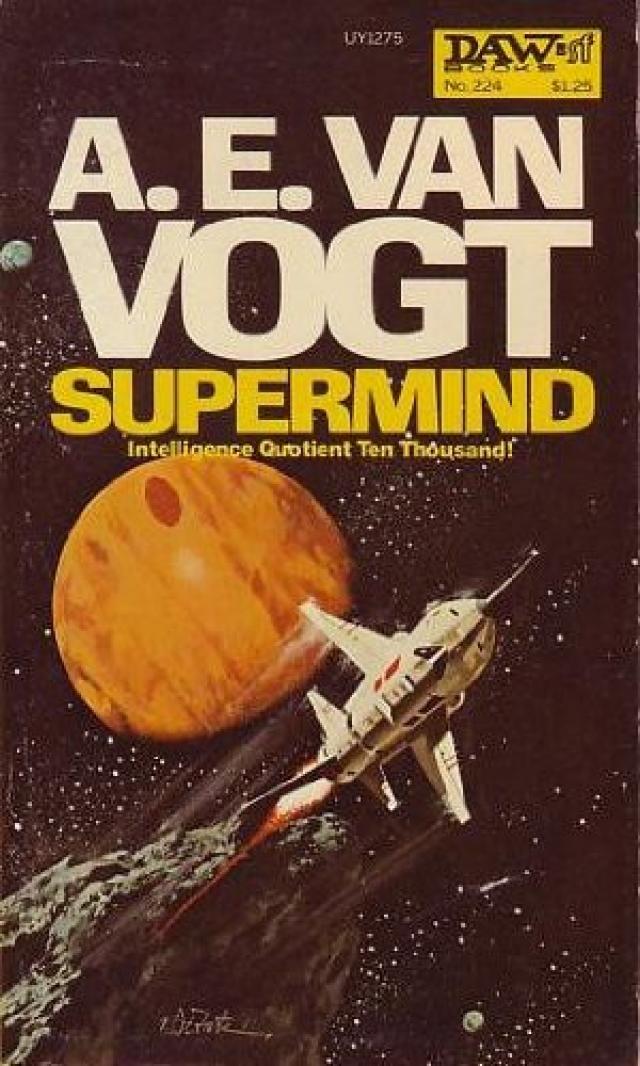


The man was saying, "There is, however, a reference to some man who transports food and merchandise from the moon Europa to the Ungarns. We will ... er ... persuade this man to show us the way."
"One of these days," said Leigh, "you're going to discover that all human beings cannot be persuaded. What pressure are you going to put on this chap? Suppose he hasn't got a mother."
"He has—life!" said the woman softly.
"One look at you," Leigh snapped, "and he'd know that he'd lose that, anyway."
As he spoke, he stepped to the left, one short step. He had an impulse to say something, anything to cover the action. But his voice had betrayed him once. And actually, it might already have done so again. The cold face of the man was almost too enigmatic.
"We could," said the woman, "use William Leigh to persuade him."
The words were softly spoken, but they shocked Leigh. For they offered a distorted hope. And that shattered his will to action. His purpose faded into remoteness. He fought to draw that hard determination back into his consciousness. He concentrated his gaze on the recorder machine, but the woman was speaking again; and his mind wouldn't hold anything except the urgent meaning of her words:
"He is too valuable a slave to destroy. We can always take his blood and energy, but now we must send him to Europa, there to find the freighter pilot of the Ungarns, and actually accompany him to the Ungarn meteor. If he could investigate the interior, our attack might conceivably be simplified, and there is just a possibility that there might be new weapons, of which we should be informed. We must not underestimate the science of the great Galactics. Naturally, before we allowed Leigh his freedom, we would do a little tampering with his mind, and so blot out from his conscious mind all that has happened in this hotel room. The identification of Professor Ungarn as the Galactic Observer we would make plausible for Leigh by a little rewriting of his psychograph report; and tomorrow he will awaken in his bed with a new purpose, based on some simple human impulse such as love of the girl."
The very fact that the Dreegh, Jeel, was allowing her to go on, brought the first, faint color to Leigh's cheeks, a thin flush at the enormous series of betrayals she was expecting of him. Nevertheless, so weak was his resistance to the idea of continued life, that he could only snap: "If you think I'm going to fall in love with a dame who's got twice my I.Q., you're—"
The woman cut him off. "Shut up, you fool! Can't you see I've saved your life?"
The man was cold, ice-cold. "Yes, we shall use him, not because he is essential, but because we have time to search for easier victories. The first members of the Dreegh tribe will not arrive for a month and a half, and it will take Mr. Leigh a month of that to get to the moon, Europa, by one of Earth's primitive passenger liners. Fortunately, the nearest Galactic military base is well over three months distant—by Galactic ship speeds.
"Finally"—with a disconcerting, tigerish swiftness the Dreegh whirled full upon Leigh, eyes that were like pools of black fire measured his own startled stare—"as a reminder to your subconscious of the error of trickery, and as complete punishment for past and—intended—offenses, this!"
Despairingly, Leigh twisted away from the metal that glowed at him. His muscles tried horribly to carry out the purpose that had been working to a crisis inside him. He lunged for the recorder—but something caught his body. Something not physical.
The pain that struck him seemed mortal. There was no visible flame of energy, only that glow at the metal source.
But his nerves writhed; enormous forces contorted his throat muscles; froze the scream that quivered there. His whole being welcomed the blackness that mercifully blotted out the hellish pain.
VII
As the scene faded, Hammond turned away from the viewplate and smiled at Helen Wendell. "So that," he said, "is the notorious Dreegh vampire. Life has its moments, doesn't it?"
The woman nodded soberly. "I've known of them all my life, and here on this remote planet we finally get to see one. Or rather—" She shuddered in a genteel way—"two." She added, "That woman was absolutely awful." She grew thoughtful. "Do you think they suspected that we were using the mechanical psychologist as an intermediary for observing them?"
"Jeel looked it over for any threat," was the reply. "When there was none of that, I'm sure he didn't care about anything else."
He had been sitting on a couch in front of the viewing instrument. Now he rose and walked over to his desk; sat down behind it. His companion followed. She was a lissome woman, quick and graceful, and she settled into the chair across from him with easy strength.
"What do we do now?" she asked.
"Still nothing. Don't forget, we're watching a police operation which one of the Great Ones initiated all of three earth years ago." He seemed strangely stimulated by the thought. "Do you realize," he asked, "that we may actually have the tremendous experience of being privy to an entire operation by one of these super-beings? This could be the educational opportunity of our lifetime."
"Hmmm."
The strong, handsome face looked bemused. "It's interesting that a Great Galactic finally noticed the Dreegh situation at all. There's so much murder and war among the thousands of lower races in this part of the universe that, from above, it must look like almost featureless carnage."
Helen Wendell confessed, "I have to admit that sometimes it also looks that way to me."
He frowned. "One thing, though, the fact that the president of Research Alpha was advised in advance suggests to me that we will eventually be directly involved."
"Oh, my God!" said the woman.
"So tell me: where are the three people you listed for me last evening? Barbara Ellington, Vince Strather, and Dr. Gloge. Were they successfully transported?"
"Getting Dr. Gloge off was not easy. He has the Omega Project, you know. But apparently there is an Asian chameleon that he's been wanting to test. So he's going to our Tokyo facility to observe the chameleon in a simulation of its natural habitat."
The woman continued, "The young man, Vince, was not too eager to go out of the country. He's an angry type; and, though he didn't say it in so many words, I gather he suspects somebody in his department is trying to maneuver him out of there. So—" faint smile—"with him it was not the promise of a new job, but reassurance that he would get his old one back."
"I see you're as skillful as ever," said the man.
"Anyway," said the woman, "they're at our British facility. I must say I can imagine the possibility of a super-scientist such as Dr. Gloge being of some vague interest to the Dreeghs, but"—she shrugged dismissingly—"these two young people, no."
Hammond was grim. "My dear, I'm taking the attitude that there are no coincidences in this affair. So the deepening role of William Leigh, a reporter, is significant. And his accidental—as you termed it—contacting of three employees of Research Alpha needs to be noted."
"What about the science team that questioned Leigh?"
"I've considered that. They were assigned objectively at random. So it's not the same."
"I have their names, in case you ever want them."
"Good." He stood up, smiling. "Now, let's go back to bed."
They both left the room.
VIII
On the third day Europa began to give up some of the sky to the vast mass of Jupiter behind it. The engines that so imperfectly transformed magnetic attraction to a half-hearted repulsion functioned more and more smoothly as the complication of gravitic pull and counterpull yielded to distance. The old, slow, small freighter scurried on into the immense, enveloping night; and the days dragged into weeks, the weeks crawled their drab course toward the full month. On the thirty-seventh day, the sense of slowing up was so distinct that Leigh crept dully out of his bunk, and croaked, "How much farther?"
The stolid-faced space tracker grinned at him. The man's name was Hanardy, and he said now matter-of-factly, "We're just pulling in. See that spot of light over to the left? It's moving this way."
He ended with a rough sympathy. "Been a tough trip, eh? Tougher'n you figgered when you offered to write up my little route for your big syndicate."
Leigh scarcely heard. He was clawing at the porthole, straining to penetrate the blackness. At first his eyes kept blinking compulsively, and nothing came. Stars were out there, but it was long seconds before his bleary gaze made out moving lights. He counted them with sluggish puzzlement. "One, two, three—seven—" he counted. "And all traveling together."
"What's that?" Hanardy bent beside him. "Seven?"
There was a brief silence between them as the lights grew visibly dim with distance and winked out.
"Too bad," Leigh ventured, "that Jupiter's behind us. They mightn't fade out like that in silhouette. Which one was Ungarn's meteorite?"
Hanardy stood up, his heavy face dark with frown. He said slowly, "Those were ships. I never saw ships go so fast before. They were out of sight in less than a minute."
The frown faded from his stolid face. He shrugged. "Some of those new police ships, I guess. And we must have seen them from a funny angle for them to disappear so fast."
Leigh half sat, half knelt, frozen into immobility. And after that one swift glance at the pilot's rough face, he averted his own. For a moment, the black fear was in him that his wild thoughts would blaze from his eyes.
Dreeghs! Two and a half months had wound their slow course since the murders. More than a month to get from Earth to Europa, and now this miserable, lonely journey with Hanardy, the man who trucked for the Ungarns. Every day of that time he had known with inner certainty that the danger had not basically altered but had assumed a more hidden form. The one fortunate reality in the whole affair was that he had wakened on the morning after the mechanical psychologist test from a dreamless sleep; and there in the psychograph report was the identification of Ungarn as the Observer, and the statement, borne out by an all too familiar emotional tension, that he was in love with the girl.
Now this! His mind flared. Dreeghs in seven ships. That meant the first had been reinforced by many. And perhaps the seven were only a reconnaissance group, withdrawing at Hanardy's approach. Or perhaps those fantastic murderers had already attacked the Observer's base. Perhaps the girl was dead.
He watched uneasily as the Ungarn meteorite made a dark, glinting path in the blackness to one side. The two objects, the ship and the bleak, rough-shaped mass of metallic stone drew together in the night, the ship slightly behind. A great steel door slid open in the rock. Skillfully, the ship glided into the chasm. There was a noisy clicking. Hanardy came out of the control room, his face dark with puzzlement.
"Those damn ships are out there again," he said. "I've closed the big steel locks, but I'd better tell the professor and—"
Crash! The world jiggled. The floor came up and hit Leigh with a violent blow. He lay there, cold in spite of the thoughts that burned at fire heat in his mind. For some reason, the vampires had waited until the freighter was inside. Then instantly, ferociously, attacked. In packs!
"Hanardy!" A vibrant girl's voice blared from one of the loud-speakers.
The pilot sat up shakily on the floor, where he had fallen, near Leigh. "Yes, Miss Patricia."
"You dared to bring a stranger with you!"
"It's only a reporter, miss. He's writing up my route for me."
"You conceited fool! That's William Leigh. He's a hypnotized spy of those devils who are attacking us. Bring him immediately to my apartment. He must be killed at once."
"Huh!" Leigh began, and then stiffened. The pilot was staring at him from narrowing eyes, all the friendliness gone from his rough, heavy face. Leigh laughed curtly. "Don't you be a fool too, Hanardy. I made the mistake once of saving that young lady's life, and she's hated me ever since."
The heavy face scowled at him. "So you knew her before, eh. You didn't tell me that. You'd better come along before I sock you one."
Awkwardly, he drew the gun from his side holster and pointed its ugly snout at Leigh.
"Get along!" he said. . . .
Hanardy reached toward an arrangement of tiny lights beside the paneled door of Patricia Ungarn's apartment—and Leigh made a single leap and struck one blow. He caught the short, heavy body as it fell, grabbed at the sagging gun, lowered the dead weight to the floor of the corridor, and then stood like a great animal, straining for sound.
Silence! He studied the blond panels of the doorway to the apartment, as if by sheer, savage intentness he would penetrate their golden, beautifully grained opaqueness. It was the silence that struck him again, presently, the emptiness of the long, tunnel-like corridors. He thought, amazed: Was it possible father and daughter actually lived here without companions or servants or any human association? And that they had some idea that they could withstand the attack of the mighty and terrible Dreeghs?
They had a lot of power here, of course. The earth-like gravity alone would take stupendous energy to maintain. But now, he'd better be on his way before the girl grew impatient and came out with one of her weapons. What he must do was quite simple, unconnected with any nonsense of spying, hypnotic or otherwise. He must find the combination automobile-spaceship in which—Mr. Patrick—had escaped him that night after they left Constantine's. And with that tiny ship, he must try to slip out of Ungarn's meteorite, sneak through the Dreegh line, and so head back for Earth.
What a fool he'd been, a mediocre human being, mixing with such people. The world was full of normal girls of his own general I.Q. level. Why wasn't he safely married to one of them? Still thinking about that, he began laboriously to drag Hanardy along the smooth flooring. Halfway to the nearest corner, the man stirred. Without hesitation, Leigh struck him hard with the revolver butt. This was no time for squeamishness.
The pilot went limp again, and the rest was simple. He deserted the body as soon as he had pulled it out of sight around the corner, and raced along the hallway, trying doors. The first four wouldn't open. The fifth was also locked, but this time Leigh paused to consider.
It seemed unbelievable that the whole place was locked up. Two people in an isolated meteorite wouldn't go around perpetually locking and unlocking doors. Carefully, he examined the door before him. And found its secret. It opened to a slight pressure on a tiny, half-hidden push button that had seemed an integral part of the design of the latch. He stepped through the entrance, then started back with a terrible shock.
The room had no ceiling. Above him was—space. An ice-cold blast of air swept at him. He had a glimpse of gigantic machines in the room, machines that dimly resembled the ultramodern astronomical observatory on the moon that he had visited on opening day two years before. That one, swift look was all Leigh allowed himself. Then he stepped back into the hallway. The door of the observatory closed automatically in his face.
As he hurried to the next door, it struck him that he had made a fool of himself. The existence of the cold air showed that the open effect of the ceiling was only an illusion of invisible glass. But he decided not to go back.
The sixth door opened into a little cubbyhole. A blank moment passed before he recognized what it was. An elevator!
He scrambled in. The farther he got away from the residential floor, the less likelihood of quick discovery. He turned to close the door, and saw that it was shutting automatically. It clicked softly, then immediately started up. Leigh frowned. The elevator was apparently geared to go to some definite point. And that could be very bad. His eyes searched for controls; but nothing was visible. Gun poised, he stood alert as the elevator stopped. The door slid open.
Leigh stared. There was no corridor. The door opened onto blackness. Not the blackness of space with its stars. Or a dark room, half revealed by the light from the elevator. But blackness! Impenetrable. He put a tentative hand forward, half expecting to feel a solid object. But as his hand entered the black area, it vanished. He jerked it back, and stared at it, dismayed. It shone with a light of its own, all the bones plainly visible.
Swiftly, the light faded, the skin became opaque, but his whole arm pulsed with a pattern of pain. He thought: Fool, fool! He laughed bitterly, braced himself. And then it happened.
There was a flash out of the blackness. Something that sparkled vividly, something material that blazed a brilliant path to his forehead—and drew itself inside his head. And then—He was no longer in the elevator. On either side of him stretched a long corridor. The stocky Hanardy was just reaching for some tiny lights beside the door of Patricia Ungarn's apartment. The man's fingers touched one of the lights. It dimmed. Softly, the door opened. A young woman with proud, insolent eyes and a queenlike bearing stood there.
"Father wants you down on Level 4," she said to Hanardy. "One of the energy screens has gone down; and he needs some machine work before he can put up another."