The Original and Complete Null-A Trilogy, page 1


Jerry eBooks
No copyright 2015 by Jerry eBooks
No rights reserved. All parts of this book may be reproduced in any form and by any means for any purpose without any prior written consent of anyone.
The Original and Complete Null-A Trilogy
A.E. van Vogt
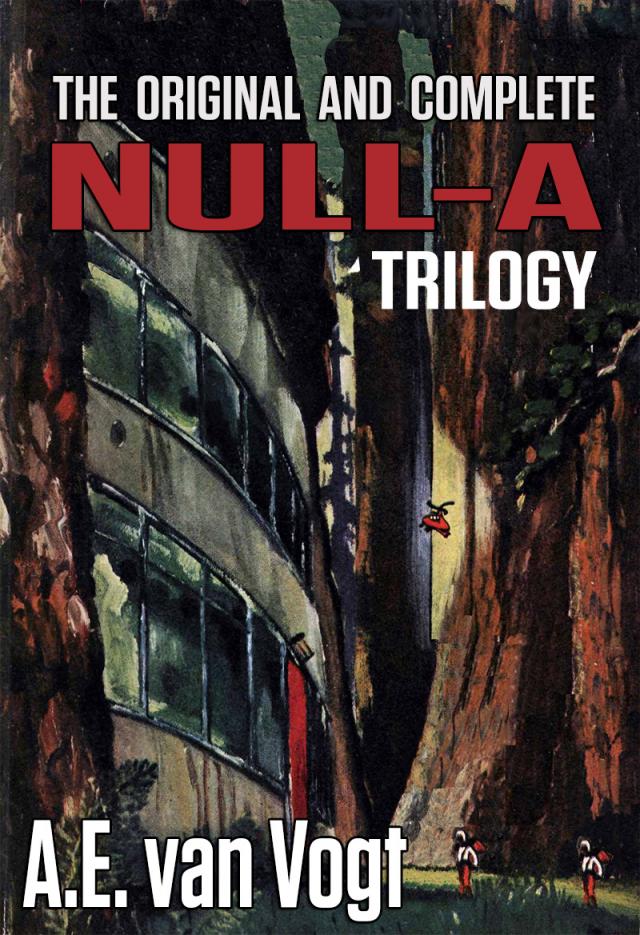
(custom book cover)
Jerry eBooks
Title Page
WORLD OF Ā
THE PLAYERS OF Ā
NULL-A THREE
World of Null-A
Astounding Science Fiction
August 1945, Volume 35, No. 6
September 1945, Volume 36, No. 1
October 1945, Volume 36, No. 2
The Players of Null-A
Astounding Science Fiction
October 1948, Volume 42, No. 2
November 1948, Volume 42, No. 3
December 1948, Volume 42, No. 4
January 1949, Volume 42, No. 5
Null-A Three
DAW Books
July, 1985
1st Printing
Custom eBooks created by
Jerry eBooks
October, 2015
WORLD OF Ā
I.
“Common sense, do what it will, cannot avoid being surprised occasionally. The object of science is to spare it this emotion and create mental habits which shall be in such close accord with the habits of the world as to secure that nothing shall be unexpected.”
B.R.
“. . . The occupants of each floor of the hotel must, as usual during the games, form their own protective groups . . .”
Gosseyn stared somberly out of the window of his hotel room. From its thirty-story vantage point, he could see the city of the Machine sprawled below him. It had no definable shape. His gaze reached towards the hazy periphery, and it was impossible to pick out even the beginning of a design.
There was a bank of river far to the right; the river itself seemed but a thread of misty silver. To the left, a blue-black sea expanded towards the horizon. Straight ahead, and on every side, were buildings, and more buildings, and more and more and more buildings.
They glittered in the setting sun. Color flashed from them to his eyes in a myriad of combinations. The city glowed and shone and blazed with a dazzling beauty, beyond all words. And the most unspeakably enthralling of all the individual parts of that enormous whole was the Machine.
The Machine was a scintillating silvery shaft, rearing into the sky nearly five miles away. Its gardens and its many subsidiary buildings were hidden in the mist of distance.
The sight of it was immensely bracing. In spite of himself, in spite of his dark mood, Gosseyn felt the wonder of that marvelous mechanism. Here he was, here, actually here at long last, to participate in the games of the Machine. The games which meant wealth and position for those who were partially successful, and the trip to Venus for the special group that won top honors.
For years and years he had wanted to come, but it had taken her death to make it possible. Everything, Gosseyn thought bleakly, had its price. In all his dreams of this day, he had never suspected that she would not be there beside him, competing herself for the great prizes.
In those days, when they had planned and studied together, it was power and position that had attracted all their hopes. The going to Venus part they had neither of them been able to imagine, nor had they considered it.
Now, for him alone, the power and wealth meant nothing. It was the remoteness, the unthinkableness, the mystery of Venus, with it promise of forgetfulness, that attracted his whole being. He felt himself aloof from the worldiness of Earth. In a completely unreligious sense, he longed for spiritual surcease.
A knock on the door ended the unconcentrated thought, and narrowed his gaze. Instinctively, Gosseyn’s fingers closed on the element in his belt. He considered the situation for a moment, then manipulated the device to create a defensive screen six inches in front of him, from his face down to his knees.
The protection would be no good against a club or a solid bullet, but it would interfere with the energy output of any small radiating weapon.
He opened the door. And looked at the boy who stood there. The boy said:
“I’ve been sent, sir, to tell you that all the rest of the roomers on this floor are in the sitting room.” Gosseyn felt blank. “So what?” he asked:
“They’re discussing the protection of the people on this floor, sir, during the games.”
“Oh!” said Gosseyn.
He was shocked, then astounded that he had forgotten. The earlier announcement coming over the hotel communicators about such protection had intrigued him, thrilled him.
Until the announcement it had seemed hard to believe that the world’s greatest city would be entirely without police or court protection during the period of the games. In outlying cities, in all other towns, villages and communities, the continuity of law went on.
Here in the city of the Machine, for a solid month there would be no law except the negative defensive law of the groups.
And he had almost missed his first cue in that intricate pattern of protection by which groups took care of themselves.
“They asked me to tell you,” the boy was saying, “that those who don’t come are not protected in any way during the period of the games.”
“I shall be right there,” smiled Gosseyn. “Tell them I’m a newcomer and forgot. And thank you.”
He handed the boy a quarter, and waved him off.
He closed the door, fastened the three plasto-windows and put a tracer on his videophone. Then, carefully locking the door behind him, he went out into, and along, the hall. As he entered the sitting room, he noticed that a man from his own town, a store proprietor named Nordegg, was standing near the door. Gosseyn nodded, and smiled a greeting.
The man glanced at him curiously, but did not return either the nod or the smile.
Briefly, that seemed odd.
The unusualness of it faded from Gosseyn’s mind, as he saw that others of the large group present were looking at him.
Bright friendly eyes, curious friendly faces with just a hint of calculation in them—that was the impression Gosseyn had.
He suppressed a cynical smile. After all the calculation was so very understandable. Everybody was sizing up everybody else, striving to determine what chance their neighbors had of winning in the games.
He saw that an old man at a desk beside the door was beckoning him. Gosseyn walked over. The man said:
“I’ve got to have your name and such for our book here.”
“Gosseyn,” said Gosseyn. “Gilbert Gosseyn, Cress Village, California, age thirty-four, height six feet one inch, weight one hundred eighty-five, no special distinguishing marks.”
The oldster smiled up at him, his eyes twinkling.
“That’s what you think,” he said. “If your mind matches your appearance, you’ll go far in the games.”
He finished: “I notice you didn’t say you were married.”
Gosseyn hesitated, thinking tensely of a dead woman. “No,” he said finally, quietly, “not married.”
“Well, you’re a smart-looking man. May the games prove you worthy of Venus, Mr. Gosseyn.”
“Thanks,” said Gosseyn.
As he turned to walk away, Nordegg, the other man from Cress Village, brushed past him, and bent over the ledger on the desk. When Gosseyn looked back a minute later, Nordegg was talking animatedly to the old man, who seemed to be protesting.
The episode departed temporarily from Gosseyn’s mind, as a small, jolly-looking man walked to an open part of the floor, and held up his hand.
“Ladies and gentlemen,” he began, “I would say that we should now begin our discussions. Everybody interested in group protection has had ample time to come here. And therefore as soon as the challenging period is over, I will move that the doors be locked, and we start.
“For the benefit,” he went on, “of those new to the games who do not know what I mean by challenging period, I will explain the procedure. As you know everybody here present will be required to repeat into the lie detector the information he or she gave to the doorkeeper. But before we begin with that, if you have any doubts about the legitimacy of anybody’s presence, please state them now.
“You have the right to challenge anybody here present. Please voice any suspicions you have, even though you possess no specific evidence. Remember, however, that the group meets every week, and that challenges can be made at each meeting. But now, any challenges.”
“Yes,” said a voice behind Gosseyn. “I challenge the presence here of a man calling himself Gilbert Gosseyn.”
“Eh!” said Gosseyn. He whirled and stared incredulously at Nordegg.
The man looked at him steadily, then his gaze went out to the small sea of faces beyond Gosseyn. He said:
“When Gosseyn first came in, he nodded to me as if he knew me, and so I went over to the book to find out his name, thinking it might recall him to me. To my amazement I heard him give his address as Cress Village, California, which is where I come from. Cress Village, ladies and gentlemen, is a rather famous little place, but it only has a population of three hundred. I own one of the three stores; and I know everybody, absolutely everybody in the village, and in the surrounding countryside.
“There is no person residing in or near Cress Village by the name of Gilbert Gosseyn.”
For Gosseyn, the first tremendous shock had come and gone while Nordegg was still speaking. The after-feeling that came was that he was being made ridiculous in some obscure way. The larger accusation seemed otherwise quite meaningless.
He said: “This all seems very silly, Mr. Nordegg—” He paused, struck by a mighty thought—“That is your name, is it not?”
“That’s right,” Nordegg nodded, “though I’m wondering how you found it out.”
“Your store in Cress Village,” Gosseyn persisted, “stands at the end of a row of nine houses, where four roads come together.”
“There is no doubt,” said Nordegg, “that you have been through Cress Village either personally or by means of a photograph.”
The man’s smugness abruptly irritated Gosseyn. Damn his miserable hide, what was he trying to pull off? With an effort, Gosseyn fought that leaping anger. He said: “About a mile westward from your store is a rather curiously shaped house.”
“House he calls it!” said Nordegg. “The world-famous California home of the Hardie family.”
“Hardie,” said Gosseyn, “was the maiden name of my late wife. She died about a month ago. Patricia Hardie. Does that strike any chord in your memory?”
He saw that Nordegg was grinning gleefully at the intent faces surrounding them.
“Well, ladies and gentlemen, you can judge for yourselves. He says that Patricia Hardie was his wife. That’s a marriage I think we would all have heard about if it had ever taken place. And as for her being the late Patricia Hardie, or Patricia Gosseyn, well”—he smiled ferociously—“all I can say is, I saw her yesterday morning, and she was very, very much alive, and looking extremely proud and beautiful on her favorite horse, a white Arabian.”
It wasn’t ridiculous any more. None of this fitted; none! Patricia didn’t own a horse, white or colored. They had been poor, working their small fruit farm in the daytime, studying at night. Nor was Cress Village world-famous as the country home of the Hardies. The Hardies were nobodies—who the devil were they supposed to be?
The question flashed by. And was gone, succeeded by a greater thought, a purpose. A purpose that had nothing to do with the people in the room, though it grew out of Nordegg’s words.
It was so important, so vital, that Gosseyn’s brain retreated abruptly from the very idea of argument; with a simple clarity he saw only the means that would end the deadlock, and enable him to carry out the all-compelling purpose inside him. He spoke the necessary words:
“I can only suggest that the lie detector will readily verify my statements.”
But the lie detector said: “Ne, you are not Gilbert Gosseyn; nor have you ever been a resident of Cress Village, California. You are—”
It stopped. The dozens of tiny electronic tubes in it flickered uncertainly.
“Yes, yes,” urged the pudgy man. “Who is he?”
There was a long pause; then: “Mo knowledge about that is available in his conscious mind,” said the detector. “There is an aura of unique strength about him. But he himself seems to be unaware of his true identity. Under the circumstances, no identification is possible.”
“Under the circumstances,” said the pudgy man with finality, “I can only suggest an early visit to a psychiatrist, Mr. Gosseyn. Certainly, you cannot remain here.”
A minute later, Gosseyn was out in the corridor. The thought, the purpose seemed now made of caked ice; it lay on his brain, a cold weight. He had to get that freezing, deadly thing out of him.
He reached his room, and put through the call on the videophone. It took about two minutes to make the connection with Cress Village, California.
A strange woman’s face came on to the plate. It was a rather severe face, but distinctive and young, even good-looking.
“I’m Miss Treechers, Miss Patricia Hardie’s California secretary. What is it you wish to speak to Miss Hardie about?”
For a moment the existence of such a person as Miss Treechers was staggering. Then:
“It’s private,” said Gosseyn, recovering. “And it’s important that I speak to her personally. Please connect me at once.”
He must have sounded, or looked, or acted authoritative; there must have been something about him. The young woman said hesitantly: “I’m not supposed to do this, but you can reach Miss Hardie at the palace of the Machine.”
Gosseyn said explosively: “She’s here, in the great city!”
He was not aware of hanging up. But suddenly the woman’s face was gone; the video was dark. He was alone with his realizations:
Patricia was alive!
He had known of course. His brain, educated in accepting things as they were, had already adjusted to the fact that a lie detector didn’t lie.
Sitting there, he felt strangely satiated with information. No impulse came to call the palace, and talk to her, see her. Tomorrow of course he would have to go there; but that seemed far away in spacetime. He grew aware that someone was knocking loudly at his door.
He opened it, and stared at four men, the foremost of whom, a bespectacled young man, said:
“I am the assistant to the manager, in charge of this section of the hotel. We’ll check your luggage downstairs, but during the policeless month, we dare not take any chances with individuals, so—”
It took about twenty minutes for Gosseyn to be ejected from the multistoried hotel. Night was falling, as he walked slowly along an almost deserted street.
II.
“The negative judgment is the peak of mentality.”
A.N.W.
It was too early as yet for grave danger. The night, though already arrived, was but beginning. The prowlers and the gangs, the murderers and the thieves, and the scores of unclean human creatures who would soon emerge from their myriad shelters, were still hidden in the oblivion of a vast city.
Gosseyn came to a sign that flashed on and off, repeating tantalizingly:
Rooms for the Unprotected
$20 a Night
They didn’t want much, he reflected grimly. At that rate, the three hundred dollars he possessed wouldn’t carry him more than ten days, counting in food and costs connected with the games.
Besides, there were ugly stories connected with such places.
He walked on. It was a bright, almost a dazzling night. As the planetary darkness deepened, more and more atomic-powered tights flashed on ill their automatic fashion. The world of the city of the Machine glowed and sparkled with an incandescent glory. For miles and miles, he could see the two lines of street lamps like shining sentinels striding in geometric progression towards a distant blaze point of illusory meeting.
Spiritually empty brightness!
The fulness of the light only served to emphasize the absence of man from his special creation, the megalopolitan city.
It was suddenly immensely depressing.
He stopped short there in the deserted street. “I must free myself,” he said aloud, intently, “from the delusions of my mind, from the false memory and the conviction I have of my identity.”
He was apparently suffering from semi-amnesia, and he must try to comprehend that in the largest sense of meaning. Only that way would freedom come.
He attempted to visualize the freeing as an event in the null-A interpretation. But the reality would not rise above the verbal level.
“One fact I have,” he told himself. “I am not Gilbert Gosseyn, though I shall continue to use the name until I find what my real name is.”
The conscious use of negation, that important mind-training system, made him feel better. And suggested a new though un-negative approach to his problem:
Perhaps if he tried to picture the event that was himself, as he was, semi-amnesia and all, he might attain to the objective level.
It worked.
The results were almost stupendous. Like water draining from an overturned basin, the doubts and fears spilled out of him. The weight of false grief, false because it had so obviously been imposed upon his mind for somebody else’s purpose, lifted.
He was free.
It was strangely intoxicating. He looked around with new, brighter vision. Long lines of glowing shop windows faced him on either side of the street. Just like that, they enticed him. Suddenly, what they offered was important and attractive. The brilliant displays of goods, the luxuries of life here shown in their most explicit form, mattered again.