The Darkness on Diamondia, page 1


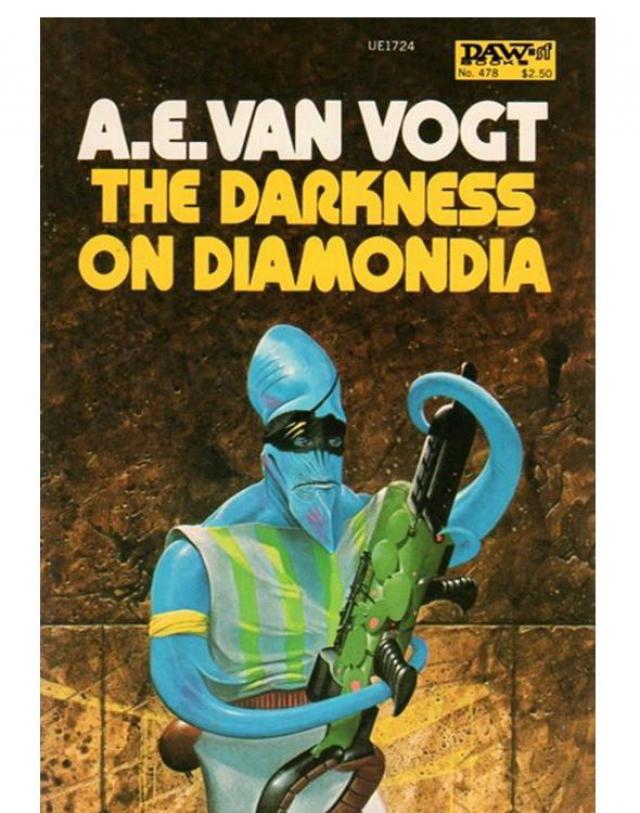
THE DARKNESS ON DIAMONDIA
A. E. van Vogt
No ordeal changes the nature of man and no crisis changes the nature of states.
Charles de Gaulle
DEDICATION
To Fred Pohl who for better or worse in 1964, when he was editor of Galaxy, Worlds of If, and Worlds of Tomorrow, persuaded me to write science fiction again.
One
“Gray thoughts,” Morton read, “under a gray sky… Across the darkening roofs of New Naples, Christomene watched from her window Vesuvius II sputtering and smoking with a tireless endurance. She let her thoughts take form in the distance, in the uneven flow of smoke, like a person looking for pictures in a dancing log fire.”
At that point he paused in his reading, because the car hit a bomb-filled hole; and, besides, that was about the limit of his attention span on anything since his arrival on Diamondia VI.
Morton closed his eyes momentarily, and surreptitiously (he hoped) squeezed them hard several times, striving once more to force the hovering darkness out of his brain. The brief effort, to be repeated hundreds of times in the course of the day, brought relief for the ten thousandth time since he had landed with the Negotiating Committee.
Suddenly, as if a weight had lifted, the darkness drew back. Instantly, he felt brighter inside; normal again. He glanced over at Lieutenant Bray, who was driving. He had heard in a vague fashion that the dynamic Intelligence officer, now attached to the New Naples command, did fiction writing. But this was the first time he had seen a sample.
“Does this kind of involved imagery really sell?” Morton asked, picking up again the thread of what he had been doing before the darkness descended on him.
Bray’s thin, intense face assumed a cautious expression. “I never know,” he confessed. “I’ve sold about thirty exactly like that. But then about thirty others, also exactly like that, have come back.
“My own idea,” he went on, “is that it all depends on how much the editor on Earth is bowled over by receiving the yarn direct from the, uh, exotic city in which it is laid. This one will be posted New Naples, Diamondia.”
Morton nodded and realized that he was smiling for the first time in many a long day. “What’s the plot?” he asked.
“A Diamondian heiress,” said the lieutenant, “caught in the turmoil of war falls for an Earth soldier—of course, he’s really a millionaire who came over as a private because he’s that kind of a guy; and she never did approve of the war.”
Morton tried to picture that and couldn’t. Then he tried to picture the steel-brained Lieutenant Bray grinding out the necessary words. That drew an even bigger blank. He leaned back in the seat. “Why don’t you write about the work we’re doing here?” he said.
Lieutenant Bray sighed. “People always ask me that. But truth is, it lacks glamour. What you and I are here for—to get Earth federation armies out of this war—is too ugly. We know perfectly well the Irsk will murder all the human beings on Diamondia when we’re gone. So I’m hoping to get this story sold before that happens.”
Morton said quickly but halfheartedly, “There’s no proof that the Irsk will massacre anybody.”
That was the official line; and he had to say it as a matter of mechanically doing his duty. Which was about what one man could do. Even someone who was on the Negotiating Committee staff, as he was.
Bray was speaking again. “Take this girl, Isolina Ferraris, whom you’re going to visit. She’s pretty enough, I suppose, if you like that kind of thing. And I understand she had an Italian mother from Earth, who died shortly after giving birth to Isolina. Theoretically, that should make her a perfect heroine. But what is the truth? She’s a Diamondian nationalist. She uses her body as a weapon. Everybody is so desperate and afraid that things we like to think of as being true about human beings have gone out of the window. But her father is a contact in this area with the underground group. So we have to deal with a mad young woman.”
He shrugged; then: “An added point is that the whole terrified outfit is assassinating dissenters right and left, and they don’t trust us. Back home, folks like to believe that the mass of the Diamondians are sensible people, who will peacefully give up their lives so backhomers can stop paying such high taxes.”
“And so they are, generally, sensible,” said Morton. To himself he added, “We keep trusting.”
“Not this bunch, colonel,” the lieutenant said. “Imagine a plot with a hundred low characters in it, all egotistical, all scoundrels, thinking only of themselves and not of the poor, overburdened taxpayers of the federation. And not one of ‘em capable of making the noble sacrifice that the heiress in my story—”
Bray stopped in midsentence, made a dangerous swerve in that heavy traffic but managed to pull over to a parking position beside a red curb. He did not even glance at Morton. Sitting there, his body rigid, he sat and squeezed his eyes several times.
Morton watched him in stunned silence, thinking, just like I’ve been doing.
Bray seemed to be recovering, and, belatedly, Morton realized that he would have to show awareness of the astonishing thing the other man had done.
“What’s the matter?” he asked.
The younger man seemed to shrink down into the seat. Yet he said in that familiar, firm voice of his, “I intended to talk to you about this today, sir. Was glad, in fact, that we were going out together so I could have the opportunity. Since my condition varies in intensity, I waited for a severe recurrence. And you just saw it.”
“Condition?” echoed Morton in a neutral tone.
A long pause. Then:
“Something periodically moves in on me,” said Bray.
“What exactly happens?” asked Morton. Involuntarily he held his breath, waited for an answer, tense, intent, unwary.
“Well—” Bray seemed uncertain.
“Is it—is it like a… darkness?” asked Morton.
“That’s it!” Bray verbally pounced on the description. “It’s as if something, another entity, is reaching in…” He paused, uncertain again.
Morton’s thoughts flashed to his own darkness. And he considered its nature in the light of the word Bray had used. Entity. He thought: Good God, can it be?
It was a moment of disaster and abrupt fear. To save himself, he did his old thing: looked around, oriented himself.
Surprisingly hard to do. Because this time the effort was almost as automatic as the inner disturbance which made it necessary. Yet he was aware that they were still on the Via Roma. All around were the madly charging vehicles driven by people with bright, cheerful eyes and vaguely smiling faces.
Watching the traffic through his own glazed eyes, Morton began to feel better. His pounding heart slowed. The fear dimmed. He realized that he was examining the entity not as a new calamity but as an old problem about which he had been offered some additional insights.
…He grew aware that Lieutenant Bray was speaking again and that in that normally determined voice there was the barest touch of grief.
“I keep intending,” said the young man, “to report in for psychiatric examination. But then I think, how the hell will that look on my record? And I can’t bring myself to do it.”
Morton, who had had a few fleeting impulses himself in the direction of medical aid, nodded his acceptance of the reason. Actually, the situation was worse than Bray feared. Such matters, he knew from his higher echelon position, were handled by a grim routine. Psychiatrists on remote planets were usually young people; and they had been taught not to try to cure anybody and risk their reputations. So off to some base hospital on another world went the unsuspecting—until that too late moment—victim. What happened to him and his career after that was cringe-level data for anyone who learned of it afterward.
He was inclined to believe that Bray—and perhaps even he himself—were not high enough echelon to evade such a fate.
Thinking about such factual matters was sobering. Suddenly he was aware not only of the traffic but of their location. “There’s the museum just ahead,” Morton said. “Pull up in front of it and let me off. I’ll walk the rest of the way.”
As Bray started the car again and gingerly edged forward, Morton said to him, “And don’t mention your condition to anyone until you have talked to me about it further. Don’t go near a psychiatrist.”
Bray nodded mutely, his eyes alertly watching the traffic. But a minute or so later when he had pulled up as instructed, he said in a troubled voice, “Colonel, are you sure you should visit this girl by yourself? These Diamondians are the damnedest bunch of assassins you ever heard of.”
“We’re their only hope,” Morton answered. “Persuading us to stay is all they’ve got. Everybody knows you can’t ship lift half a billion people off a planet. So they’d better not make us mad.”
Bray continued to scowl unhappily. “May I ask, sir, what is our purpose in dealing at all with this General Ferraris gang?”
“Well,” Morton began.
And then he stopped, momentarily blank.
What bothered him was the recollection that he actually had no clear-cut instructions from Paul Laurent, who headed the Negotiating Committee. Laurent had simply said to him, “Basically, Charles, there’s nothing for us to do. Our committee title is a misnomer. The word ‘Negotiating’ is not relevant, because we’re here to get the Earth federation forces off this planet, and we’re going to do that whether or not anyone negotiates with us. But nonetheless, act as if negotiation is our purpose. That way we may actually get something settled here.”
He’d become vague about those words. Somehow, Morton thought, as he sat there beside Bray, I’m already more involved than those instructions permit. He wanted, he realized, negotiations to solve the deadly problem on Diamondia.
Aloud slowly, he said, “Don’t be too cynical, lieutenant. And don’t assume all of these groups are equally murderous. General Ferraris and his daughter, according to my report—and that is why I’m here—have contacted a large, representative Irsk group, and have dispatched a sizable peace delegation. I’d like us to discover the details of that transaction, and it occurred to me, why don’t I just go over and ask?”
Bray said, “Oh!”
Morton changed the subject, saying matter-of-factly, “You turn off here.” He pointed. “La Strada dell’Arenaccio is just beyond the botanical gardens. Drive along it until you come to Capodochino Corapo, I can’t remember how many miles—eight, maybe. I’ll join you there later tonight for the visit to the Ferraris farm. Starting noon tomorrow we watch the junction at Corapo and in the afternoon stop certain cars. According to our information, the people in them will be the returning peace delegation.”
He almost added, “I hope,” but restrained himself. Instead he said, “And don’t forget our purpose is not to screw up peace negotiations but to find out their nature. If we use our enforcement technology correctly, we can count on the members of the peace delegation not revealing that we stopped them… Their self-esteem.” He broke off. “My guess is that a solution on Diamondia will have a very high finite logic number. Meaning reason will not be involved. As for Captain Marriott, he’s in charge at Corapo. Whose side is he on? We need to know.”
Bray said he would do his best to find out. But his voice as he said it was not very interested. And in his face was a new thought. He looked baffled. “Sir,” he said abruptly, “it is now nearly two thousand years since technology and science began in earnest. Yet here in 3819 A.D., Man is still obstreperous and unthinking. By this time why isn’t there a pill that we can give all these mad Diamondians and civilize them?”
Morton had to smile though the question wrenched him from his previous thoughts. “I have an answer,” he said. “I don’t know if it’s the answer.”
“What is it?”
“Man thinks with what used to be called modern logic. But his basic nature, like the universe, operates on finite logic.”
“Well—” shrugged Bray, “I suppose you’re right.”
But his youthful face showed continuing dissatisfaction, and he moved his body in a way that anticipated that Morton would now leave the car.
Morton didn’t move. He was astonished to realize that there was actually an opposite purpose in him.
My discovery that Bray also has a darkness in his mind is an Intelligence event of preemptive importance. Could it be that somebody had a machine focused on Bray and himself?
So far it didn’t seem dangerous. But the fact that two people in Intelligence were affected had to be significant.
Can the darkness wait on other events? It cannot! The Diamondian nationalists had to come second to the thing in Bray’s head and his. For example, he must find out at once if other people were having a similar experience.
…Bray’s voice came in on his thoughts, sounding slightly remote, “What’s the matter, sir?”
Morton was instantly warned by that sudden sense of farawayness. Another of his numerous battles with the entity was about to transpire.
He spoke hurriedly, “Cancel the orders I just gave you, lieutenant. The girl can wait. What you’ve just told me about that thing in your head interests me. Drive me back to headquarters.”
As he spoke the words, he realized that the mass of blackness moving in was extra large, as occasionally happened. He braced himself.
And that was the last thing he later remembered doing.
Two
For Lieutenant Bray, the visible event, then, was: the man in the seat beside him suddenly went limp. As Bray gazed, wide-eyed, Morton’s body slowly slid down under the dashboard. The head ended up leaning, mouth open, with the neck against the seat itself. There, all hunched up, with no further room to move, it remained jammed in.
At that point, and not an instant earlier—
My God, Bray thought, he’s been assassinated.
Horrified, he ducked down beside the still body of his superior. He crouched there, permitting himself no further reaction. Simply, he recorded through his senses.
The warm, warm wind, with the name Bray could never remember, was blowing across the car from the direction of the bay. It brought with it some of the perpetual heat from the continent a hundred miles away over the water and brought, too, something of the dampness of the water above which it had passed.
It occurred to the sweating Bray that if there had been an energy sound in connection with the killing, he would never have heard it. Even a pistol shot—which was more likely in old-fashioned New Naples—would have got swallowed up in the hum and the throb and the roar of the passing cars.
He deduced then that no one else had even noticed the disaster. Crouching there, he realized: It’s up to me.
With that awareness, his finger sought the catch on the little hook under the dashboard. Pulled it like a trigger. As might a sliding door, the flexible graphite-fiber top came gliding up from its bed and clicked into place.
Instantly he was safe from all except overwhelm impacts. And so for the first time he examined the body, looking for a wound.
Found nothing.
But he realized that the older man was breathing.
He’s alive.
Bray had already straightened up. Now he opened the door on his side of the machine, jumped out, ran around to the other side and jerked open that door. Moments later, he had dragged Morton out of the car and had him lying full length on the sidewalk.
He was now able to verify that the older man had suffered no wounds, and that his heart was beating normally and his breathing was regular.
But there was no sign of returning consciousness.
Nonetheless, the young officer began to feel up. To Bray the world was what it was, no more and no less, no better and no worse. Diamondia was no exception. He climbed to his feet, and he stood there beside the unconscious body; and he felt no sense of urgency or special concern now that he knew it was an alive body.
Even in unconsciousness, Bray observed, Morton looked strong. His face muscles held their firm shape. Lying there, the older man was the epitome of a determined person struck down but waiting. His was a handsome face, and a lean (but not too lean) body. Bray himself an active product of a muscle buildup regimen, was both thinner and, of course, younger.
Yet in his association with Morton, he had occasionally accidentally bumped, jostled, or run into the older man… and each time had almost literally bounced. He surmised Morton to be in his late thirties and at an optimum balance of maturity and good health. Which made what had now happened just a little sad.
Thinking thus but not letting it dim him, Bray whistled softly and watched the people who went by on the sidewalk. At first they were all Diamondians. They had, if anything, a blond Scandinavian or even English cast of countenance. And they were not about to involve themselves in his problem.
Bray mentally conducted several silent conversations from the Diamondian point of view.
Look at that federation officer lying there.
I see him. He’s a member of the Negotiating Committee. Notice that special shoulder insignia.
Then to hell with him, signor.
And again:
See that poor officer.
Don’t get involved, my friend. Before you know it, you also will be on the non-negotiating Negotiating Committee, wasting your time as they are wasting theirs.
Finally:
Is he dead, I wonder.
Let us hope so. Maybe that will give these federation rascals the feel of what it’s going to be like here on Diamondia after they’re gone.
It seemed to Bray that something like that must be going through the minds of the Diamondians who hurried by in either direction. They merely glanced at Morton and himself and otherwise paid no attention.