Complete Short Fiction, page 1


Jerry eBooks
No copyright 2020 by Jerry eBooks
No rights reserved. All parts of this book may be reproduced in any form and by any means for any purpose without any prior written consent of anyone.
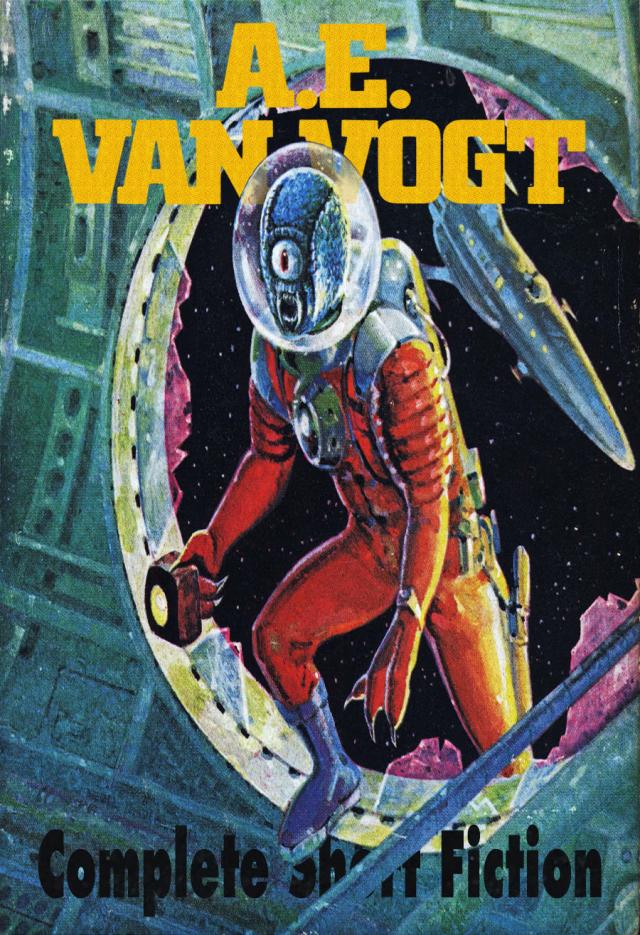
Complete Short Fiction
A.E. van Vogt
Cover
Jerry eBooks
Title Page
About A.E. van Vogt
Pseudonyms
“Author, Author”
Bibliography
Short Fiction Bibliography: chronological
Short Fiction Bibliography: alphabetical
Short Fiction Series
1939
BLACK DESTROYER
DISCORD IN SCARLET
1940
THE SEA THING
REPETITION
VAULT OF THE BEAST
SLAN (Part One of Four Parts)
SLAN (Part Two of Four Parts)
SLAN (Part Three of Four Parts)
SLAN (Part Four of Four Parts)
1941
NOT THE FIRST
THE SEESAW
1942
RECRUITING STATION
CO-OPERATE—OR ELSE!
ASYLUM
SECRET UNATTAINABLE
THE GHOST
THE SECOND SOLUTION
NOT ONLY DEAD MEN
THE WEAPON SHOP
THE FLIGHT THAT FAILED
1943
THE SEARCH
THE WEAPON MAKERS (Part I)
THE WITCH
THE WEAPON MAKERS (Part II)
ABDICATION
THE WEAPON MAKERS (Conclusion)
THE GREAT ENGINE
M 33 IN ANDROMEDA
CONCEALMENT
THE BOOK OF PTATH
THE STORM
THE BEAST
1944
FAR CENTAURUS
THE RULERS
THE CHANGELING
THE WINGED MAN (Part One)
THE WINGED MAN (Conclusion)
JUGGERNAUT
A CAN OF PAINT
THE HARMONIZER
1945
THE MIXED MEN
THE PURPOSE
HEIR APPARENT
WORLD OF Ā (Part One)
WORLD OF Ā (Part Two)
WORLD OF Ā (Conclusion)
1946
A SON IS BORN
FILM LIBRARY
CHILD OF THE GODS
THE CHRONICLER (First of two parts)
THE CHRONICLER (Conclusion)
HAND OF THE GODS
1947
HOME OF THE GODS
CENTAURUS II
THE CATAAAAA
DEFENSE
THE BARBARIAN
1948
THE SHIP OF DARKNESS
THE RULL
THE GREAT JUDGE
THE MONSTER
DORMANT
THE PLAYERS OF Ā (Part One of Four Parts)
THE PLAYERS OF Ā (Part II of IV)
THE PLAYERS OF Ā (Third of Four Parts)
1949
THE PLAYERS OF Ā (Conclusion)
THE WEAPON SHOPS OF ISHER
THE EARTH KILLERS
THE GREEN FOREST
PROJECT SPACESHIP
FINAL COMMAND
DEAR PEN PAL
1950
THE SHADOW MEN
THE SOUND
ROGUE SHIP
THE WIZARD OF LINN (First of Three Parts)
WAR OF NERVES
THE WIZARD OF LINN (Second of three parts)
THE WIZARD OF LINN (Conclusion)
ENCHANTED VILLAGE
AUTOMATON
PROCESS
1951
HAUNTED ATOMS
THE STAR-SAINT
THIS JOE
FULFILLMENT
1963
ITSELF!
THE EXPENDABLES
1964
THE SILKIE
1965
THE REPLICATORS
RESEARCH ALPHA
1966
SILKIES IN SPACE
THE ULTRA MAN
1967
ENEMY OF THE SILKIES
1968
THE PROXY INTELLIGENCE (condensed version)
1969
HIM
LAUGH CLONE, LAUGH
HUMANS, GO HOME!
1970
CARTHING
1971
THE HUMAN OPERATORS
THE PROXY INTELLIGENCE (full-length version)
THE RAT AND THE SNAKE
THE REFLECTED MEN
ALL THE LOVING ANDROIDS
1972
THE TIMED CLOCK
THE CONFESSION
THE BARBARIAN (1972 expanded version)
ERSTAZ ETERNAL
THE SOUND OF WILD LAUGHTER
LOST: FIFTY SUNS
1973
DON’T HOLD YOUR BREATH
FUTURE PERFECT
1974
ALL WE HAVE ON THIS PLANET
1978
DEATH TALK
THE GODS DEFIED
PENDULUM
THE MALE CONDITION
LIVING WITH JANE
THE FIRST RULL
FOOTPRINT FARM
THE NON-ARISTOTELIAN DETECTIVE
1979
FEMWORLD: before the revolution
1980
THE DREAM OF THE SORCERESS
1981
IDENTITY
1984
THE PANDORA PRINCIPLE
1985
THE BRAIN
1986
PROLOGUE TO FREEDOM
2007
SLAN HUNTER (Part 1)
SLAN HUNTER (Part 2)
SLAN HUNTER (Part 3)
Alfred Elton van Vogt was born on April 26, 1912 in a rural Russian Mennonite community in Manitoba, Canada. His father was a lawyer who, affected by the Great Depression, had to constantly move his family from place to place. Until he was four years old, van Vogt and his family spoke only a dialect of Low German in the home.
After WWII, he moved to Hollywood, California where his writing changed dramatically. He wrote three novels focusing on the General Semantics of Alfred Korzybski and the idea of all-encompassing knowledge. Totalitarianism affected him greatly, and he wrote many novels dealing with the topic. Despite his views towards totalitarianism, his writing was very sympathetic to absolute monarchy as a form of government. During this period, he also systematized his writing, using scenes of 800 words, and several of his stories work on a temporal conundra theme. L Ron Hubbard briefly appointed him the head of Dianetics in California, which was the precursor to Scientology. After the center fell apart, he and his wife opened their own Dianetics center, financed by his writings until he quit several years later. He died from Alzheimer’s disease in 2000, survived by his second wife.
After starting his writing career by writing for “true confession” style pulp magazines like True Story, van Vogt decided to switch to writing something he enjoyed, science fiction. This happened after he casually picked up the August 1938 issue of Astounding Science Fiction from a newsstand, and found the story “Who Goes There?”. The story inspired him to write “Vault of the Beast”, which he sent to the same magazine. It was rejected, but the rejection letter encouraged him to try again. He then sent in a new story called “The Black Destroyer”, which was accepted. A rewritten version of “Vault of the Beast” would be published in 1940.
Van Vogt’s first SF publication was inspired by The Voyage of the Beagle by Charles Darwin. “The Black Destroyer” was published by John W. Campbell in Astounding Science Fiction, July 1939, the centennial year of Darwin’s journal. It featured a fierce, carnivorous alien, the coeurl, stalking the crew of an exploration spaceship. In 1939, he followed up with another space monster story, “Discord in Scarlet” which introduces the readers to Ixtl, the last survivor of a once-great galactic civilization, floating alone in interstellar space. The Weapon Makers and The Book of Ptath were published in 1947.
In 1941, van Vogt decided to become a full-time writer, quitting his job at the Canadian Department of National Defence. Extremely prolific for a few years, van Vogt wrote a large number of short stories. In the 1950s, many of them were retrospectively patched together into novels, or “fixups” as he called them, a term which entered the vocabulary of science fiction criticism.
Van Vogt’s first completed novel, and one of his most famous, is Slan, which Campbell first published as a serialized novel in Astounding September to December 1940. Using what became one of van Vogt’s recurring themes, it told the story of a 9-year-old superman living in a world in which his kind are slain by Homo sapiens.
In the 1948 novel, The World of Null-A, the protagonist Gilbert Gosseyn discovers his memories are false, and seeks his real identity in a world where the mentally superior dominate over the rest.
The “Black Destroyer” and “Discord in Scarlet” along with two other stories “War of Nerves” and “M33 in Andromeda” were integrated into his classic, The Voyage of the Space Beagle published in 1950.
He was married to Edna Mayne Hull from 1939 to 1975. She helped him by typing his stories, and later began to write herself, under the name E. Mayne Hull. She died from cancer on January 20, 1975.
In 1979, he married his second wife Lydia Bereginsky, who had two children from an earlier marriage. She had been a model and a court interpreter who specialized in Russian.
A.E. van Vogt died on January 26, 2000, at the age of 87 from Alzheimer’s disease.
Pseudonyms
Alfred E. van Vogt • Alfred Elton van Vogt • A.E. van Voigt
AUTHOR, AUTHOR
A.E. van Vogt
In the July 1939 issue of ASTOUNDING-SCIENCE-FICTION appeared a story, “Black Destroyer”, by a then unknown writer, A.E. van Vogt. Other stories followed, soon bringing him to a leading position in the STF field. With the publication of “Slan”, since acclaimed by many the greatest superman story ever written, van Vogt established his place high among Science Fiction’s “greats”.
Alfred E. van Vogt has since had a total of more than 40 stories published in the field.
Any discussion of “Van’s” work must include mention of Mrs. van Vogt, well known in her own right under her maiden name of E. Mayne Hull. Her “Artur Blord” stories and others that have appeared in ASTOUNDING and UNKNOWN are well and favorably remembered. Before her marriage, she wrote numerous articles for newspaper magazine sections, and love stories.
Those who have been fortunate enough to meet “Van”, as he is known to his many friends, retain a memory of his warm personal charm and unassuming friendliness. He is extremely self-possessed and at ease in all circumstances, tho in his speech at the Pacificon he implied that this had not always been true.
If “Van” has any hobby, it is that of experimenting on himself with the newer mental sciences. In 1945, he became interested in the Bates system for eye training, and reported many interesting details of this method in his two-part serial, “The Chronicler”. About the same time he trained himself to type with ten fingers instead of two. Recently, he has become a student of hypnosis.
But enough of introductions. Let “Van” speak for himself.
I have been trying to pin down the interest that Science Motion readers may have in me, and it surely cannot be that they want to know the bare facts about my life. Most of them have had far more exciting lives themselves to judge by what I have seen and heard both in Toronto and Los Angeles, but it is clear that they do not realize this. The fans, I discovered were like most other people, striving to get a little happiness out of life, and not quite knowing how to do it. That is the trouble. In my speech at the Pacificon, I tried in my dim way to point out a few paths of self-development that I consider neccessary before anyone can participate in the larger life of the world. The politics, the community, the realities of national life are always second, after personal achievement. How can you know what is good for a people if you have never discovered what is good for yourself?—I am not referring to money, an important tangible which I would like to have more of.
But I am sure, too, that fans are not interested in my private opinions about life, politics and the state of the nation. That is not why they read my stories. But just for the record let me list myself as a person who believes that the belief of Americans, that Communism is the only alternative to Democracy, is the most important idea sale ever made in the history of the world. The far-reaching effect of this will not be apparent until the next degression. Civilization will disolve overnight.
As you will see, it is going to be difficult to discover what about me will interest sf readers. I was born in Canada, and lived in Toronto before coming down to L.A. in 1944. I feel like a Californian, and find it a happy state of mind. I have two problems “down” here, however. The first of these is trying to stay alive despite the high cost of living. The second one is psychological. All my life I have existed mentally from six months to couple of years in the future. Just how this is done I cannot define exactly, but it includes hoping that someday I will be able to take off a little time end have some fun. So far it hasn’t happened. Since cornicing to L.A., however, I have gradually tried to edge up to a point where I live about two weeks in the future only. Someday, I really hope to live in the present, but this is not a scheme to stop me from writing Science Fiction.
I have often been asked concerning my part in the Mayne Hull stories. I can see now that it is a mistake to try to define with exactitude (as Mayne and I have tried to do) the extent of the work we have done on each other’s stories. I edited all of her stories, added scenes, made changes and so on—but, then, Mayne has always done the same for my stories; so it was merely a trade. Recently, an author’s agent heavily pencilled one of my stories (not sf), suggested inumeruble changes and made many others. I doubt, however, if it will occur to either of us that the agent is the author of the story.
This kind of discussion is fairly futile. I did write most of one of the Blord stories, but it was Mayne who saw the possibilities of the idea. Both Mayne and I had sold many stories and articles before we met, and we could do it again. But it is nice to have someone around who can detect weak spots in a story immediately. Usually, it takes several days to see the faults of your own stuff. That makes for slower production, and in sf that’s starvation.
I have been reading sf off and on for a long time. In 1927, I picked up the copy of AMAZING which contained the first installment of THE SECOND DELUGE. I was a steady reader after that, and got most of the back issues. But I stopped reading the magazine in 1930, and did not read sf again until 1938, when I picked, up the copy of ASTOUNDING which contained Don A. Stuart’s great story, WHO GOES THERE? Campbell’s best story, in my opinion, and the best horror sf ever written. During the next six months my mind was active on sf plots. I finally wrote up one of them very briefly, sent it to Campbell, and asked him what he thought about it.
He replied promptly (to an absolute unknown, as far as he was concerned), suggesting that I concentrate on the atmosphere and character aspect of the story rather than the idea part. The story that resulted was later printed under the title of VAULT OF THE BEAST.
The “monster story” period of my writing career culminated in SLAN. Then there was a gap, followed by a different approach to sf, which reached its high point in ASYLUM. Followed another shift, culminating in THE WEAPON MAKERS. Next, I became interested in science fiction. This included stories like THE STORM. I got an obsession: THE WORLD OF A resulted. In an effort to get away from that and concentrate on character, I wrote the “gods” stories, in which I plumped atomic energy down in the Roman Empire, and used incidents and people right cut of history. It is my desire now to find a happy medium of all these diverse types, and to settle down to writing stories that will make everybody love me. In striving to do this, I am only ecphoriating my inherited engrains, so I hope that everybody will understand and appreciate me . . .
I have sold confession stories, love stories, radio plays, articles, trade paper articles, in addition to fantasy and sf. Even before I sold, I regarded myself as a writer (a curious state of mind). I can only assume that I finally convinced myself that I really was, and so sold my first story in 1932.
-A.E. van Vogt.
(To those who missed it, we highly recommend the speech, TOMORROW ON THE MARCH, which van Vogt made as guest of honor at the Pacificon. Copies may be obtained from E. Everett Evans, 628 South Bixel Street, Los Angeles 14, California.)
Originally appeared in Fanscient #1, September 1947
BIBLIOGRAPHY
Novels
The Book of Ptath (1947)
The House That Stood Still (1950)
The Voyage of the Space Beagle (1950)
The Weapon Shops of Isher (1951)
The Mixed Men (1952)
The Universe Maker (1953)
Planets for Sale (1954)
The Mind Cage (1957)
Empire of the Atom (1957)
The Mind Cage (1957)
The Violent Man (1962)
The Beast (1963)
Rogue Ship (1965)
The Silkie (1969)
Children of Tomorrow (1970)
Quest for the Future (1970)
The Battle of Forever (1971)
The Darkness on Diamondia (1972)
Future Glitter (1973)
The Secret Galactics (1974)
The Man with a Thousand Names (1974)
Supermind (1977)
The Anarchistic Colossus (1977)
Renaissance (1979)
Cosmic Encounter (1979)
Computerworld (1983)
Null-A Three (1985)
Magazine-published Novels
The Book of Ptath, Unknown Worlds, October 1943
The Shadow Men, Startling Stories, January 1950
Rogue Ship, Super Science Stories, March 1950
Serials
Slan, Astounding Science Fiction, September-December 1940
The Weapon Makers, Astounding Science Fiction, February-April 1943
The Winged Man, Astounding Science Fiction, May-June 1944
The World of Ā, Astounding Science Fiction, August-October 1945