The Barbarian (ss), page 1


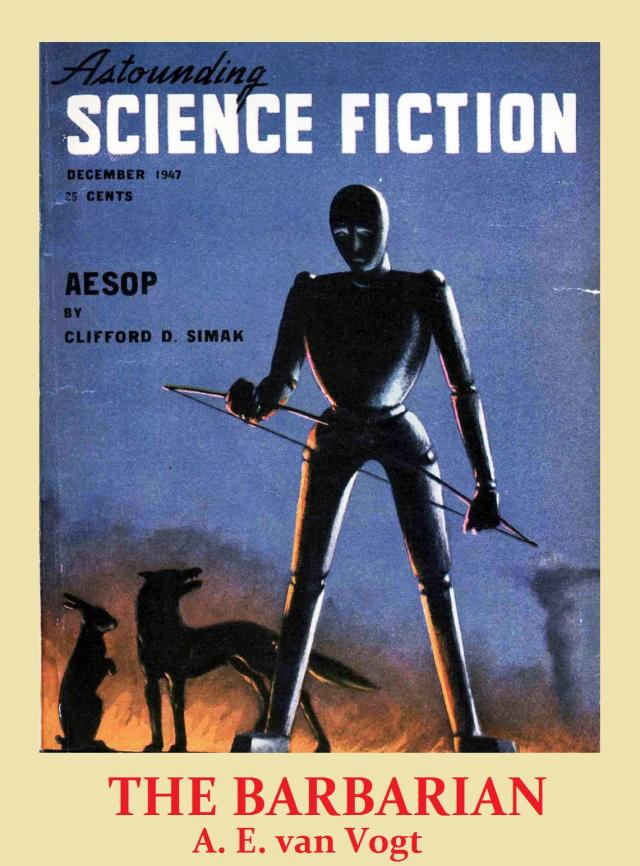
THE BARBARIAN
by
A. E. van Vogt
The Empire could handle enemies it understood.
But the Barbarian was something the Child
of the Gods wasn’t properly prepared for—
the Empire troops didn’t know how to meet him—
Illustrated by Orban
From : Astounding Science Fiction, December 1947 - Novelette
Illustrations Paul Orban
Note : Used as part of the Fix-up novel “Empire of the Atom” 1957.
The only warning was a steely glinting of metal in the early morning sky.
The invaders swooped down on the city of Linn in three hundred spaceships. There must have been advance spying, for they landed in force at the gates that were heavily guarded and at the main troop barracks’ inside the city.
From each ship debouched two hundred odd men.
“Sixty thousand soldiers!” said Lord Adviser Tews after he had studied the reports.
He issued instructions for the defense of the palace, and sent a carrier pigeon to the three legions encamped outside the city ordering two of them to attack when ready. And then he sat pale but composed watching the spectacle from a window which overlooked the hazy vastness of Linn proper.
Everything was vague and unreal. Most of the invading ships had disappeared behind large buildings. A few lay in the open, but they looked dead. It was hard to grasp that vicious lighting was going on in their vicinity.
At nine o’clock, a messenger arrived from the Lady Lydia, Tews’ aging mother:
Dear Son:
Have you any news? Who is attacking us?
Is it a limited assault or an invasion of the empire?
Have you contacted Clane ?
L.
The first prisoner was brought in while Tews was scowling over the unpalatable suggestion that he seek the advice of his mutation cousin. The prisoner, a bearded giant, proudly confessed that he was from Europa, one of the moons of Jupiter, and that he feared neither man nor god.
The man’s size and obvious physical prowess startled Tews. But his naive outlook on life was cheering. Subsequent prisoners had similar physical and mental character! sties. And so. long before noon, Tews had a fairly clear picture of the situation.
This was a barbarian invasion from Europa. It was obviously for loot only. And, unless he acted swiftly, Linn would be divested in a few days of treasures garnered over the centuries.
Bloodthirsty commands flowed from Tews’ lips. Put all prisoners to the sword. Destroy their ships, their weapons their clothing,. Leave not one vestige of their presence to pollute the eternal city.
The morning ran its slow course. Tews considered making an inspection of the city escorted by the palace cavalry. But abandoned the plan when he realized it would be impossible for commanders to send him reports if he was on the move.
For the same reason he could not transfer his headquarters to a less clearly marked building.
Just before noon, the relieving report arrived that two of three camp legions were attaching in force at the main gates.
The news steadied him. he began to think in terms of broader, more basic information about what had happened. He sat somber while the court historian delivered a brief lecture on Europa.
The amazing thing to Tews was how little was known about that remote moon .of Jupiter. It had been inhabited from legendary times by fiercely quarreling tribes. Its vast atmosphere was said to have been created artificially with the help of the atom gods by the scientists of the golden age. And, like all the artificial atmospheres, it contained a high proportion of the gas, teneol, which admitted sunlight, but did not allow heat to escape into space.
Starting about five years before, travelers had begun to bring out reponse of a leader named Czinczar who was ruthlessly welding all the hating factions of the planet into one nation.
Czinczar. The name had a sinister rhythm to it, a ring of leashed violence, a harsh, metallike tintinnabulation. If such a man and his followers escaped with even a fraction of the portable wealth of Linn, the inhabited solar system would echo with the exploit. The government of Lord Adviser Tews might tumble like a house of cards.
Tews had been hesitating. There was a plan in his mind that would work better if carried out in the dead of night. But that meant giving the attackers precious extra hours for loot.
he decided not to wait, but dispatched a command to the third— still unengaged—camp legion to enter the tunnel that led into the Central Palace.
As a precaution, and with the hope of distracting the enemy leader, he sent a message to Czinczar in the care of a captured barbarian officer. In it he pointed out the foolishness of an attack that could only result in bloody reprisals on Europa itself, and suggested that there was still time. for an honorable withdrawal.
There was only one thing wrong with all these schemings. Czinczar had concentrated a large force of his own for the purpose of capturing the Imperial party. And had held back in the hope that he would learn definitely whether or not the Lord Adviser was inside the palace.
The released prisoner, who delivered Tews’ message, established his presence inside.
The attack in force that followed captured the Central Palace and everyone in tx and surprised the legionnaires who were beginning to emerge from the secret passageway.
Czinczar’s men poured all the oil in the large palace tanks into the downward sloping passageway, and set it afire.
Thus died an entire legion of men.
That night a hundred reserve barbarian spaceships landed behind the Linnan soldiers besieging the gates. And in the morning, when the barbarians inside the city launched an attack, the two remaining legions were cut to pieces.
Of these events the Lord Adviser Tews knew nothing. His skull had been turned over the previous day to Czinczar’s favorite goldsmith, to be plated with Linnan gold, and shaped into a goblet to celebrate the greatest victory of the century.
To Lord Clane Linn, going over his accounts on his country estate, the news of the fall of Linn came as a special shock.
With unimportant exceptions, all his atomic material Was in Linn.
He dismissed the messenger, who had rashly shouted the news as he entered the door of the accounting department. And then sat at his desk—and realized that he had better accept for the time being the figures of his slave bookkeepers on the condition of the estate.
As he glanced around the room after announcing the postponement, it seemed to him that at least one of the slaves showed visible relief.
He did not delay, but called the man before him instantly. He had an inexorable system in dealing *with slaves, a system inherited from his long dead mentor, Joaquin, along with the estate itself. Integrity, hard work, loyalty, and a positive attitude produced better conditions, shorter working hours, more freedom of action, after thirty the right to marry, after forty legal freedom.
Laziness and other negative attitudes such as cheating were punished by a set pattern of demotions.
Clane could not even imagine a better system. And now, in spite of his personal anxieties, he carried out the precept of Joaquin as it applied to a situation where no immediate evidence was available. He told the man, Oorag, what had aroused his suspicions, and asked him if they were justified.
“If you are guilty and confess,*’ he said, “you will receive only one demotion. If you do nut confess and you are later proven guilty, there will be three demotions, which means physical labor, as you know/’ The slave, a big man, shrugged, and said with a sneer:
“By the time Czinczar is finished with you Linnans. you will be working for me.”
“Field labor,” said Clane curtly, “for three months, ten hours a day.” He was astonished. Again and again, he had noticed this self-destructive instinct in people. Men and women in the highest and lowest walks of life yielded to the instinct to say something devastating for the sake of a momentary defiance or thrill of superiority.
As the slave was led out by guards, he shouted a final insult over his shoulder:
“You wretched mutation, you’ll be where you belong when Czinczar gets here.”
Clane forbore an answer. He considered it doubtful that-the new conqueror had been selected by fate to punish all the evildoers of Linn according to their desserts. It would take too long. He put the thought out of his mind, and walked to the doorway. There he paused, and faced the dozen trusted slaves who sat at their various desks.
“Do nothing rash/’ he said slowly in a clear voice, “any of you. If you harbor emotions similar to those expressed by Oorag, restrain yourselves. The fall of one city in a surprise attack is meaningless/’
He hesitated. He was. he realized, appealing to their cautious instincts, but his reason told him that in a great crisis men did not always consider all the potentialities.
“I am aware,” he said finally, “there is no great pleasure in being a slave, though it has advantages —economic security, free craft training. But Oorag’s wild words are a proof that, if young slaves were free to do as they pleased, they would constitute a jarring if not revolutionary factor in the community. It is unfortunately true that people of different races can only gradually learn to live together.”
He went out, dissatisfied with his argument, but unable to see the flaw in it, if there was one.
He had no doubt whatsoever that here in this defiance of Oorag, the whole problem of a slave empire had shown itself in miniature. If Czinczar were to conquer any important portion of Earth, a slave uprising would follow automatically.
There were too many slaves, far too many for safety, in the Linnan empire.
Outside, he saw his first refugees. They were coming down near the main granaries in a variety of colorful sky scooters.
Clane watched them for a moment, trying to picture their departure from Linn. The amazing thing was that they had waited till the forenoon of the second day. People must simply have refused to believe that the city was in danger, though, ot course, early fugitives could have fled in different directions. And so not come near the estate.
Clane emerged decisively out of his reverie. He called a slave, and dispatched him to the scene of the arrivals with a command to his personal guards:
“Tell these people who have rapid transportation to keep moving. Here, eighty miles from Linn, we shall take care only of the foot-weary.”
Briskly now, he went into his official residence, and called the commanding officer of his troops.
“I want volunteers.” he explained, “particularly men with strong religious beliefs, who on this second night after the invasion are prepared to fly into Linn and remove all the transportable equipment from my laboratory.”
His plan, as he outlined it finally to some forty volunteers, was simplicity itself. In the confusion of taking over a vast city, it would probably be several days before the barbarian army would actually occupy all the important residences. Particularly, on these early days, they might miss a house situated, as was his. behind a barrier of trees.
If by some unfortunate chance it was already occupied, it would probably be so loosely held that bold men could easily kill every alien on the premises, and so accomplish their purpose.
Clane hoped so, violently.
“I want to impress upon you,” he said, “the importance of this task. As all of you know. I am a member of the temple hierarchy. I have been intrusted with sacred god metals and sacred equipment, including material taken from the very homes of the gods.
“It would be a disaster if these precious relics were to fall into unclean hands. I. therefore, charge you that, if you should by some mischance be captured, do not reveal the real purpose of your presence. Say that you came to rescue your owner’s private property. Even admit that you were very foolish to sacrifice yourself for such a reason.”
Clane finished: “And finally,” he said, “no matter what time of the night you return. I wish to be awakened immediately!”
When they had gone out to prepare for the mission, Clane dispatched one of his private spaceships to the nearby city of Goram. and asked the commander there, a friend of his. what kind of counteraction was being prepared against the invader;
“Are the authorities in the cities and towns,” he asked, “showing that the> understand the patterns of action required of them in a major emergency? Or must the old law be explained to them from the beginning?”
The answer arrived in the shortest possible time, something under forty minutes. The general placed his forces at Clane’s command, and advised that he had dispatched messengers to every major city on earth, in the name of “his excellency, Lord Clane Linn, ranking survivor on Earth of the noble Tews, the late Lord Adviser, who perished at the head of his troops, defending the city of Linn from the foul and murderous surprise attack launched by a barbarian horde of beastlike men, who seek to destroy the fairest civilization that has ever existed.”
There was more in the same vein, but it was not the excess of verbiage that startled Clane . It was the offer itself, and the implications. In his name, an army was being organized.
He had from childhood taken it for granted that soldiers regarded mutations as bad luck. Even the presence of a mutation on a field, it was said, could demoralize entire legions.
After rereading the message, he walked slowly to the full length mirror in the adjoining bathroom, and stared at his image.
He was dressed in the fairly presentable reading gown of a temple scientist. Like all his temple clothing, the cloth folds of this concealed his “differences” from casual view. An observer would have to be very acute to see how carefully the cloak was drawn around his neck, and how tightly the arm ends were tied together at his wrists.
It would take three months to advise Lord Jerrin on Venus, and four to reach Lord Draid on Mars, both planets being near the far side of the Sun from Earth. It would require almost, though not quite, twice as long to. receive back a message from them.
Only a member of the ruling family could possibly win the support of the diversified elements of the empire. Of the Lord Adviser’s immediate family, there was the venerable Lady Lydia—too old ; and there was Lord Dane, younger brother of Jerrin, grandson of the late Lord Leader.
For not less than six months accordingly he could be the legitimate Lord Leader of Linn.
The afternoon of that second day of the invasion waned slowly. Great ships began to arrive, bringing soldiers. By dusk, more than a thousand men were encamped along the road to the city Linn, and by die riverside. Darting small craft and wary full-sized spaceships floated overhead, and foot patrols were out, guarding all the approaches to the estate.
The roads themselves were virtually deserted. It was too soon for the mobs from Linn, which air-scooter scouts reported were fleeing the captured city by the gates that, at mid-afternoon, were still open.
During the last hour before dark, the air patrols reported that the gates were being shut one by one. And that the stream of refugees was dwindling to a trickle near the darkening city.
All through that last hour, the sky was free of scooters transporting refugees.
It was clear that the people who could afford the costly machines were either already safe, or had waited too long, possibly in the hope of succoring some absent member of the family.
At midnight, the volunteers departed on their dangerous mission in ten scooters and one spaceship. As a first gesture of his new authority, Clane augmented their forces by adding a hundred soldiers from the regular army.
He watched the shadowy ships depart, then hurried to attend a meeting of those general officers who had had time to arrive. A dozen men climbed to their feet as he entered. They saluted, then stood at attention.
Clane stopped short. He had intended to be calm, matter-of-fact, pretend even to himself that what was happening Vas natural.
The feeling wasn’t like that. An emotion came, familiar but terrifying. He could feel it tangling up the remoter reflexes of his nervous system as of old, the beginning of the dangerous childish panic, product of his early, horrible days as a tormented mutation.
The muscles of his face worked. Three times he swallowed hard. Then, with a stiff gesture, he returned the salute. And, walking hastily to the head of the table, sat down.
The acting Lord Leader of Linn was in conference with his general staff.
Clane waited till they had seated themselves, then asked for brief reports as to available troops. He noted down the figures given by each man for his province, and at the end added up the columns.
“With four provinces still to be heard from.” he announced, “we have a total of eighteen thousand trained soldiers, six thousand partly trained reserves, and some five hundred thousand able-bodied civilians. The—”
He stopped. The confidence went out of him. “Is that all?” he asked sharply.
“Your excellency,” said his friend, Morkid, “the Linnan empire maintains normally a standing army of one million men. On Earth by far the greatest forces were stationed in or near the city of Linn, and they have been annihilated. Some four hundred thousand men are still on Venus, and slightly more than two hundred thousand on Mars.
Clane, who had been mentally adding up the figures given, said quickly :
“That doesn’t add up to a million men.”
Morkid nodded, gravely. “For the first time in years, the army is understrength. The conquest of Venus seemed to eliminate all potential enemies of Linn, and Lord Adviser Tews considered it a good time to economize.”