The Storm (ss), page 1
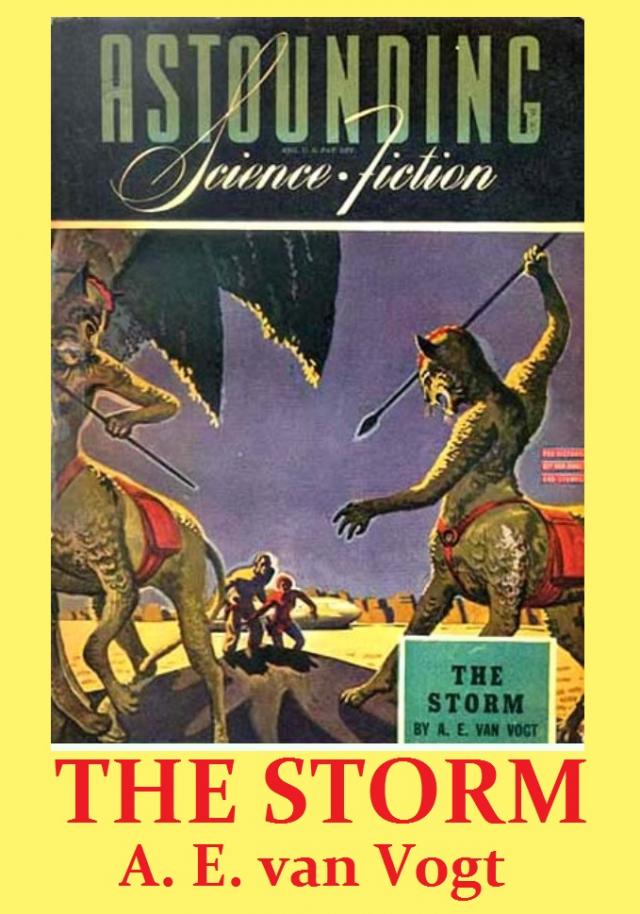


The Storm
by A. E. van Vogt
The combined military powers of all the people of that galaxy could not stand up to the tremendous might of the battleship of space. But there was one force their galaxy held that could smash that or any other ship!
Illustrated by Orban
First Published in Astounding Science Fiction - October 1943 edition
Over the miles and the years, the gases drifted. Waste matter from ten thousand suns, diffuse miasm of spent explosions, of dead hellfires and the furies of a hundred million raging sunspots — formless, purposeless.
But it was the beginning.
Into the great dark the gases crept. Calcium was in them, and sodium, and hydrogen; and the speed of the drift varied up to twenty miles a second.
There was a timeless period while gravitation performed its function. The inchoate mass became masses. Great blobs of gas took a semblance of shape in widely separate areas, and moved on and on and on.
They came finally to where a thousand flaring seetee suns had long before doggedly “crossed the street” of the main stream of terrene suns. Had crossed, and left their excrement of gases.
The first clash quickened the vast worlds of gas. The electron haze of terrene plunged like spurred horses and sped deeper into the equally violently reacting positron haze of contraterrene. Instantly, the lighter orbital positrons and electrons went up in a blaze of hard radiation.
The storm was on.
The stripped seetee nuclei carried now terrific and unbalanced negative charges and repelled electrons, but tended to attract terrene atom nuclei. In their turn, the stripped terrene nuclei attracted contraterrene.
Violent beyond all conception were the resulting cancellations of charges.
The two opposing masses heaved and spun in a cataclysm of partial adjustment. They had been heading in different directions. More and more they became one tangled, seething whirlpool.
The new course, uncertain at first, steadied and became a line drive through the midnight heavens. On a front of nine light years, at a solid fraction of the velocity of light, the storm roared toward its destiny.
Suns were engulfed for half a hundred years — and left behind with only a hammering of cosmic rays to show that they had been the centers of otherwise invisible, impalpable atomic devastation.
In its four hundred and ninetieth Sidereal year, the storm intersected the orbit of a Nova at the flash moment.
It began to move!
On the three-dimensional map at weather headquarters on the planet Kaider III, the storm was colored orange. Which meant it was the biggest of the four hundred odd storms raging in the Fifty Suns region of the Lesser Magellanic Cloud.
It showed as an uneven splotch fronting at Latitude 473, Longitude 228, Center 190 parsecs, but that was a special Fifty Suns degree system which had no relation to the magnetic center of the Magellanic Cloud as a whole.
The report about the Nova had not yet been registered on the map. When that happened, the storm color would be changed to an angry red.
They had stopped looking at the map. Maltby stood with the councilors at the great window staring up at the Earth ship.
The machine was scarcely more than a dark sliver in the distant sky. But the sight of it seemed to hold a deadly fascination for the older men.
Maltby felt cool, determined, but also sardonic. It was funny, these — these people of the Fifty Suns in this hour of their danger calling upon him.
He unfocused his eyes from the ship, fixed his steely, laconic gaze on the plump, perspiring chairman of the Kaider III government — and, tensing his mind, forced the man to look at him. The councilor, unaware of the compulsion, conscious only that he had turned, said:
“You understand your instructions, Captain Maltby?”
Maltby nodded. “I do.”
The curt words must have evoked a vivid picture. The fat face rippled like palsied jelly and broke out in a new trickle of sweat.
“The worst part of it all,” the man groaned, “was that the people of the ship found us by the wildest accident. They had run into one of our meteorite stations and captured its attendant. The attendant sent a general warning and then forced them to kill him before they could discover which of the fifty million suns of the Lesser Magellanic Cloud was us.
“Unfortunately, they did discover that he and the rest of us were all descendants of the robots who had escaped the massacre of the robots in the main galaxy fifteen thousand years ago. But they were baffled and without a clue. They started home, stopping off at planets on the way on a chance basis. The seventh stop was us. Captain Maltby —”
The man looked almost beside himself. He shook. His face was as colorless as a white shroud. He went on hoarsely:
“Captain Maltby, you must not fail. They have asked for a meteorologist to guide them to Cassidor VII, where the central government is located. They mustn’t reach there. You must drive them into the great storm at 473.
“We have commissioned you to do this for us because you have the two minds of the Mixed Men. We regret that we have not always fully appreciated your services in the past. But you must admit that, after the wars of the Mixed Men, it was natural that we should be careful about —”
Maltby cut off the lame apology.
“Forget it,” he said. “The Mixed Men are robots, too, and therefore as deeply involved, as I see it, as the Dellians and non-Dellians. Just what the Hidden Ones of my kind think, I don’t know, nor do I care. I assure you, I shall do my best to destroy this ship.”
“Be careful!” the chairman urged anxiously. “This ship could destroy us, our planet, our sun in a single minute. We never dreamed that Earth could have gotten so far ahead of us and produced such a devastatingly powerful machine, After all, the non-Dellian robots and, of course, the Mixed Men among us are capable of research work; the former have been laboring feverishly for thousands of years.
“But, finally, remember that you are not being asked to commit suicide. The battleship is absolutely invincible. Just how it will survive a real storm we were not told when we were shown around. But it will. What happens, however, is that everyone aboard becomes unconscious. As a Mixed Man, you will be the first to revive. Our combined fleets will be waiting to board the ship the moment you open the doors. Is that clear?”
“Yes.”
It had been clear the first time it was explained, but these non-Dellians had a habit of repeating themselves, as if thoughts kept growing vague in their minds.
As Maltby closed the door of the great room behind him, one of the councilors said to his neighbor:
“Has he been told that the storm has gone Nova?”
The fat man overheard. He shook his head. His eyes gleamed as he said quietly: “No. After all, he is one of the Mixed Men. We can’t trust him too far no matter what his record.”
All morning the reports had come in. Some showed progress, some didn’t. But her basic good humor was untouched by the failures.
The great reality was that her luck had held. She had found a planet of the robots. Only one planet so far, but —
Grand Captain Laurr smiled grimly. It wouldn’t be long now. Being a supreme commander was a terrible business. But she had not shrunk from making the deadly threat: provide all required information, or the entire planet of Kaider III would be destroyed.
The information was coming in. Population of Kaider III, two billion, one hundred million; two-fifths Dellian, three-fifths non-Dellian robots.
Dellians were physically and mentally the higher type, but were completely lacking in creative ability. Non-Dellians dominated in the research laboratories.
The forty-nine other suns whose planets were inhabited were called, in alphabetical order: Assora, Atmion, Bresp, Buraco, Cassidor, Corrab —
They were located at (1) Assora: Latitude 931, Longitude 27, Center 201 parsecs; (2) Atmion —
It went on and on.
Just before noon, she noted with steely amusement that there was still nothing coming through from the meteorology room, nothing at all about storms.
She made the proper connection and flung her words: “What’s the matter, Lieutenant Cannons? Your assistants have been making prints and duplicates of various Kaider maps. Aren’t you getting anything?”
The old meteorologist shook his head. “You will recall, noble lady, that when we captured that robot in space, he had time to send out a warning. Immediately on every Fifty Suns planet, all maps were despoiled, civilian meteorologists were placed aboard spaceships that were stripped of receiving radios, with orders to go to a planet on a chance basis, and stay there for ten years. To my mind, all this was done before it was clearly grasped that their navy hadn’t a chance against us. Now they are going to provide us with a naval meteorologist, but we shall have to depend on our lie detectors as to whether or not he is telling us the truth.”
“I see.” The woman smiled. “Have no fear. They don’t dare oppose us openly. No doubt there is a plan being built up against us, but it cannot prevail now that we can take action to enforce our unalterable will. Whoever they send must tell us the truth. Let me know when he comes.”
Lunch came, but she ate at her desk, watching the flashing pictures on the astro, listening to the murmur of voices, storing the facts, the general picture, into her brain.
“There’s no doubt, Captain Turgess,” she commented once, savagely, “that we’re being lied to on a vast scale. But let it be so. We can use psychological tests to verify all the vital details. For the time being, it is important that you relieve the fears of everyone you find it necessary to question. We must convince these people that Earth will accept them on an equal basis without bias or prejudice of any kind because of their robot orig —”
She bit her lip. “That’s an ugly word, the worst kind of propaganda. We must eliminate it from our thoughts.”
“I’m afraid,” the officer shrugged, “not from our thoughts.”
She stared at him, narrow eyed, then cut him off angrily. A moment later, she was talking into the general transmitter:
“The word robot must not he used — by any of our personnel — under pain of fine —”
Switching off, she put a busy signal on her spare receiver and called Psychology House. Lieutenant Nestor’s face appeared on the plate.
“I heard your order just now, noble lady,” the woman psychologist said. “I’m afraid, however, that we’re dealing with the deepest instincts of the human animal — hatred or fear of the stranger, the alien.
“Excellency, we come from a long line of ancestors who, in their time, have felt superior to others because of some slight variation in the pigmentation of the skin. It is even recorded that the color of the eyes has influenced the egoistic in historical decisions. We have sailed into very deep waters, and it will be the crowning achievement of our life if we sail out in a satisfactory fashion.”
There was an eager lilt in the psychologist’s voice, and the grand captain experienced a responsive thrill of joy. If there was one thing she appreciated, it was the positive outlook, the kind of people who faced all obstacles short of the recognizably impossible with a youthful zest, a will to win. She was still smiling as she broke the connection.
The high thrill sagged. She sat cold with her problem. It was a problem. Hers. All aristocratic officers had carte blanche powers and were expected to solve difficulties involving anything up to whole groups of planetary systems.
After a minute, she dialed the meteorology room again.
“Lieutenant Cannons, when the meteorology officer of the Fifty Suns navy arrives, please employ the following tactics —”
Maltby waved dismissal to the driver of his car. The machine pulled away from the curb, and Maltby stood frowning at the flaming energy barrier that barred farther progress along the street. Finally, he took another look at the Earth ship.
It was directly above him now that he had come so many miles across the city toward it. It was tremendously high up, a long, black torpedo shape almost lost in the mist of distance.
But high as it was, it was still visibly bigger than anything ever seen by the Fifty Suns, an incredible creature of metal from a world so far away that, almost, it had sunk to the status of myth.
Here was the reality. There would be tests, he thought, penetrating tests before they’d accept any orbit he planned. It wasn’t that he doubted the ability of his double mind to overcome anything like that, but — it would be well to remember that the frightful gap of years which separated the science of Earth from that of the Fifty Suns had already shown unpleasant surprises.
Maltby shook himself grimly and gave his full attention to the street ahead. A fan-shaped pink fire spread skyward from two machines that stood in the center of the street. The flame was a very pale pink and completely transparent. It looked electronic, deadly.
Beyond it were men in glittering uniforms. A steady trickle of them moved in and out of buildings. About three blocks down the avenue, a second curtain of pink fire flared up.
There seemed to be no attempt to guard the sides. The men he could see looked at ease, confident. There was murmured conversation, low laughter, and — they weren’t all men.
As Maltby walked forward, two fine-looking young women in uniform came down the steps of the nearest of the requisitioned buildings. One of the guards of the flame said something to them. There was a twin tinkle of silvery laughter. Still laughing, they strode off down the street.
It was suddenly exciting. There was an air about these people of far places, of tremendous and wonderful lands beyond the farthest horizons of the staid Fifty Suns.
He felt cold, then hot, then he glanced up at the fantastically big ship, and the chill came back. One ship, he thought, but so big, so mighty that thirty billion people didn’t dare send their own fleets against it. They —
He grew aware that one of the brilliantly arrayed guards was staring at him. The man spoke into a wrist radio, and after a moment a second man broke off his conversation with a third soldier and came over. He stared through the flame barrier at Maltby.
“Is there anything you desire? Or are you just looking?”
He spoke English, curiously accented — but English! His manner was mild, almost gentle, cultured. The whole effect had a naturalness, an unalienness that was pleasing. After all, Maltby thought, he had never had the fear of these people that the others had. His very plan to defeat the ship was based upon his own fundamental belief that the robots were indestructible in the sense that no one could ever wipe them out completely.
Quietly, Maltby explained his presence.
“Oh, yes,” the man nodded, “we’ve been expecting you. I’m to take you at once to the meteorological room of the ship. Just a moment —”
The flame barrier went down, and Maltby was led into one of the buildings. There was a long corridor, and the transmitter that projected him into the ship must have been focused somewhere along it.
Because abruptly he was in a very large room. Maps floated in half a dozen antigravity pits. The walls shed light from millions of tiny point sources. And everywhere were tables with curved lines of very dim but sharply etched light on their surfaces.
Maltby’s guide was nowhere to be seen. Coming toward him, however, was a tall, fine-looking old man. The oldster offered his hand.
“My name is Lieutenant Cannons, senior ship meteorologist. If you will sit down here, we can plan an orbit, and the ship can start moving within the hour. The grand captain is very anxious that we get started.”
Maltby nodded casually. But he was stiff, alert. He stood quite still, feeling around with that acute second mind of his, his Dellian mind, for energy pressures that would show secret attempts to watch or control his mind.
But there was nothing like that.
He smiled finally, grimly. It was going to be as simple as this, was it? Like hell it was.
As he sat down, Maltby felt suddenly cozy and alive. The pure exhilaration of existence burned through him like a flame. He recognized the singing excitement for the battle thrill it was and felt a grim joy that for the first time in fifteen years he could do something about it.
During his long service in the Fifty Suns navy, he had faced hostility and suspicion because he was a Mixed Man. And always he had felt helpless, unable to do anything about it. Now, here was a far more basic hostility, however veiled, and a suspicion that must be like a burning fire.
And this time he could fight. He could look this skillfully voluble, friendly old man squarely in the eye and —
Friendly?
“It makes me smile sometimes,” the old man was saying, “when I think of the unscientific aspects of the orbit we have to plan now. For instance, what is the time lag on storm reports out here?”
Maltby could not suppress a smile. So Lieutenant Cannons wanted to know things, did he? To give the man credit, it wasn’t really a lame opening. The truth was, the only way to ask a question was — well — to ask it.
Maltby said, “Oh, three, four months. Nothing unusual. Each space meteorologist takes about that length of time to check the bounds of the particular storm in his area, and then he reports, and we adjust our maps. Fortunately” — he pushed his second mind to the fore as he coolly spoke the great basic lie — “there are no major storms between the Kaidor and Gassidor suns.” He slid over the untruth like an eel breasting wet rock. “However, several suns prevent a straight line movement. So if you would show me some of your orbits for twenty-five hundred light years, I’ll make a selection of the best ones.”
He wasn’t, he realized instantly, going to slip over his main point as easily as that.
“No intervening storms?” the old man said. He pursed his lips. The fine lines in his long face seemed to deepen. He looked genuinely nonplused; and there was no doubt at all that he hadn’t expected such a straightforward statement. “Hm-m-m, no storms. That does make it simple, doesn’t it?” He broke off. “You know, the important thing about two” — he hesitated over the word, then went on — “two people, who have been brought up in different cultures, under different scientific standards, is that they make sure they are discussing a subject from a common viewpoint.