Lost Dogs and Monsters (the kaiju queen), page 1


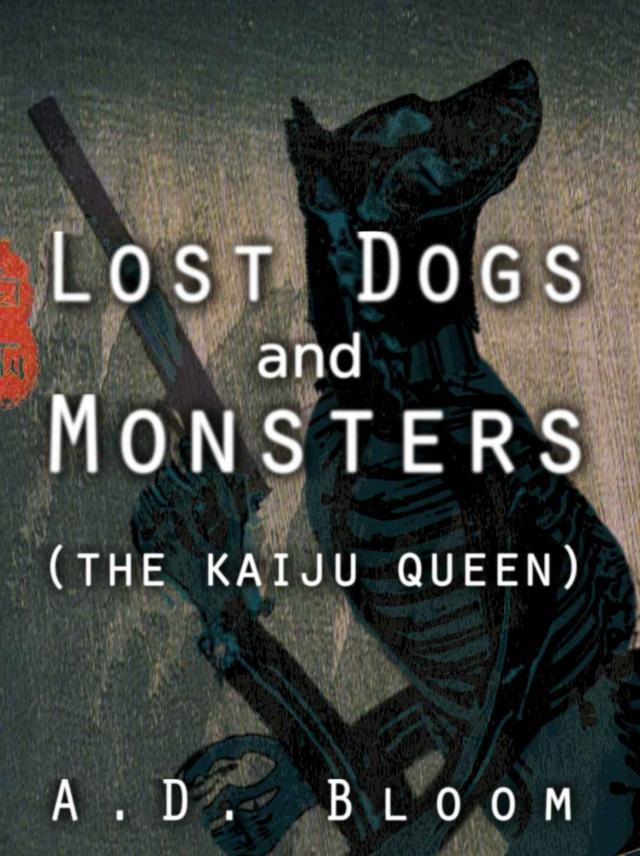
Lost Dogs and Monsters
(the kaiju queen)
by A.D. Bloom
© 2013 All Rights Reserved
Table of Contents
Prologue
Chapter 1 Into the Dark
Chapter 2 Vojin's Bitches
Chapter 3 Transmogrified
Chapter 4 Kitty Hawk's Gene-Tweak Circus
Chapter 5 Rumpus Time
Chapter 6 Frida the Cut
Chapter 7 Dog's Teeth and Daggers
Chapter 8 The Immortal Cindy Lane
Chapter 9 Nena
Chapter 10 Killer
Chapter 11 We Two Dogs Together Clinging
Chapter 12 The Trail
Chapter 13 The Clone and the Prince
Chapter 14 Spiders and Flies
Chapter 15 War Stories
Chapter 16 CiLa
Chapter 17 The Prince of North Pyongyang
Chapter 18 Lost Dogs
Chapter 19 The Flat Earth
Chapter 20 Exodus
Chapter 21 Golgoro Attacks
Chapter 22 A Means to an End
Chapter 23 Golgoro vs. Mandaro
Chapter 24 Night
Chapter 25 Epilogue
Prologue
Haj and Cindy made canine butlers and gave them thumbs. They grew talking cats with human tongues and Pocket Ponies for racing. Haj Oto and Cindy Lane wrote the gene-code for all the world's bestselling creatures and made T&J the top bio-industrial of the twenty-second century. The patent money made them rich.
After nearly two decades of success, Haj and Cindy wed. They had their reception at T&J, down in the labs, surrounded by their co-workers and their creatures. It was only proper. It was where they met. It was where they worked and fell in love.
Haj and Cindy stood close and arm in arm as dozens of Bosley Hound tenors sang a chorale. The sight of the two-legged butler dogs dressed up in dinner jackets and the way the serenading pooches sang off key made Cindy laugh until her neck and chest flushed. Haj couldn't look away from her blushing bride.
Weston, the clone, the company man was there. After he gave a speech, there were more drinks and more toasts to love and genius, and it took aeons, but Haj sneaked Cindy away. In a darkened grow room off the main lab the two clung and kissed until Cindy shrieked and jumped in Haj's arms. “Something bit me!” Haj turned on the lights and saw it, twisted and hunchbacked. It looked like one of the scratch-sheet Capuchin monkeys they grew for rewrite testing and rough drafts, but this one had been birthed twisted and misshapen. As it ran to the corner, its gnawed umbilical hung. “How did it get out?”
Haj pointed to a bay across the room and the corpse of the burst and bloody thing that had mothered it. As Cindy examined the punctures in her calf, Haj snatched the newborn killer from the floor. It hissed. It said, “no. bad. no.” It spoke with Cindy's blood on its lips, and Haj gripped it around the neck and twisted. “no. nooooo,” it cried hoarse.
“Haj! Don't!” The little bones snapped and out it snuffed, unmade. Cindy looked like she'd be sick. “Oh, god, Haj. You didn't have to kill it.”
In Cindy's moistening eyes Haj saw herself holding the Capuchin by the neck. It hung tiny from her hands and she hunched over its broken body. “It bit you.” Cindy looked behind Haj's eyes. Other women, other men had looked into the shadows there and run away. She cupped Haj's cheek in her hand and pretended a smile. I would snuff out the sun for you, Haj thought.
“Just... Put it in the burn box,” Cindy said. “Take me home.”
*****
Twenty-eight days later, Cindy Lane lay comatose on a table inside T&J's labs while her former colleagues sampled her mutated flesh for experiments. Something rewrote her, defaced her gene-code almost overnight, and the new genes had been activated to hideous and nightmarish effect. Nobody could even grasp the mechanism by which it had happened, let alone cure her.
Haj tried to change Cindy back to the woman she was, but T&J wouldn't let her because Cindy Lane's new cells had unique growth properties. Weston, the company man, said Haj was the real talent and that Cindy was worth ten-thousand times more to the shareholders now than she'd ever been worth as a synthetic geneticist. The T&J artificial intelligence known as Legal petitioned for and received a restraining order in less than ten seconds. Security locked Haj out of the lab while Legal's army of lesser bot attorneys filed suits.
There was no choice for Haj but to find a cure on her own.
She studied the baffling gene-code that had been written into Cindy Lane. She found bits of it in other species – arthropods, mammals, plants, so many branches and species of life, in fact, that Haj quickly realized that fragments and strings of Cindy Lane's new, mutated gene-code were everywhere, all over the earth. They were buried in the introns and exons and junk DNA of every living thing on the planet, hidden away as apparently inactive, vestigial coding – cruft.
The logic of these shared gene-sequences made no sense to Haj by the science she knew, but she reasoned that these bits were only fragments, pieces of a larger puzzle she might understand if she saw it reconstructed in its entirety. So Haj trekked across seven continents and seas, sampling and collecting pieces of a puzzle she despaired she'd never understand.
Two years later, on the Tibetan Plateau, she found long, unbroken sequences of Cindy's new gene-code hidden inside some of the microorganisms that inhabited the high desert. The sequences weren't just longer than Haj had ever seen – in them she saw DNA common to mutated Cindy and to a thousand completely different organisms, all strung together as if they were parts of one living thing. It defied Haj's understanding of genetics and made her theorize that the correctly assembled puzzle might form a single, impossible and massive genome, the blueprint for some ancient version of life – some kind of distributed organism that was both many creatures and one.
Haj reasoned that whatever nightmare had mutated Cindy must have originally come from this lost creature. Once she put all the pieces of its gene-code back together and understood how it was made, then she'd know how to unmake it. Then, she'd know how to save the woman she loved.
Chapter 1
Into the Dark
Daylight died and when Haj Oto couldn't see, the windshield of the hundred-ton truck amplified the starlight for her. The eight-wheeled behemoth of a prospector was an antique from the late twenty-first century and although it crawled across the barren boulder-fields and dunes at a mule's pace, it was discrete. Haj appreciated discretion. That's why she'd hired Li and his crew and the beast that carried them across the Tibetan Plateau in its belly.
Li drove. When his dog barked at the blinking light on the console, he said, “We're arriving at the last waypoint you gave me. Where do we go now?”
“Stop here. I want to wait until my proxies return.” He grunted in acknowledgment, eased back on the throttle, and slowed the giant prospector to a stop. The engines idled and Haj's ears rang in the relative quiet.
“How long?” Li asked. “How long do you need?”
“I'll need to examine the samples,” she said. “Figure out a new bearing. Twenty minutes.”
Li got up from his seat as the dust plume kicked up by the machine's twelve-foot-tall wheels drifted ahead of them across the plateau. He'd tossed candied plum wrappers over his shoulder for days as he drove, and when he walked to the rear, his feet rustled through them like fallen leaves.
He made tea. As Hong and Hop Dai, the other two men on the crew, got up from their survey stations to join him, Li's dog jumped up in her lap. He panted at her with a black tongue. “Mao Mao likes you,” Li said. The Hollander was cold and Mao Mao liked the extra body heat, she thought. She kept Mao Mao warm against her and played her fingers through his fur while her proxies flew closer.
When the drones were near, Haj waited outside for them while the whipping winds stole breath from her mouth. Even without the wind, it was hard to breathe at 14,000 feet.
Haj wore a featureless circlet on her head, a ring of nanoscale transducers and computers like a minimalist crown. It tickled her optic nerve to mark in her eye the returning bird-sized proxies, and as Haj held up her outstretched arms, the circlet atop her head read her hands' dancing motions. She commanded her flock.
They lighted at her feet and raised fleeting plumes of dust. Mao Mao bounded out of the dark and tried to catch them, but they all took to the air and hovered five-feet-up as he barked. One by one, they flew to the fast gene sequencer in Haj's hand and deposited what they'd collected from the desert before flying away and cleaning their sampling chambers with little firefly flashes and puffs of smoke.
Minutes later, Haj went back inside. While Li, Hong, and Hop Dai smoked hand-rolled shag from a sheep's bladder humidor pouch and burnt their throats with scalding tea, the circlet Haj wore on her head displayed the newly sequenced genomes. Her hands danced like bees as she gestured commands. When she saw E. coli taken from sites to the Southwest had strings of DNA in their sequences that matched Cindy Lane's, but were fifty-times longer than she'd ever seen anywhere else, her heart pounded. A spike like this meant she might be close to a place where the last, unbroken pieces of the puzzle waited to be found.
Across seven continents and seas, she'd tramped and sampled and sought, and now Li must have seen the excitement in her because he finally looked up from his tea and asked her the question she knew he'd been holding back for weeks: “This old thing you're looking for out in my desert. How much is it worth?”
“We're going Southwest,” she said. “Bearing 248.”
Li asked, “What will they pay you for it?” His question echoed in her head, and as the Hollander rolled forward to the Southwest, the gun in Haj's pocket bounced with nagging, unwanted reminder of precisely why she'd bought it. Once Li thought she had whatever mysterious thing she'd paid so much to come here and obtain, then he and his men would almost certainly try and take it.
Just hours later, Hong and Hop Dai's imagers spotted a cave system under the plateau. It went on for miles. It was a maze of narrow passages, the most shallow-buried of which lay thirty feet under the earth. Samples of micro-flora and fauna she took from the surface were so promising that when Hong and Hop Dai couldn't find Haj an entrance to the caverns below, she told Li to unpack the three robotic diggers that rode on the prospecting vehicle's back and have them make her one.
*****
Nearly a day later, Haj and barking Mao Mao watched as the digger bots cut and scraped and clawed out those last few yards. When they broke through into the caves, dust plumed high, carried on gasses trapped under pressure for aeons.
The bots carved her a steep ramp leading down into the plateau, and as Hajume walked its length with Mao Mao trotting behind her, the earth rose up on either side. She went deeper and deeper with every step until tonight's sky was only a starry, far-away sliver, high above her head.
At the six-foot hole's edge, Mao Mao dipped his paws in the dark. His gray whiskers twitched as he sniffed at the unknown. “You're staying here,” she told him.
Haj sent her proxies down into the earth flapping their wings in the black. Then, one of the digger bots lowered her down through the hole they'd made. She swayed on the cable while Mao Mao barked. He howled once she was out of sight.
Where her feet landed she found chemoautotrophs growing on the rock. The microorganisms reproduced so slowly that they could barely be said to be animate. Long gene-codes take longer to reproduce. Their code was grotesquely long and in it she found unbroken strings of the lost genome she sought that were a hundred times longer than anything above. If the bizarre, distributed organism she sought had ever existed, then this cave was where she would find the last pieces of it. This was the place.
Mao Mao barked and barked. Haj took one last look up at his silhouette peering down from above and stepped into the dark.
Chapter 2
Vojin's Bitches
Mao Mao followed Haj out of the desert. Across the badlands of Persia they rode the slow caravans of solar-powered trucks and trailer trains – the only way to travel without showing up on T&J's radar. She'd surface and show herself, but not yet. Mao Mao swam in the Black Sea and the Bosporus. In the night, he trotted next to Haj's horse as smugglers led them around the Caliphate's Guard and across the border of the Yugo.
Rising heat from Sarajevo's concrete generated afternoon storms. Once they'd passed, Haj and Mao Mao walked South, to the steaming malls of Grbavica. She was sure she would find what she needed because in Grbavica they'd surpassed the ten-thousand-womb factory farms of Canton and the guerrilla cut 'n grow operations of the Amazon to become the world's capitol of unlicensed, pirate gene-pets and biologicals made for industry. Whether it was furries for consumers or custom-cut microorganisms for nanoscale manufacturing, half the city made their money from living counterfeit.
After wandering through the post-storm crowds in a pedestrian mall, Mao Mao's nose picked a pet store that looked right. Most back-room growers used dogs, so when Mao Mao jumped up the steps and ran into a tiny storefront, Haj thought he must smell the bitches in the back room.
Cages lined the walls and a mustachioed man in his early fifties sat smoking and drinking coffee, reading off the counter top display. Nutcracker Mice hopped and hooted in a high-sided tray set on a folding luggage stand where the children could see them. Mao Mao barked, but the children ignored him. Three of them poked at the mice with pencils, herding the three-dozen or so four-inch-tall, terrified, bipeds from one side of their tray to the other.
Haj remembered writing them with Cindy Lane almost two decades ago – back when she and Cindy were just colleagues. They'd agreed the thumbed and two-legged mice were ridiculous little abominations, living jokes, but it was money from creatures like this that first made them rich. The Toy Soldiers children bought to battle the Nutcracker Mice weren't as painful to look at.
Three healthy, calico Lingo-Cats paced back and forth in a tank near the Nutcracker Mice, watching the children terrify them. They batted at the unbreakable glass with their paws and repeated the same word in the same frustrated voice. “Mouse,” they said.
“Mouse.”
“Mouse.”
When she peered at the kitten-sized, pigmy bear cubs, the ursines all pressed their noses up against the glass and then did little tumbling tricks. The growth-retarded bears all had the same slivers of emerald in their irises – the exact same defect. The T&J patent on that gene-code had run out years ago, but they'd been pirated anyway. There wasn't much money in cloning something on which the patent had run out – not enough to support middle-men. That meant the owner probably made them himself and somewhere here there was a cut 'n grow operation – a back room genetics lab with all the equipment she needed.
The owner browsed pages off the counter, but he wore data-glasses as well. They might be for anything, but Haj thought she knew what kind of data he displayed in them.
One of the children snatched up a Nutcracker Mouse and ran out with it, ducking through the mall's crowd. The other two glanced up at the man behind the counter before they ran past Haj and out the door. Haj turned to the owner who smiled without barely looking up from the newspaper that scrolled by with his fingertip. “They think they're stealing them,” he said. “But they'll be back for the pet food I sell. The mice don't eat much of it, but everyone knows how horribly they die and what a mess they make if you don't give them T&J pet food...”
“These little appaloosas are nicely done,” she said, nodding her chin at the six-inch ponies. A herd of a dozen ran in a treadmill cage. “Whoever made these did an excellent job. Badly cloned ones break their legs only days after birth. Did you grow these?”
“Pirating of patent-protected T&J gene-pets is a serious intellectual property crime. I'm sorry,” he said. “I'm closing now. I have an appointment.”
“I don't work for the IP enforcement goons,” Haj assured him.
“We're closed. Come again.” He smiled at her and turned back to his newspaper, tight-lipped and tense in his shoulders.
Time for a more direct approach. Haj snatched up a Nutcracker Mouse from the tray. The ribs bent under her grasp as it tried to wriggle free. She and Cindy had to rewrite those ribs over and over to make sure they could survive a child's hands. This mouse had one tough skeleton and a purpose-built, cruft-free gene-code short enough that his cells divided quickly – so fast that if you fed him enough T&J pet food, he'd manage to heal from almost any trauma. If they didn't need the special food and they could reproduce, Haj had no doubts the Nutcracker Mice would give the urban rat a run for its money. She'd seen pictures of discarded mice using nails and sharpened chopsticks for weapons.
She held the unnatural mouse fast, and he screamed “oh no! oh no!” and waved his little hands as she roughly pulled out a patch of hairs from behind his ear. Some follicles and a bit of skin and blood came with it.
The pet store owner shouted, “Hey! What are you doing?” She set the bleeding mouse down, pulled the sequencer from her handbag and fed it the fur and flesh. “Go on! Test them!” he shouted. “See for yourself! Those are genuine, licensed T&J products! I have receipts!”
“Of course you do,” Haj agreed. “Only a fool would bother to pirate giveaways like these.” Haj reacquainted herself with the gene-code the circlet now displayed in her eye. Behind it, she saw the owner raise the counter on its hinges. “Don't throw me out yet,” she said. “I'm making you a present.”
Nutcracker Mice had an enzymatic deficiency and without T&J feed, that deficiency led to improper mitosis, transcription errors, tumors, and explosive hemorrhaging. It had been encoded into the mice in a manner such that you'd have to write the whole mouse from scratch to make one that didn't need the T&J feed. Once, that would have taken Dr. Haj Oto weeks even with Cindy Lane and a lab full of T&J's finest gene-cutters working non-stop beside her.