Radix, page 1
part #1 of Radix Tetrad Series


RADIX
A.A. Attanasio
Phoenix Pick
An Imprint of Arc Manor
**********************************
Want Free Ebooks?
Sign up for our Monthly Free Ebook Coupon
http://www.PPickings.com
**********************************
Radix Copyright © 1981, 2010 A. A. Attanasio. All rights reserved. This book may not be copied or reproduced, in whole or in part, by any means, electronic, mechanical or otherwise without written permission from the publisher except by a reviewer who may quote brief passages in a review.
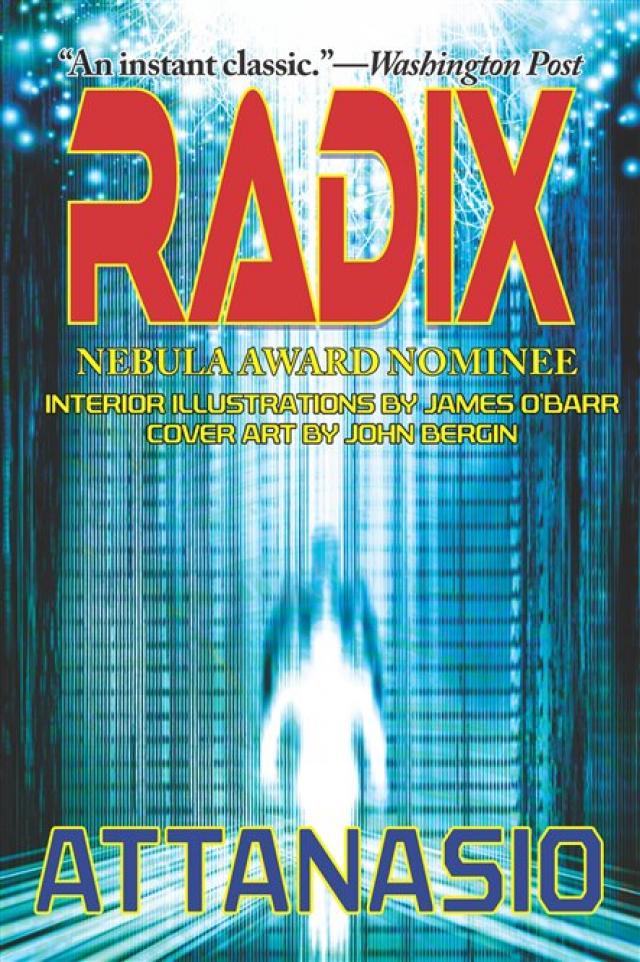
Cover Artwork Copyright © by John Bergin. Used with permission.
Interior Artwork Copyright © by James O'Barr. Used with permission.
Tarikian, TARK Classic Fiction, Arc Manor, Arc Manor Classic Reprints, Phoenix Pick and logos associated with those imprints are trademarks or registered trademarks of Arc Manor Publishers, Rockville, Maryland. All other trademarks and trademarked names are properties of their respective owners.
This book is presented as is, without any warranties (implied or otherwise) as to the accuracy of the production, text or translation.
Second Edition.2010. Revised and Corrected 2011.
ISBN (Digital Edition): 978-1-60450-492-7
ISBN (Paper Edition): 978-1-60450-459-0
www.PhoenixPick.com
Great Science Fiction
Author’s Website:
www.AAAttanasio.com
Published by Phoenix Pick
an imprint of Arc Manor
P. O. Box 10339
Rockville, MD 20849-0339
www.ArcManor.com
**********************************
For
LIGHTWORKERS
across time and space
***
ACKNOWLEDGMENTS
The inwardness of this effort has indebted me to many people. I am particularly grateful to my family for their compassionate support; the poet Jon Lang for sharing his visions and for allowing me to transmogrify his poem “The Other” into the Voor Litany (page 259); the editor Maria Guarnaschelli for ennobling this book with her clarity and caring; the composer Victor Bongiovanni for permission to use a voice from his musical composition “Berceuse from Suite for Piano Four-Hand”[“Berceuse from Suite for Piano Four-Hand” copyright © 1979 by Victor Bongiovanni.] as Sumner’s undersong (page 377); Artie Conliffe for the map of the hemisphere; and the copy editor Betsy Cenedella for closing the circle.
Robert Silverberg published an early and greatly re-visioned excerpt of “The Blood’s Horizon” in his New Dimensions 7 (Harper & Row, 1977).
For the second edition, I salute John Bergin for the cover art he shaped from light, James O’Barr whose sublime skill in the black art of ink graces the interior—and Leo Scarpelli, who befriended this novel in the human wilderness.
***
Foreword to the Second Edition
Originally titled Emblems and Rites, my first novel, Radix, began with an insight from one sentence in a third century biography of Greek thinkers, Lives of Ancient Philosophers: “Diogenes the Cynic lit a lamp in broad daylight and said as he went about, ‘I am looking for a man,’” He says nothing about “the man” being honest.
In Radix, I am looking for a man. To represent our polluted age, this man must be ugly. He must be weak from the ineptitude of his body, as our manufactured world is weak from ecological stupidity. He is a hungry man, as avaricious as our mercantile society.
This man must be a monster in a world of monsters. The rites in Emblems and Rites intend to provoke outrage, not admiration or pleasure, or there is no possibility of transformation. The nightmare of reason we call civilization is our exile from the truth of our humanity, which emerged out of the blind regime of matter into consciousness. True reason, the human spirit, offers the strength to contend against this blind regime of accidents, diseases, and malign obsessions. Through mindfulness, we possess the power of transformation.
Likewise, the man I seek, vexed by his own derangement and alienation, carries his humanity hidden inside himself, within a resurrection core. But to claim this deep power requires an art of self-forgetting, an audacious transformation that empties the ego and recalls the unity of existence.
Looking for the man who can represent us, I knew the emblems too must be grotesque or there is no hope for beauty in the transformation. I resolved to forsake reason, remembering what Goya wrote in his own hand on the forty-third Capricho: “The sleep of reason produces monsters.”
The nightmare of reason—the environmental iniquities and calamitous impersonality of civilization—abstracts us from the sensate experience of the universe and secludes us among symbols. These are the flagrant emblems of our concealment from ourselves. The philosopher Kenneth Burke identifies homo sapiens as a “symbol-using animal.” In symbols, we sort out our perplexed reflections about this Mystery, the haunted now that is ghosting through us. These soft powers called symbols have taken us far behind the world and stranded us in the darkest precincts of nowhere. As Burke puts it in Language as Symbolic Action, our reality has “been built up for us through nothing but our symbol system.” Within this artificial construct, we have eaten of dreamflesh and hallucinated an irreality where other powers and intelligences take den within us. The human heart is their killing yard. They are the “-isms” that dominate us with unspeakable ferocity. In their grip, we are not what we are. But there is an art that, in its deep disposition to darkness, bleeds oppression from their wrath. It is an art of self-forgetting...
The name of the darkling man in this novel of self-forgetting has to be as emblematic as his monstrous actions, a name beckoning thought to our thoughtless time, and I chose Kagan—Son of Aodhagáin, the stupendous Thinker in the Black Book of Caermathon, the medieval Welsh classic that introduces the most important hero of our tragic modernity, King Arthur. For a first name, I went with Sumner: “one who summons”...One Who Summons the Thinker.
I wanted this novel to summon me as well as the reader to think on what our alienated age disregards, what the ancient Vedantic masters knew and contemplated: the whole universe is inside us.
Emblems and Rites became Radix as I explored that remarkable point of view, the way storytellers of old did, dramatizing the natural world in human form—only instead of sun gods and moon maidens intriguing with mortals, I wrote about aliens from other worlds confronting human beings. The story is the same: it’s the hero’s clash with the gods. In our psychological age, that clash is the individual’s struggle to create an identity, and thus a destiny, out of the infinite flux we call reality.
Is the infinite expanse of the universe really inside each of us? And, if so, what do we do with—infinity?
21st century physics agrees that the universe appears infinite: black holes collapse to singularities, which are infinitely dense; and light—the fabric of our biological reality—has no rest mass and so is timeless. Our very bodies are composed of powers of mass so imponderably small that even photons cannot illuminate them, where they emerge from cosmic strings vibrating in a domain of higher dimensions beyond measure.
Yet, few of us actually believe that we are infinite. Such a bold conception seems delusional, because we refuse to accept the basic Vedantic assumption that waking and dreaming are the same. What then is waking? What is the mind? And who is scripting our dreaming? Mind emerges from the brain. The brain is a very specific configuration of atoms. Atoms plus geometry = psyche. We are projected by stellar evolution and Darwinian forces into a geometry of atoms aware of geometry and atoms. Waking and dreaming both emerge from neurological structures whose fundamental constituents touch infinity.
Science fiction provides an ideal vehicle for this descent into the dark abyss where the geometry of mind and organic molecules copulate. The frenzied passion of this union is everything we call soul.
Radix is about waking up to this unifying perception, joining mindful spirit with soulful body and becoming aware that we wandered out of Great Silence to house ourselves in language. We look back from our narrative present, and we gauge the distances to the galaxies and beyond with stories that redshift toward mystery. Outside discursive thinking is the unspeakable—the arbitrary, the unpredictable and undetermined reality against which language shelters us. Out there, in the infinite, truth disappears, all the better to reveal beauty.
The man in the transformative rite adorned with emblems of beauty is the solar votive hero of myths worldwide. He embodies the light of consciousness, and he reincarnates in this novel as the obese, slovenly form of Sumner Kagan. Kagan the Thinker lives in a world exposed to the strange light from an open black hole at the center of our galaxy. This naked singularity has transformed Earth into the landscape of the soul, where everything contaminates everything else: animal and human forms bleed together into distorts, starlight rearranges the human genetic code and reconstructs an alien sentience called voors, and ideas from bizarre alternate universes fuse with flesh and become godminds. On this haunted Earth, everyone Sumner confronts is actually himself. And the world changes around him exactly as he does.
Writing Radix confronted me with the literary challenge of fitting the motive of the novel, which is Diogenes’ quest for a man, into a story that most readers would accept as a narrative and not a manual about self-transformation. Contemporary physics provided the metacognitive framework for the novel’s summons to think about being human in our surreal technological epoch.
Cosmology theorizes that the universe is a
To be alive in the 21st century means to be summoned to think about this: each observer, each one of us, decides our past all the way back to the Big Bang. And not only that but also this: our future, what will happen, has already happened...and is choosing us.
So what are we in All This? We exist in one particular timeline, with the future deciding our present, as our choices decide our past. The sun doesn’t rise. As the Earth turns, our fortunes roll over from the future into the past.
Radix dramatizes this contemporary creation myth. The bizarre reality for Sumner Kagan is the same as it is for us. We are born as we are being borne.
In Kagan’s drama, we see that we are broken where darkness has found us, and our calamitous confusion has set us against ourselves. We already know, for we have always suspected, and now science sanctions our mystic surmise: all that is was once light, every atom of every stone, the fiercest light, at the primordial instant of creation. The radiant memory of our origin is there in each of us, behind the awesome forgetting of being human.
Between mind and experience, between presence and the long-dreamt, in that middle realm among all the timelines available to us from the uncanny dark sources of wonder and self-expression that assure our humanity, I wrote Radix to find myself—and all these years later I find myself here with you, the reader, setting out to discover a new fate—for ourselves and the world.
A. A. Attanasio
Kohelepelepe, Hawai’i 2010
***
Things can be—
and their Being is grounded
in Nothing’s ability to noth.
—Kenneth Burke, Language as Symbolic Action
***
>DISTORTS<
No man knows himself.
—Yi Jing
Firstness
Blinded by the headlights, Sumner Kagan lunged off the road and slid down the dirt embankment into the dark. Above and behind him braking tires squealed furiously. Savage voices yowled as the Nothungs, in leather streetgear, rolled out of their Death Crib and chased after him. Five viper-thin men with blood-bruised eyes and teeth filed to points charged down the slope yelling, “Run, Wad—run!”
At the bottom of the incline Sumner veered into the marsh. He looked like a spooked cow in the dark, waddling heftily side to side. The Death Crib’s headlights shimmering off his smudged and tattered shirt, he pushed into the tall grass, arms flailing wildly. His night vision had returned, and he could see clearly the squat silhouette of the alkaloid factory on the horizon. He knew there was a packed dirt path somewhere around here.
Not far behind, the Nothungs whistled chains through the air, howling and cracking stones together. If he merely stumbled, he would be torn to pieces—the police could search the marshes for weeks and still they wouldn’t find all of him. He thrashed through a brake of cattails, and then his feet hit hard earth. It was the path, a straight run to the alkaloid factory. In the west, the Goat Nebula was rising. He screwed his mind into that brilliant green spark and kept his thick legs pumping.
When he reached the chain-link fence of the factory, the Nothungs were close enough to pelt his broad, stoop-shouldered back with scattered handfuls of gravel. There was barely time to locate the hole that he had sheared through the fence earlier that day. He found it beneath the massive and mud-streaked billboard: NO GO! TRESPASSERS SHOT!
Bellycrawling through, he strained to haul his corpulent body upright and jog onward. He banged up a long metal ramp toward a broad staircase that ascended into the dark galleries of the factory.
It was bad planning, he told himself, to have to climb stairs after such a long run. It might all end here. Rau! Legs numb with fatigue, heart slamming in his throat, he fixed his eyes on the dark shadows at the head of the stairs and ignored the pain that stabbed him more sharply with each step.
Just as he made it to the top, one of the Nothungs clutched at his pants and ripped off his back pocket. Desperately, spastically, he sprawled forward and kicked free. Struggling with his own pendulous weight, he pulled himself to his feet as the Nothungs came bellowing over the top.
Exhaustion staggered him, but he fought against it. The big vat was up ahead. He could see it below through the wire mesh of the ramp.
The Nothungs came up strong directly behind him, ricocheting chains off the pipes on either side. They thought they had him trapped. Alone, in an abandoned factory. That appealed to their imaginations. Sumner had known it would.
The silver scars on the metal post, where the DANGER sign had once been, blurred past him, and Sumner took its cue and leaped. The knotted rope was there all right, and its stiff threads stung his pulpy hands as he swung heavily to the other side. Two sharp screams rang out behind him, two splashes.
Swiftly, he looped the rope around the railing and, plodding off into the darkness, found the broad pipe that would carry him back to the other side. He staggered along it, adjacent to the ramp where three silent Nothungs meekly peered down into the darkness that had swallowed their companions. An emergency water-hose waited where he had left it. He had tested it that morning.
One of the Nothungs yelled across the darkness: “We’ll find you, fat boy! We’ll rip you!”
“Aw, blow it out, screwfaces,” Sumner answered, just loud enough to be heard. He had already turned the waterpower on, and as three faces dark with rage spun around, he opened the valve. The blast clipped their legs out from under them and logrolled the Nothungs off the ramp, their wails lost in the hiss and bang of water hitting acid.
***
Sumner listened deeply to the hissing water as he crouched with fatigue over the limp hose. Breath tight in his throat, leg muscles spasming from the hard run, he paused only briefly before taking a canister of red spray paint from its hiding place beside the water-hose. With an unsteady arm he mist-scrawled on one of the broad overhead pipes: SUGARAT.
***
Sumner didn’t stop to rest until he got to his car in a lot behind the factory: a standard bottle-green electric car, squarebacked, with three small hard rubber tires and two scoop seats. He loved it more than anything else. It was his home, more of a place of fealty and comfort than the rug-walled residence he shared with his mother.
He slumped over and laid his head and arms on the cool metal roof. When he caught his breath, he opened the door and dropped into the driver’s seat, head lolling back against the headrest. One hand fingered the wooden steering wheel, and the other dangled over a carton of stale crumbcake. He stuffed a morsel in his mouth, and though it was dry and powdery, a fossil of its original flavor spread over his tongue. He closed his eyes to savor it. He hadn’t eaten in two days. He had had to settle this thing with the Nothungs, and he couldn’t enjoy eating when he was thinking about killing. But now that was over. It was time for the Tour. His stomach grumbled in anticipation.
Stuffing another block of cake in his mouth, he slid the starter chip into the ignition slot. He felt warmth spread over him as he opened the clutch, set the car in gear, and wheeled out through the elephant grass.
Sumner and his car had a lot in common. They were both bulky, squarebacked, and sloppy. Dunes of crumbs drifted out of the corners and over stains of beer, gravy, and pastry fillings. Shreds of wrapping paper, crushed cookie cartons, a bedraggled sock, and numerous bottle caps had wedged between the seats and under the dash. And there on a battered card taped to the windshield, beneath the particolored triangular Eye of Lami—which Jeanlu the witch-voor had given him as protection from his enemies—three words defined him: BORN TO DREAD. Their ambiguity pleased him. Besides eating, the thing he did most consistently and with the most fervor was dread.