

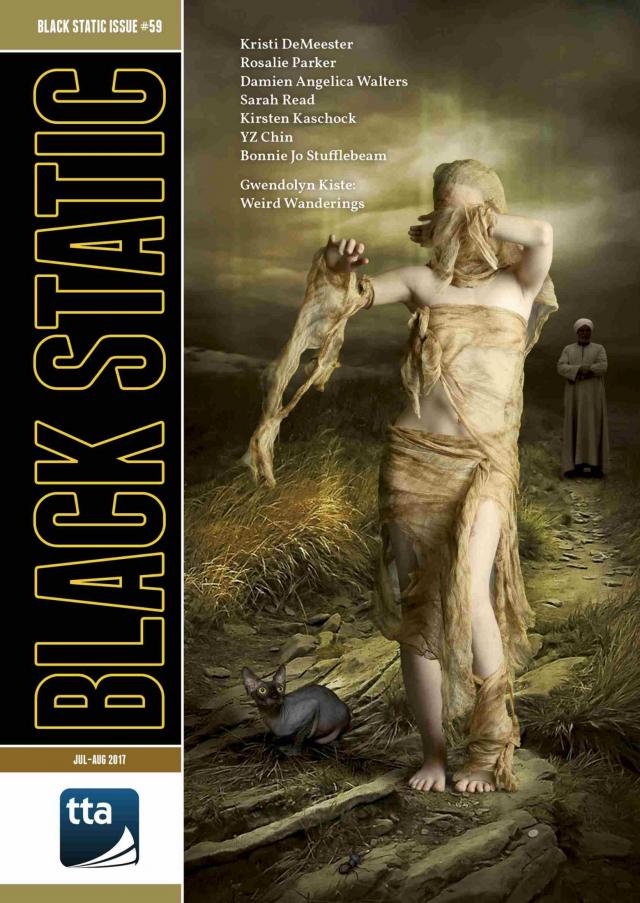
Black Static #59 (July-August 2017), page 1


BLACK STATIC XX
JULY–AUGUST 2017
© 2017 Black Static and its contributors
PUBLISHER
TTA Press, 5 Martins Lane, Witcham, Ely, Cambs CB6 2LB, UK
ttapress.com
EDITOR
Andy Cox
andy@ttapress.com
BOOKS
Peter Tennant
whitenoise@ttapress.com
FILMS
Gary Couzens
gary@ttapress.com
SUBMISSIONS
Unsolicited submissions of short stories are always very welcome, but please follow the guidelines: tta.submittable.com/submit
SMASHWORDS REQUESTS THAT WE ADD THE FOLLOWING:
LICENSE NOTE: THIS EMAGAZINE IS LICENSED FOR YOUR PERSONAL USE/ENJOYMENT ONLY. IT MAY NOT BE RE-SOLD OR GIVEN AWAY TO OTHER PEOPLE. IF YOU WOULD LIKE TO SHARE THIS MAGAZINE WITH OTHERS PLEASE PURCHASE AN ADDITIONAL COPY FOR EACH RECIPIENT. IF YOU POSSESS THIS MAGAZINE AND DID NOT PURCHASE IT, OR IT WAS NOT PURCHASED FOR YOUR USE ONLY, THEN PLEASE GO TO SMASHWORDS.COM AND OBTAIN YOUR OWN COPY. THANK YOU FOR RESPECTING THE HARD WORK OF THE CONTRIBUTORS AND EDITORS.
BLACK STATIC 59 JULY-AUGUST 2017
TTA PRESS
COPYRIGHT TTA PRESS AND CONTRIBUTORS 2017
PUBLISHED BY TTA PRESS AT SMASHWORDS
CONTENTS
COVER ART
UNTITLED
RICHARD WAGNER
BACK TO LYNCHLAND
NOTES FROM THE BORDERLAND
LYNDA E. RUCKER
SIX WORDS
INTO THE WOODS
RALPH ROBERT MOORE
STORY
WHEN WE ARE OPEN WIDE
KRISTI DeMEESTER
STORY ILLUSTRATED BY RICHARD WAGNER
THE BODY IS CONCENTRATED GROUND
KIRSTEN KASCHOCK
STORY
THE DREAMING
ROSALIE PARKER
STORY
HERE, ONLY SORROW
DAMIEN ANGELICA WALTERS
STORY
GHOST TOWN
BONNIE JO STUFFLEBEAM
STORY
ENDOSKELETAL
SARAH READ
STORY ILLUSTRATED BY RICHARD WAGNER
TO DANCE IS FELINE
YZ CHIN
BOOK REVIEWS + GWENDOLYN KISTE INTERVIEW
CASE NOTES
PETER TENNANT
FILM REVIEWS
BLOOD SPECTRUM
GARY COUZENS
NOTES FROM THE BORDERLAND
LYNDA E. RUCKER
A PLACE BOTH WONDERFUL AND STRANGE: BACK TO LYNCHLAND
Unless you’ve been stranded somewhere extremely remote with no access to media outside of Black Static for the past couple of years, you’re probably aware that David Lynch has returned to the small screen with a new season of Twin Peaks. I haven’t really read any commentary on the new episodes so far or paid much attention to their reception because, well, I don’t actually really care. I’m enjoying this deep dive into the psyche of Lynch (and Mark Frost, lest we forget!) away from the low constant buzz of social media or critical nattering.
This journey back to Lynchland has been, for me, a revelation. The twenty-first century has been hard on Lynch fans longing for his feature-length storytelling; we’ve had only Mulholland Drive and Inland Empire, and nothing at all for a decade. Lynch has been a huge influence on me since the early nineties, but in this long stretch with no new work, my understanding of that influence had waned. Everything I loved by him was still powerful when I went back to it – and indeed, rewatching season one of Twin Peaks last year, I was stunned anew by what he had managed to accomplish on American network television in 1990 – but there’s no substitute for watching new material from him in 2017.
I had honestly not imagined that I could be so inspired in this particular way by a writer or filmmaker at this point in my life. Just as there is nothing quite like the all-encompassing imaginative experience of reading as a child, there is an exhilarating experience, as an adolescent and young adult, of finding art that breaks rules. As a teenager, long before I knew words and concepts like metafiction, I was entranced when a friend pressed a copy of Slaughterhouse Five into my hands, saying something to the effect of it being weird and unlike anything he’d ever read before and that I should read it. He was right. It sounds so ordinary – Vonnegut, right? – but the gateway writers through which many of us first encounter ideas such as the breakdown of narrative and linguistic games often do seem mainstream or obvious to adult readers. It’s important to remember that when you are young, everything is fresh, everything is new. I remember reading Slaughterhouse Five with such a sense of giddy delight because I hadn’t know you were allowed to do things like that in fiction.
Lynch, of course, goes well beyond metafictional experiments, with a set of personal obsessions, subtext and a worldview so unique that only the eponymous adjective Lynchian can begin to encompass it. Fresh Lynch, in the form of Twin Peaks: The Return is a reminder that there are still artists who can intoxicate me. Working with Frost, what Lynch is putting on screen is uncompromising, fiercely personal, challenging. Online, I saw someone fret that with eighteen episodes, perhaps Lynch had been given space to be overly indulgent. I thought: Indulgent? If you’re worried about the man being indulgent, why on earth are you watching Lynch in the first place?
***
Years ago, someone whose writing advice I trusted said that while it was okay to write ambiguous stories, the writer had to have a very clear understanding of what was going on in those stories. The trouble with writing advice, no matter who it’s coming from, is that when it’s prescriptive in this way, all it really means is this is a thing that has been true for me. And this turned out to be very bad advice for me.
The problem with this advice is that it removes the role of the subconscious or unconscious mind from the creative process. There’s a kernel of truth in it; when you write a story that is allusive, ambiguous, enigmatic, it has to feel true. This is, of course, subjective in terms of how the reader or viewer perceives it, but it isn’t for the artist. There’s a difference in aiming to convey something but failing and simply fucking with the audience. That’s the advice I needed. Is it real? Is it true? Is it sincere? I eventually figured that out on my own, but watching Twin Peaks: The Return is reminding me to be even bolder.
And while Lynch can be playful, he is also absolutely sincere, sometimes painfully so. Watching Lynch with an audience is always an interesting experience because most of the time, he refuses to give you conventional cues as to how you should react to something. And then you realize how dependent you are on those cues. Am I supposed to be laughing? Crying? Moved? He is a master of making his audience as uncomfortable as possible in a variety of ways, and people don’t know what to do with themselves during scenes like Jeffrey’s outburst to Sandy in Blue Velvet: “Why are there people like Frank in the world? Why is there so much trouble in the world?” We laugh nervously because of the bald earnestness and naivete of the question, but the truth is we have all asked ourselves the same thing. And then Sandy relates her dream of robins, coming to a dark world where there was no love. “There will be trouble till the robins come,” she says. I think this scene gets at one of Lynch’s core truths that we see reimagined over and over in his work: there are two worlds existing side by side, one of love and light, and one of unimaginable horror.
***
David Lynch is, among other things, a horror director. He said as much himself, in his audacious billing of Lost Highway as “a 21st century horror noir”, but plenty of us had already long considered his work firmly rooted in the horror aesthetic. Moreover, he’s one of the few filmmakers who makes movies that genuinely terrify me.
Of course, he is many other things as well: his work, is, by turns or sometimes all at the same time, melodramatic, surreal, noirish, saccharine, explicitly and sickeningly violent, idealistic. But above all, what I am finding so wildly inspiring about Twin Peaks: The Return is its absolute boldness. This is Lynch firing on all cylinders, uncompromising, relentless, and maddening. Engaging in a critical manner with books and films is usually one of the pleasures of the mediums for me, yet I find myself reluctant to critique or analyze anything that is happening in the new series. It’s partly because this is clearly an eighteen-hour movie we’re watching and to do so feels premature, but it’s also because I’m not sure how much value there is in making glib observations the morning after. Lynch’s work simply does not lend itself to easy or quick assessment, and to do so feels like an attempt to make something small and manageable and digestible out of storytelling that is anything but that.
In order to produce work that is truly great, we have to be unafraid. We have to take enormous risks, expose ourselves to the possibility of ridicule and failure. This is almost entirely antithetical to the aims of commercial publishing and filmmaking, which above all wants sure things and even-more-successful versions of what has come before.
Lynch’s career, of course, has suffered terribly from his inability to color in those commercial lines. In addition to his struggles to get funding, he’s often critically misunderstood and reviled as well, with an understanding and reassessment of some of his films only coming years after their initial release. Against this backdrop, it seems almost impossible that, at the age of seventy-one, he’s been given the opportunity to return to one of his most beloved works and finish what he was forced to
INTO THE WOODS
RALPH ROBERT MOORE
SIX WORDS
I had no trouble writing this first sentence.
Practice.
When Mary and I were getting ready to leave California, wander across America to find a new home, we decided to bring our white Mustang in to have it checked out. The last thing we wanted was for the car to break down a thousand miles from anyone we knew, some small town with mountains in the far distance, sprawling metropolis crowded with one way streets, angry car honks.
The balding mechanic told us it would take four hours to check out all the systems, repair any weak spots. We walked away from the repair shop holding hands, headed towards the business district three sunny sidewalks away. Found a restaurant where we could sit down over breakfast, eggs on a white plate are so reassuring, then run some ‘leaving everything we know’ errands.
One of the places we visited was a multi-storied department store. We wound up on the top floor, and carrying bags with the store’s logo by our sides, went down the escalator to the building’s third floor.
At the third floor of that escalator a middle-aged man was wiping the hand rail. He smiled at us. We stepped off with our bags, circled left, stepped onto the descending steps of the next escalator, taking us to the second floor. At the bottom of that escalator was the same middle-aged man from the floor above, again cleaning the hand rail. Again, he smiled at us.
It could be the store had hired twins, but I doubt it. To this day, I don’t have any explanation how the same maintenance man showed up on two floors of that department store, seconds apart. Or why.
Going down that escalator reminded me of Thomas M. Disch’s short story, ‘Descending’. In fact, every time I go down an escalator reminds me of that story. That’s how powerful a writer Disch was. Oscar Wilde said of the painter J.M.W. Turner that he “invented sunsets”, and it’s just as true to say Disch invented escalators.
‘Descending’ deals with an unnamed protagonist who wakes up hungry in his NYC apartment. The story starts with a list of various foods (“Catsup, mustard, pickle, relish, mayonnaise, two kinds of salad dressings…”) he owns, and going through all those commas it doesn’t take us too long to realize that the protagonist has nothing of substance in his pantry – only condiments for the staples he can’t afford. He has no money for food, and is behind in his rent.
He decides to go to Underwoods, a multi-floored department store a subway ride away, to obtain some provisions. Once he arrives at Underwoods he selects a number of “fancy groceries”. And what are those fancy groceries? Instant coffee, a tin of corned beef, pancake mix, canned tuna fish. He’s a desperate man, hungry and poor. Carrying his tins and boxes, he descends the escalators to the cashiers on the first floor, but without having any means to pay for this food. To be able, instead of just carrying food, to eat it.
Disch went on to have a celebrated career after ‘Descending’ was published, as a novelist, short story writer, poet, essayist, critic. His children’s book, The Brave Little Toaster, was a critical success, made into a Disney movie.
Mary and I ended up in Maine, winter storms starting, windows and hands going cold. We didn’t have much money either. The idea was Mary would find temporary work while I wrote my first novel, Always Again. Very quickly, so I could find work myself, to help pay for rent and food. You don’t want to be homeless when there’s three feet of white and black snow on the red brick sidewalks. I still remember, vividly, that first day, Mary at work, me sitting down in our new apartment to start my novel. Pen and paper, pressure, like I know so many of you who are writers have felt, keenly aware I had to walk across the desert of that first blank page of hundreds of blank pages and find under my footsteps, forests.
And I couldn’t. I had the mustard and salad dressing for some subsequent sentences in my novel, but not that all important opening sentence. I carried one arrangement of words after another, riding down into my imagination, riding further down, further, but never reaching inspiration.
Disch lived with the poet Charles Naylor. Naylor died in 2005, and Disch became progressively more depressed.
As the protagonist of ‘Descending’ goes down one escalator after another, it occurs to him that something is wrong. He is descending far more floors than he ever rose. “At first, he allowed the escalator to take him along at its own mild pace, but he soon grew impatient of this. He found that the exercise of running down the steps three at a time was not so exhausting as running up.”
‘Descending’ was published early in Disch’s career, July of 1964, fifty-three years ago this month, in Fantastic Stories of the Imagination.
In 2008, Disch started a LiveJournal account online, posting about his life. July 2, 2008 Disch posted an entry titled ‘Inflation/Starvation/Fun’. The post talks about the themes of ‘Descending’, without ever mentioning the story by name, and it’s possible Disch didn’t consciously relate what he was posting to his story from so long ago. “Short of succumbing to the madness of anorexia, I doubt I am likely to experience actual starvation before I die…” That was the final entry in his blog. Two days later, on July 4, 2008, Independence Day, nine years ago this month, Disch, instead of picking up a pen, picked up a gun.
And that’s really the point of ‘Descending’. If he were in a real department store, he would have to reach a cashier eventually, have to pay for his food in order to leave the store, carry the food home, eat it. Except he couldn’t pay for the food, because he had no money. So the food, his precious armful of “fancy groceries”, would have been taken away from him.
But since this is a horror story, he is forever trapped on one descending escalator after another, never getting any closer to the cashier’s station, and therefore never having to pay for his food. If he weren’t trapped in this never-ending loop he would starve. Because he is trapped in this loop, he’s able to enjoy a wide variety of foodstuffs over the course of his never-ending descent, opening the tins of food over the course of his descent, no one on the escalator to stop him. The horror of his situation saves him. In some ways, as bleak as the story appears to be, it has a happy ending. Our hungry, anonymous man is finally able to eat a decent meal before his death.
After several hours of writing words, crossing them out, sideways pen strokes like hands trying to wave away the realization of my failure as a writer, descending deeper and deeper into the despair that maybe I wasn’t really a writer, I finally came up with the first sentence of my first novel.
“The birds wake up the monkeys.”
Six words, but I am so proud of them. It was the perfect opening sentence. For my purposes. And that morning, that was what mattered. It was what I needed. Uncorked, all the subsequent sentences came spilling out, puckering the page.
“Then, he was lying at the foot of the escalator. His head rested on the cold metal of the baseplate, and he was looking at his hand, the fingers of which were pressed into the creviced grill. One after another, in perfect order, the steps of the escalator slipped into these crevices, tread in groove, rasping at his fingertips, occasionally tearing away a sliver of his flesh.”


