

Wourism and Other Stories, page 23


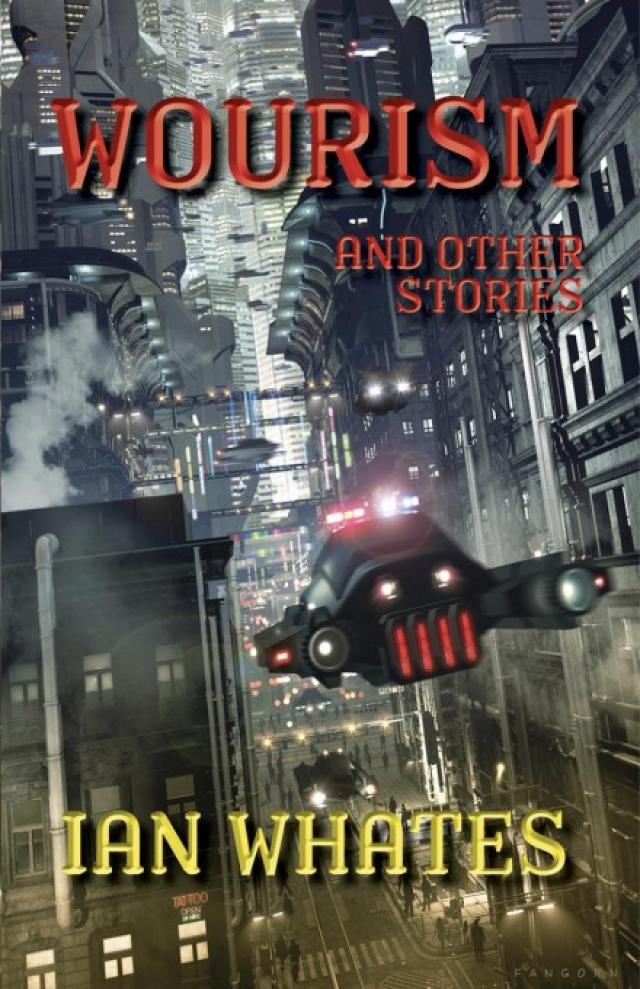
WOURISM
And Other Stories
Ian Whates
Text Copyright (c) 2019 Ian Whates
Cover Image (c) 2019 Fangorn
Harvester Logo (c) 2019 Francesca T Barbini
First published by Luna Press Publishing, Edinburgh, 2019
Wourism & Other Stories (c) 2019. All rights reserved. No part of this publication may be reproduced, stored in a retrieval system, or transmitted in any form or by any means, electronic, mechanical, photocopy, recording or otherwise, without prior written permission of the copyright owners. Nor can it be circulated in any form of binding or cover other than that in which it is published and without similar condition including this condition being imposed on a subsequent purchaser.
Wourism. First published in Galaxy's Edge 10, 2014.
Montpellier. First published in Galaxy's Edge 19, 2016.
No Smoke Without Fire. First published in Fables from the Fountain (NewCon Press), 2011.
For Your Own Good. (original to this collection)
Digital Democracy. First published in The Human Genre Project (Edinburgh University), 2009.
Eros for Annabelle. First published in Nature, 2013.
Reaper's Rose. First published in Nightmare Magazine, 2016.
Beth and Bones. First published in Holdfast 5, 2015.
Royal Flush. First published in Escape Velocity 4, 2009.
Triptych i) Browsing. First published in Nature, 2016.
Triptych ii) Trending. First published in Daily Science Fiction, 2014.
Triptych iii) Temporary Friends. (original to this collection)
The Failsafe. First published in Explorations: Colony (Woodbridge Press), 2017.
Sane Day. (original to this collection)
Between Blood and Bone. First published in Daily Science Fiction, 2018.
The Gun. First published in Speculative Realms: Beneath the Surface (Speculative Realms Press), 2008.
The Final Fable. First published in 2001: An Odyssey in Words (NewCon Press), 2018.
www.lunapresspublishing.com
ISBN-13: 978-1-911143-76-5
For Neil Williamson:
fine writer and true friend.
Wourism and Other Stories: An Introduction by Ian Whates
Short stories have always been important to me. Reading them as a young teen, in anthologies borrowed from the library, was my gateway to discovering so many of the authors whose work I would come to love. Writing them was the means by which I honed my craft and first learned how to create credible characters and mould an effective narrative. Before I ever dared to present a novel to publishers or agents, I had sold some two dozen short stories and seen them published in a variety of venues, and it was short fiction that brought me my first appearances on award shortlists.
The problem is that with every passing year time becomes an increasingly precious commodity. Novel contracts, novella commitments, and running a busy independent publisher, have combined to squeeze the available time from every direction, and writing short stories is one of the things that has suffered. Whereas once the goal of producing one short piece a month would have sounded perfectly reasonable, now I'm delighted if I manage one or two in a calendar year.
This volume represents virtually all my published stories from the past five years, along with two pieces I held back from previous collections due to the vague intention of including them one day in a mosaic novel (as explained further in the accompanying story notes at the back of this book), one which always felt incomplete if lifted from its original context in a shared world volume, until I wrote a follow up this year and so can now present both in one book, and a couple of new pieces that have never appeared anywhere before.
Therefore, the stories gathered here were written at different times for different reasons and were intended to achieve different things. As a result, they provide the variety that any such collection should boast - there's humour, dark forebodings, pointed social commentary and pure fun dotted around the pages. Yet gathering these disparate sparks of narrative into one place and viewing them as a single body of work reveals a few aspects that have surprised me, even though I wrote them. I hadn't realised until now, for example, how short much of my recent fiction has been. Yes, I knew that I'd written a number of flash pieces with specific purpose in mind (the three components of "A Triptych for Tomorrow" being prime examples) but hadn't appreciated how prevalent that brevity has been in the past few years. I suspect this is a product of the time pressure mentioned earlier. Ten years ago, a story idea may well have been allowed to evolve and expand at leisure, whereas now when an opportunity to write presents itself (or the urge to do so becomes too overwhelming to ignore), I tend to focus on producing as short and sharp a narrative as possible, because I'm conscious of the other twenty things I ought to be dealing with at the same time... Don't get me wrong, I'm not suggesting these pieces are rushed or under-cooked, merely that they are leaner, more focussed than once they might have been. This is by no means a bad thing, it just makes this volume a little different from previous ones; nor is this a collection of flash fiction. There are several stories here that comfortably top 4,000 words and more, but I was a little surprised by the number that don't.
Another aspect that caught me off guard was the number of stories told in the first person. This isn't a voice I've ever employed for a novel-length work, where a broader canvas has always felt more appropriate and more convenient, but it is a perspective that I feel comfortable in using for shorter fiction. It's a mechanism that can make the story more immediate and help to hold the reader close to the narrative. At a quick count, I've utilised first person for seven of the seventeen pieces in this book, which is a larger minority than I would have anticipated.
I'm very proud of the stories in Wourism. Every craftsman in whatever field likes to think that they improve at what they're doing, that with the benefit of experience - we never stop learning, after all - they are able to produce more polished, more refined work. I'm no different, and I feel that this volume includes some of my best and most effective short stories to date.
I can only hope that you agree.
Ian Whates
Cambridgeshire
December 2018
Wourism
"The storms were the worst thing. The power outages and food shortages, the ignominy of standing in queues for basics, even bread and water--we coped with all of that. This was war, after all. The constant fear of explosion and the almost incessant gunfire, the destruction of buildings and the roads--they were terrible, horrific, but it's amazing what you can learn to live with when you have to. The weather turning against us, though, that was the final straw. None of us had ever seen rain like it: relentless, pummelling the city as if God Herself had forsaken us and joined in the bombardment; and as for the lightning..."
The woman's narrative was abruptly punctuated by a loud peal of thunder and the pervading gloom shattered in a dazzle of electric discharge. Somebody, possibly Gretchen, exclaimed in surprise and even I started a little. This well-staged drama heralded the surround-sound arrival of steady rain and a rolling series of thunderous rumblings, though the latter were far more subdued than that first spectacular clap.
The woman continued speaking. The image of her narrow face still dominated the room, but now behind it and through it a distant cityscape began to emerge, illuminated by vivid lightning strikes and the ruddy stain of smouldering fires.
"This was the closest our collective spirit came to breaking," the woman said. "Even the deaths seemed so much worse in the relentless storms. Disposing of bodies became a logistical nightmare as well as an emotional one. Somebody claimed that the freak weather was a sign of severe damage to the ionosphere, that in a struggle somewhere high above us doomsday weapons were being deployed, unleashing fearsome energies that had unbalanced the atmosphere of the entire planet. Such things meant nothing to us. What did we care about the planet or even the next district over? Our whole world had narrowed down to a handful of streets and the struggle to survive for just one more day."
The woman's face faded. Perspective tilted and we swooped down towards the besieged city and then into it, stopping only once we had reached street level. The sound of rainfall intensified and it was joined by the chatter of small-arms fire and the clatter of running footsteps. The 3D effect was far more immediate and more convincing now that we were this close. There was even a faint smell of smoke and of dampness, and a billow of heat from a fire at our backs. Only the absence of any actual rain hampered the suspension of disbelief. Long shadows moved across the walls of shattered buildings to our left: people running. A man screamed, and one of the shadows convulsed in mid-stride, threw up its arms and collapsed.
The woman's face appeared once more, superimposed on the street scene to hover in the air before us. Her eyes held a great weariness that underlined her words. "Little Danilo, my younger brother, was killed in the first few days of the bombardment; my eldest, Toma, towards the end." She spoke with a cold detachment that made her account all the more chilling. "Toma had joined the militia by then. No one lived long in the militia. The imminence of his death overshadowed the start of each new day like a pall and haunted our dreams at night, until it became reality. My mother fell ill not long after. By this stage there was no medicine--supplies had run out months before. We did our best, but all we had to offer her were prayers and love and comforting words. She didn't leave her bed in the last two weeks and died the day before the cease-fire. My father never really recovered. Nor, in truth, did any of us."
A caption appeared beneath the woman's face: 'Jasna Petrovic: Survivor', it read.
"My name is Jasna Petrovic, and I was one of the lucky ones."
With that, she was gone. The soundtrack had dwindled to nothing during her final declaration and now the scene faded too as the lights came back up, to leave us blinking at each other across a plain-walled room.
In a gauche display that the word 'insensitive' didn't begin to cover, somebody beside me started clapping. I was mortified to realise that it was Alex.
"What?" he asked in the face of my glare. "It was a very good show."
"For fuck sake, Alex..." I don't swear as a rule, but he'd earned it.
I was eight months out of university and yet to decide what I wanted to do with my life. Alex was seven years older than me, worked in corporate finance for a company with offices on five worlds and had an apartment in the sort of complex my friends and I used to dream of seeing inside. He was big on team building and I would tease him that his favourite words were 'bonding' and 'incentive'.
As I looked around I noticed a middle-aged woman standing stock-still while everyone about her relaxed and chatted; an island of calm amidst the fidgeting. Tall, slender, she wore a burgundy suit--very smart and business-like--and was staring straight ahead, as if she could still see the harrowing scene long after the rest of us had lost it in the glare of brightened lights.
"Oh, come on, Ginny. She's not real, you know," Alex said, reclaiming my attention. "You do know that, don't you? Just an actress hired to play the part, and her performance was outstanding, so I showed my appreciation."
I wasn't so sure. The narrator's eyes and her voice--the whole presentation--seemed to resonate with sincerity to me. Of course, Alex would argue that it was meant to.
He turned away to talk to Gretchen and Hassan--a couple we'd fallen in with since arriving here. I consulted my wrist perminal. A quick search of the local database revealed that there had been no fewer than seven Jasna Petrovics resident in Serna at the outbreak of the war. A flutter of fingertips brought a parade of images scrolling across the screen. I froze the sequence at one who might have been our narrator, though she was a lot younger when this was taken; and she was smiling, which was something she had never threatened to do during the presentation. I narrowed the search to images of this particular Jasna Petrovic and took great satisfaction in discovering that yes, the woman was genuine.
Her story and her suffering were real, whatever Alex might think.
He could have checked all this easily enough on his own perminal had he wanted to. He wouldn't, of course; far too comfortable in his own false assumptions. Why risk undermining a declared cynicism with anything as inconvenient as the truth?
"If you'd like to follow me, ladies and gentlemen," Malcolm, our slick, camp, white-suited guide said, "we have some wartime armament to show you next; a unique collection of genuine artillery pieces and weaponry that saw service during the siege and were recovered and restored at the end of hostilities."
"Now we're talking," Alex said, flashing me a broad grin, taking it for granted that we two were collaborators in his enthusiasm.
He was soon chatting happily with Gretchen and Hassan. None of them seemed to notice that I lagged a little behind.
Everyone knew the basic story of this place; that while the rest of the city was rebuilt and reshaped in the aftermath of the war, one large section of Serna had been kept as a ruin--though it hadn't, of course; that was just the desired illusion. In fact this area too had been rebuilt, but in the image of its war-torn self. 'Despite appearances, every element of the park is structurally sound' had been the message stressed repeatedly during the promo we'd watched prior to booking. This was a battleground sanctioned by health and safety.
Serna became the first, the biggest, the most famous Warzone Theme Park, and a previously obscure term entered common parlance: Wourism.
Our route from the projection room took us through a corridor lined with display cases housing various small items. I stopped before one: a child's soft toy, a grimy orange-brown teddy bear, with the left eye missing and the left side of its face sooty and blackened.
Sensing my presence, an audio commentary started up, explaining that the bear had been pulled from the rubble of a flattened building during the clean up. Nobody knew the name of its owner or if they'd survived, though several bodies were also recovered at the scene.
I became conscious of somebody standing beside me and looked round to see the woman in the burgundy suit. Close-up, she looked younger than I'd first thought, though her face had that lived-in quality which makes age such a difficult thing to judge.
We smiled at one another and she said, "I used to have a bear just like that, before the war."
"Were you...?" I didn't like to ask.
"I was in Serna during the siege, yes. I was eleven when it started."
I had no idea what to say, rejecting several possibilities which struck me as little more than platitudes; the sort of thing that I would cringe about later.
Fortunately, Alex came back just then. "Come on, Ginny, keep up, it's the big guns next." So he had noticed my absence after all. I nodded to the woman and went with him.
The 'big guns' proved to be imposing, grim, and soulless--chunky blocks of metal in grey or green, sheets of armour plating in pristine mottled camouflage paint, long barrels with gaping muzzles, compact but powerful flat-bodied drone tanks, swivelling turrets, field generators, heat-diffusion nets, projection boards, pulse guns, multiple missile launchers, a stack of lethally indiscriminate pepper mines, some 'smart' bombs, a cluster of artillery shells standing on end and arranged aesthetically in order of size so that their tips created a graceful curve, even a pair of gleaming white snub-winged UAVs--which the hovering 3D sign haughtily designated 'Unmanned Aerial Vehicles'.
Alex got to sit in the control seat of one array, which gyrated in a series of rapid swivels and tilts under his inexpert control.
Gretchen tried to be sociable while Alex fooled around but I wasn't in the mood. Despite having been genuinely moved by Jasna Petrovic's account I was beginning to have serious misgivings about this trip. Alex and I had been together for six months now and this was our first time away as a 'couple'. He'd been pressing me to move in with him in recent weeks. At that particular moment, I couldn't have been more delighted that I'd demurred.
It wasn't just Alex, though; it was Serna and all that the place represented.
The entire venture was a delicate balancing act. Initially, revenue from the park had helped to stimulate the local economy and contributed significantly to the city's recovery. Latterly, that economy had come to rely on the flow of income and jobs provided by the park. That was how I'd justified coming along in the first place: this wasn't exploitation at all but something that actually benefited the local community. So, now that I was here, why did I feel vaguely... grubby? Why did this whole setup strike me as little more than morbid voyeurism?
"I might head back to the hotel for a long soak in the bath and a lie down..." I said to Alex as we left the big guns behind.
"What? Why?"
"Just feeling a bit tired."
"Oh, come on, Ginny, you can't desert me. You know I won't enjoy myself if you're not here." Liar! "Besides, we've spent a lot of money to experience this park," he meant that he had, "so let's experience it! Plenty of time to lie down later... I'll give you a back rub." The accompanying leer offered a more honest indication of what he really hoped to give me.
I should have left at that point despite his objections but knew that he would be shirty and insufferable all evening if I did, so I stayed. To keep the peace; which held a certain irony given the setting.
It was warm outside but not oppressively so. Our party piled onto the minibus--a lozenge-shaped vehicle, its sides more glass than metal. I ended up sitting next to Hassan, with Alex beside Gretchen's explosion of blonde curls in the seat directly in front of us.


